Inside The Tech Stacks And Teams Powering DTC Beauty Brands' E-Commerce Websites
From establishing differentiation to building awareness, negotiating supplier fees and prioritizing how to allot limited resources, emerging founder-led digitally native brands face consistent challenges. Plus, it’s becoming more and more difficult acquire and retain customers as beauty brands proliferate, advertising rates rise and powerhouse beauty players crowd out smaller brands in digital marketing arenas.
According to Diffusion’s 2022 Direct to Consumer Purchase Intent Index, nearly half (43%) of polled 2021 holiday shoppers didn’t intend on purchasing from a DTC brand, citing better prices and shipping options from traditional retailers as their main reasons. Thirty-seven percent of shoppers failed to see any distinction between DTC brands and traditional retail brands.
So, how do budding DTC brands attempt to compete or at least carve out a niche with their customers? A well-managed e-commerce website that effectively balances the consumer-facing experience with back-end analytics is a logical place to start. Not only is it the main distribution channel for many DTC brands, but it’s also the center of customer activity, helping brands gain valuable insights into purchasing behavior.
To help navigate this delicate balance, we spoke with DTC strategists, consultants and brand founders about the best platform powering e-commerce sites, the role of internal team structure, top plug-ins, the costs involved in launching a competitive DTC site, and top tips and learnings from early-stage DTC brands.
With roughly 29% of e-commerce platform market share in the United States as of April 2021, it’s not surprising that Shopify was universally recommended by DTC experts and brand founders due to its accessibility and ease of use, especially for startups. “Shopify support is amazing and for a startup or boot-strapped company you have the ability—without technical or developer expertise—to design and launch your own store within hours. It’s pretty seamless,” says Michela Solanch, chief strategy officer at e-commerce marketing firm Cake Commerce.
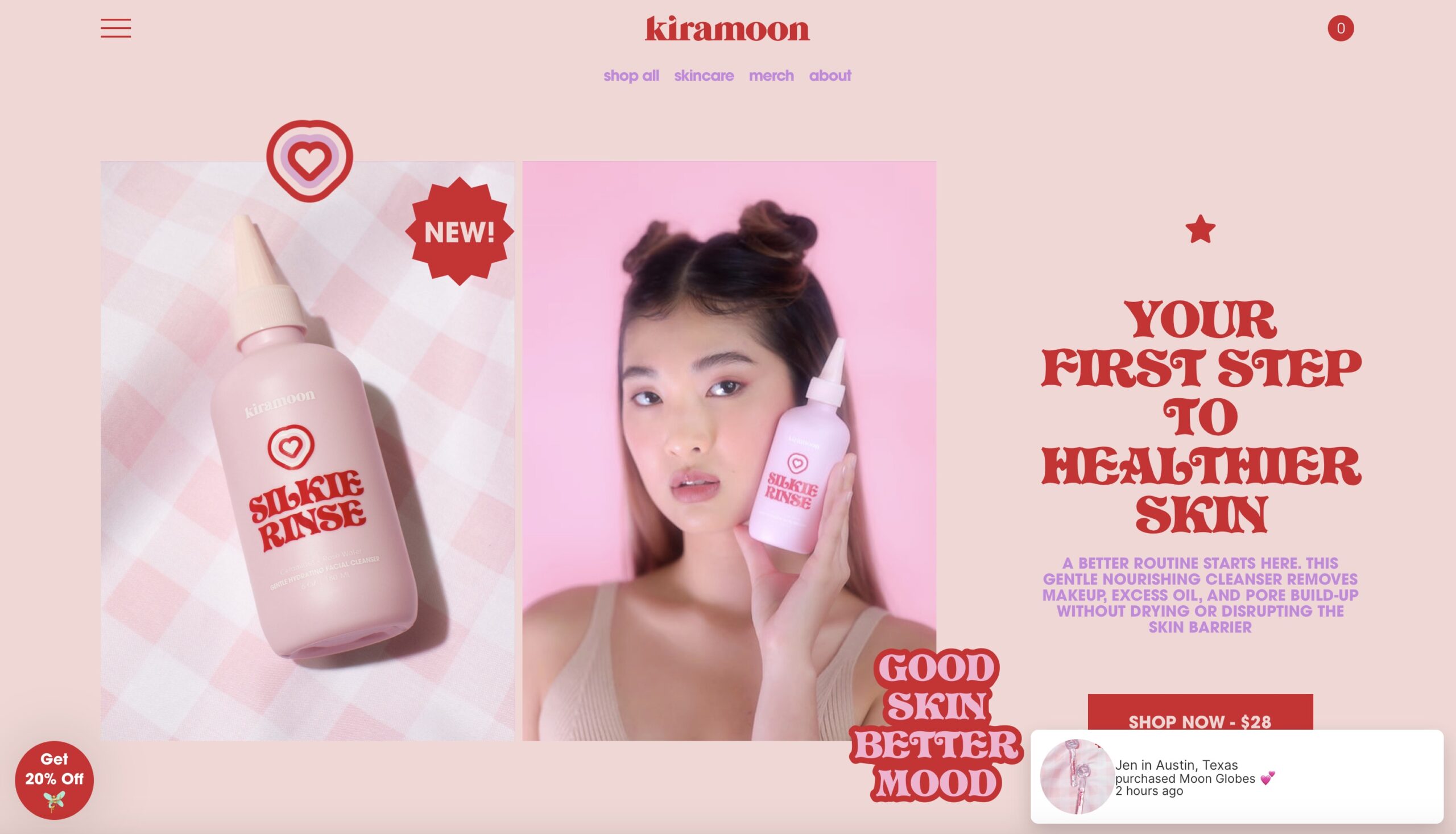
When founder and CEO Lindsey Martin was deciding on an e-commerce platform to use before launching her DTC indie skincare brand Kiramoon at the beginning of 2021, there was no other choice than Shopify. “It’s the platform that most agencies want to use, plus they have access to the most plug-ins,” she says. “It can feel a little more complex at first, but, if you want to scale and grow your brand long term, Shopify is where it’s at.”
“Ninety-nine percent of brands can easily be launched on Shopify, from Selena Gomez’s Rare Beauty to new companies with one-person teams just starting out,” echoes Nik Sharma, CEO of DTC brand consultancy Sharma Brands. “You can build something that looks very unique by purchasing a website theme and customizing it to match your brand’s look and feel. It’s the best possible platform you can use, plus it’s very user-friendly and affordable.”
Shopify subscriptions range from $29 per month for the smallest e-commerce shops up to $299 per month for scaling businesses that want enhanced reporting. Shopify Plus is its highest tier at $2,000 per month. Heavyweight brands like Kylie Cosmetics, Heinz, Staples and Rothy’s are Shopify Plus customers.
Because Shopify is a fully hosted platform, brands don’t own their websites. That’s different if brands go with a self-hosted solution like WooCommerce, for example. If a brand reneges on its monthly payments, Shopify can freeze its store, and shut out administrators and customers.
While a brand founder may not need coding experience or even a developer to initially launch an e-commerce site on Shopify, Mary Hartje cautions young brands on the “false sense of ease” that platforms like Shopify can give in the long run. “Shopify seems very plug and play, but it’s not,” says the owner of e-commerce consultancy UltraMod Digital. “The one-person brand founder will eventually need to scale their digital strategy team to properly scale their business on Shopify and other e-comm platforms. All the software and all the algorithms may know who your customer is and what to offer them next, but it’s still someone at the back end developing this stuff and getting the automations to work properly.”
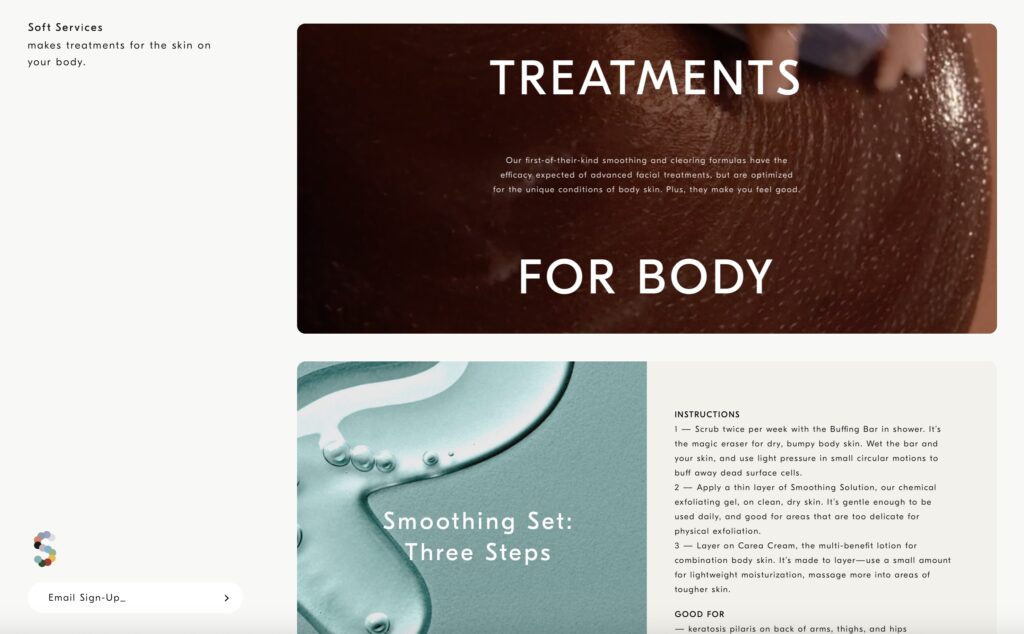
“Companies should always play to their strengths and specifically to their core team. My co-founder and I are both quite strong in terms of direct-to-consumer,” says Rebecca Zhou, CEO of the DTC body care brand Soft Services. Before Zhou and co-founder Annie Kreighbaum launched Soft Services, they were colleagues at Glossier, where Zhou served as head of digital product. “I consider myself an e-comm nerd. Before Glossier, I was at an agency that worked on the Harry’s dot-com build and the Reformation direct-to-consumer transformation.”
Rooted in its co-founders’ digital expertise, Soft Services handles its e-commerce functions itself, and Zhou plans to keep it that way in the future. “In terms of looking at strategy, data, sales performance, etc, that’s all done in-house. That’s really important to us. That’s how you’re gaining insight on your customers,” she says. “When that gets outsourced to an agency, that level of knowledge-sharing may not be as fluid.” Soft Services’ website is powered by Shopify Plus.
Besides a freelance developer, Martin is currently a one-person e-commerce and digital strategy team over at Kiramoon. The setup has more to do with budget and circumstance than level of expertise. “The design and layout upkeep requires a developer, but, so far, I’ve done most of the data analyzing on my own. It’s a real labor of love,” she says. “I think the DTC brands that are doing well have a performance marketing agency that’s constantly doing A/B testing on their website for improvements. I can’t afford that right now, but I think in the first year it’s good to be scrappy.”
According to Hartje, a robust digital team consists of about eight roles. “Ideally, your team would be in-house, but some brands work with multiple agencies on digital and e-comm. That’s a mistake,” she says. “There is no good piecemeal strategy. It has to be holistic in order to work.”
The roles Hartje suggests include:
1. Digital brand identity, user experience and digital designer, which are roles that can be occupied same person.
2. Developer to take care of backend functions.
3. Digital copywriting for website, email and social.
4. Social media management for user engagement, and to create content schedules and posts.
5. Email marketing management to develop and design automations, and manage email platform, customers and campaigns.
6. SEO and content creation to work with copywriter to create blog posts and SEO metadata for organic customer acquisition.
7. Digital advertising managers to pinpoint target audiences and oversee Facebook, Instagram and Google for ROAS (return on advertising spend) for PPC (pay per click).
8. High-level digital strategist to orchestrate the digital approach from a macro perspective.
The experts tapped for this article either use or recommend Klayvio to their clients for email and SMS marketing. “Klayvio offers the best in customer segmentation, which is so important as you grow,” says Martin. Solanch says, “Email is going to be your highest converting channel, so you need to make sure you’re taking full advantage of Klayvio’s functionality: welcome emails, abandon cart emails, win back post-purchase emails, all that. I see some clients come here with just a welcome series running, and it’s like going 10 mph in a Ferrari! I will not spend a dime of a client’s media dollars on Google or Facebook unless their automations are built out to make money while they sleep.”
Along with Klayvio, Hartje and Sharma recommend Omnisend and Postscript, respectively, for SMS marketing. “SMS marketing is becoming more important than email because of open rates and visibility,” says Hartje. “A lot of marketing emails go to promotion folders and customers tend not to check those. It’s important to be mobile now and be in the palm of your customer’s hand.”
Lucky Orange is a heat-mapping tool that tracks individual sessions on a site and records where customers interact (or don’t) based on a site’s layout. It gives brands and agencies insight into the interplay between e-commerce functionality and customer experience. “We were experiencing high bounce after updating some of our Klayvio email flows. From a Lucky Orange recording, I realized that users who came over from Facebook or Instagram ads viewed our website from the in-app browser on their phones,” says Martin. “That completely changed the format of the page and how the customer plugged info into the site. If I didn’t have that recording, I just would have thought that the ads weren’t working.”
Having multiple plug-ins that leverage data from an array of sources can lead to fragmentation that’s overwhelming to manage and challenging to interpret. Gorgias, Alloy and Glew connect the data points together, making it easier for brands to make judgements and actionable decisions about customer behavior and marketing.
Gorgias is a customer support platform centralizes a brand’s communication channels like email, SMS, chat, Messenger, Facebook and Instagram into one dashboard. “We recommend Gorgias because it’s extremely easy to use for anybody,” says Sharma. “It can support businesses that are just starting out as well as ones that are generating half a billion dollars of revenue online.”
Zhou highly recommends using Alloy for e-commerce automation. “It can help us pick up on trends. As an example, we have an app that guesstimates the gender of each of our customers based on first name,” she says. “We use Alloy to put all that information into both Gorgias and Klayvio, so when we send emails we can segment and see how something performs via the filter of gender.”
An all-in-one business intelligence dashboard, Glew gathers data from up to 60 sources to create 10 unique customer cohorts that brands can employ for targeted marketing campaigns. “If you need to make another $5,000 to meet your number by the end of the month, it’s as simple as pulling a segment that’s so core to the brand and saying, ‘Let’s target them on Facebook or Google or wherever, or let’s find customers similar to them.’ It’s low-hanging fruit,” says Solanch. “It also shows your velocity of sales, which can link up to your warehouse management, and the lapse point of your customer to help drive up lifetime value.”
Other plug-in recommendations to streamline front-end DTC functions include JudgeMe, Okendo, Yotpo and Junip for customer reviews; Recharge, Recurly, and Smartrr for subscriptions; Affirm and AfterPay for payments; Loyalty Lion and Smile.io for loyalty programs; Co-Op Commerce and ReConvert for upselling and cross-selling; OrderlyEmails for email design; Enquire for post-purchase customer surveys; ManyChat and Attentive for social media and mobile chat automation; and Sauce Social Commerce for shoppable social content. For back-end DTC functions, recommendations include Tydo and Google Analytics for data analytics; Tribe Dynamics for influencer marketing analytics; Lifetimely for customer lifetime value chronicling; and Back in Stock for inventory.
E-commerce customers expect seamless browsing and purchasing experiences. Therefore, DTC brands must build websites that function quickly and effectively yet still delight users and interact with them in meaningful ways. It’s a tall order that comes at a price.
To erect a competitive DTC website, the experts we talked to advise brands to budget anywhere from $5,000 to $10,000 at the very low end to $100,000 to $200,000 at the high end. The cost depends on functionality and labor. An outside agency pushes up the price. For clarity, the budget figures provided don’t factor in creating and managing a digital strategy, which is, on average, should be budgeted at 15% to 25% of a brand’s projected revenue for the year, according to Hartje.
Martin spent between $15,000 and $20,000 building the Kiramoon site. “It’s not about how much money you spend on building or managing your site. To me, it’s more about who you have on your team, what do they know and what their experience level is,” she says. “If you can spend time vetting people out, you can find incredibly talented young people that can build you a fabulous website for well under $100,000.”
“Build something that you feel you can control,” counsels Zhou. She lists several questions to guide the site launch process: “Firstly, what is your product? Secondly, what do you need to communicate about it, and what does the customer need to know to convert? Thirdly, what is your conversion funnel (are people coming through search, etc.)? Lastly, who is on your team and what is their expertise?”
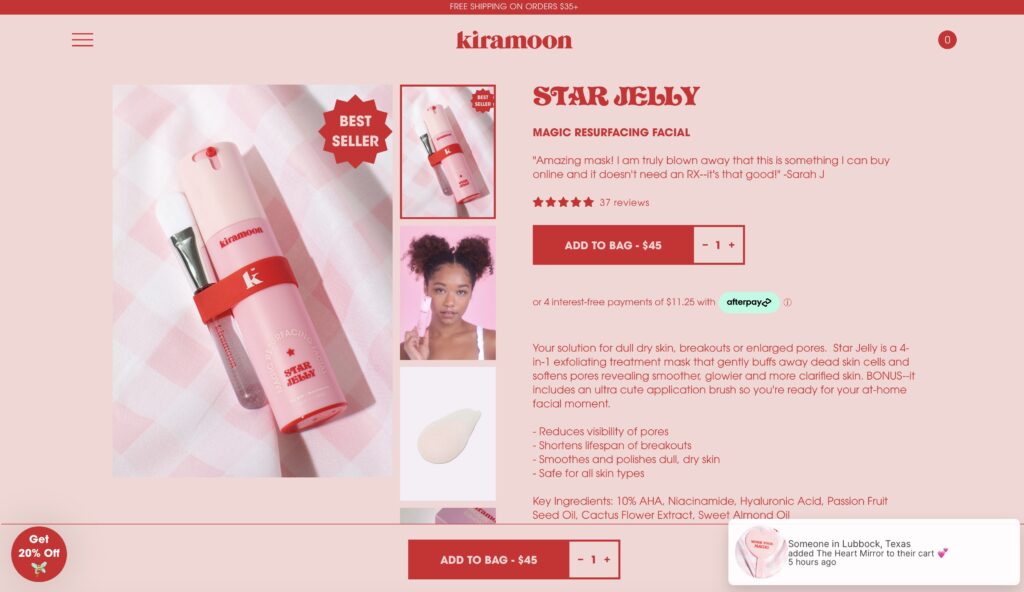
While Martin is proud of the design of the Kiramoon’s site, managing it as the brand scales hasn’t been a cinch. She cautions startups and young brands to be proactive early and ask the right questions when choosing designers and developers. “Make sure your website is coded by someone who really understands whichever e-comm platform you choose to use,” she says. “In our case, the person who originally set up our website wasn’t that familiar with Shopify.”
She continues, “As we’re growing and adding more complex data-collecting apps, I keep running into difficulty with something that should in theory be a simple plug-in. If I could do it all again, I’d bring in a UX conversion optimization person to work alongside my designer to create something that’s not only beautiful, but that also converts well.”
Despite the challenges, customer retention on the site is trending near 30% for the year so far. “We have high converting email flows. I spent a lot of time researching subject lines and how to keep out of people’s spam folders,” says Martin. “I also analyze brand websites I admire and subscribe to all their email lists so I know how often they send out their marketing and what they’re saying.”
Kiramoon expanded into retail last year. It’s been picked up by Nordstrom, Urban Outfitters and Asos. Just over 60% of its 2021 revenues were from retailers. However, Martin plans on beefing up the brand’s DTC channel this year through affiliate marketing, email marketing and live-stream selling.
Soft Services’ products are currently only available through the brand’s site. It designed to be optimized for mobile use—and mobile optimization is a big issue Zhou believes brands should pay attention to. “Design your website, test your website, and think through the user experience in a mobile-first way,” she says. “Our traffic is on average 85% mobile. Our conversion rate on mobile is a bit smaller than our desktop, but it’s still above industry average. Usually, you see a 1% to 2% difference between mobile and desktop, but ours is very close.”
In addition, Zhou warns young brands about data fragmentation. “Brands should definitely be aware of it because there can be a lot of missed opportunity if it’s not considered early on,” she says. “We always ask this question as we’re building out our ecosystem of the tools and apps, how can all this data be linked together?”
The players
5 mentionedBetter Being

Harry's
The Center
Rare Beauty
Glossier