Should The US Want A Beauty Manufacturing Job Renaissance?
In the beauty industry, where market research firm NielsenIQ estimates only 7% of products are made in the United States, reshoring manufacturing that fled long ago to other countries, China most significantly, would be a radical change. Even if it could be done, and the general consensus in the industry is that tariffs might cause an incremental upswing in domestic beauty manufacturing, not a gargantuan leap in the percentage of beauty products made in the U.S., there remains deep ambivalence over whether it should be done.
Are beauty manufacturing jobs stable, upwardly mobile jobs that Americans covet? Are growing them at increased wages economically feasible for manufacturers and their brand clients? Are there enough American workers available that will occupy these jobs to make the creation of them advisable?
The answers could depend on how tariffs will transform the landscape of American employment, but today entry-level beauty manufacturing jobs aren’t compensated equivalently to unionized World War II and post-World War II factory jobs, which accounted for roughly 40% of factory jobs in the 1940s to 1960s and were tied to middle-class wages and defined benefit plans. The U.S. cosmetic and beauty products manufacturing industry employs approximately 55,382 people, according to marketing research firm IBISWorld, more than double the number of people in cut-and-sew apparel manufacturing in the country.
In the past five years, IBISWorld estimates beauty manufacturing has registered anemic 1.3% growth. Beauty product sales have risen at a greater rate. Last year, the market research firm Circana estimates prestige beauty sales climbed 7% and mass beauty sales were up 3%.
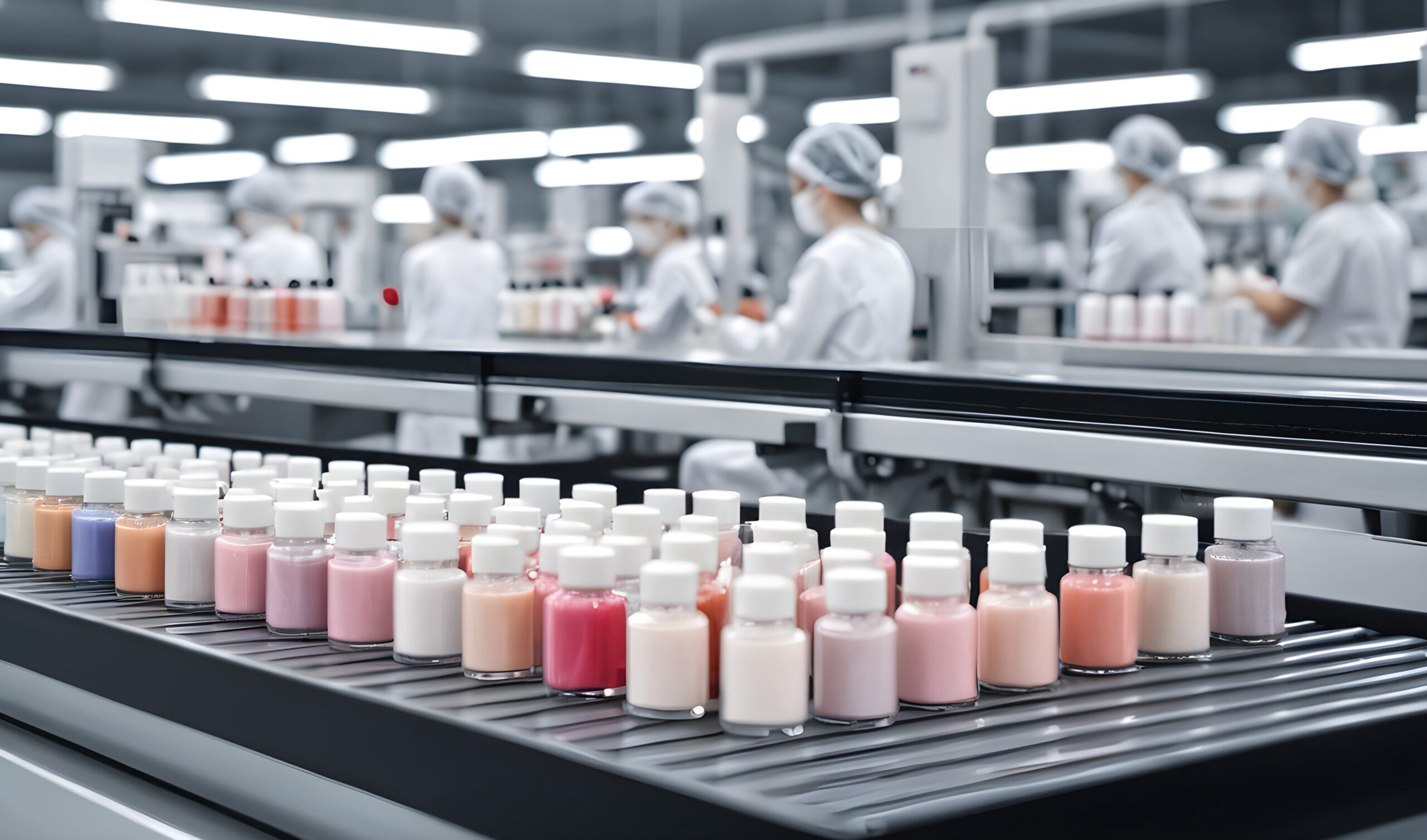
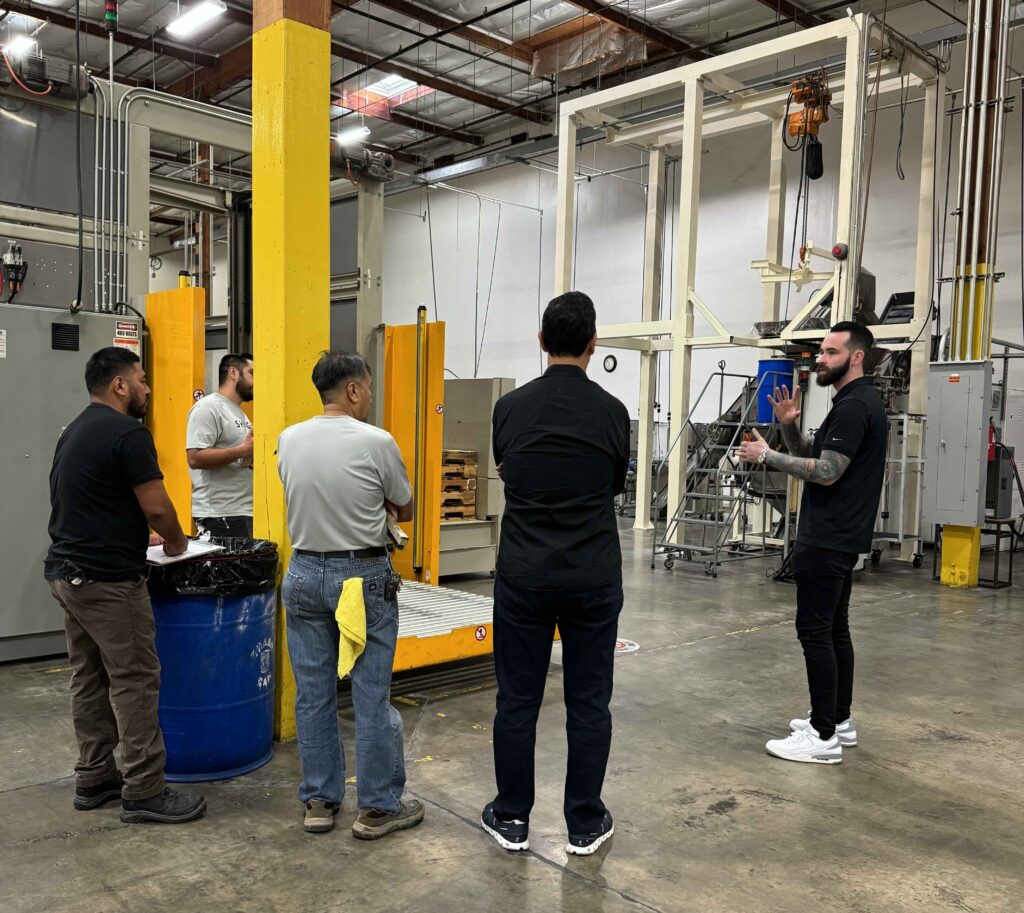
Not dissimilar from manufacturers in other arenas, beauty manufacturers are organizations with several different types of employees, from workers on the production floor to cosmetic chemists and project managers to quality control supervisors. Russ Dancho, president of iLABS, a beauty manufacturer with a facility in Mahwah, N.J., says a production worker on the floor is paid the state minimum wage to start—that’s largely $15.49 an hour in New Jersey—while workers in technical roles can earn $30 to $40 per hour, and project managers can make close to $50 per hour.
For comparison, in Guangdong Province, a hotbed of beauty manufacturing in China, the minimum wage is 16.1 to 22.2 yuan or $2.21 to $3.05 per hour at the current exchange rate. Prior to Trump’s tariff regime, it’s estimated that producing a large run in China would be 20% to 40% cheaper than producing it in the U.S., inclusive of shipping, duties and related costs.
Dancho points out that some production workers on the floor are in temporary positions. “That is the nature of this business in the majority of operations, but the key for control is that the supervisors and the line leaders are permanent employees and many started as temporaries,” he says. “[At iLABS], the current director of operations started as a line worker.”
Nate Call, president and CEO of quality management company Qualitas Executive Group, has found that starting wages are often $18.50 to $22 per hour on the production floor at beauty manufacturers. For technical hourly roles like sanitation technicians, wages can rise to the $23 to $30 an hour range. At the manager level, salaries are usually between $80,000 and $110,000. Salaries for director-level and above roles range widely. Call has seen directors of quality earn anywhere from $80,000 to $300,000 a year.
It can be a challenging task for beauty manufacturers to get people for entry-level manufacturing jobs as they contend with openings in other sectors like retail, restaurants, hospitality and healthcare. They tend to turn to staffing agencies for assistance.
If demand surges for American beauty manufacturing, manufacturers could compete better on wages. However, they’re dealing with soaring input costs, and margins—Eric Korman, CEO of clean beauty manufacturer The Goodkind Co, told Beauty Independent in 2023 that beauty manufacturers’ earnings before interest, taxes, depreciation and amortization (EBITDA) are 8% to 10% on the low end and in the 20% range at the high end—being squeezed, making it less likely they could raise pay substantially.
The beauty industry’s workforce is primarily not unionized, although Call says unions are present in California and New York beauty manufacturing. That leaves workers with limited bargaining power, especially when the labor market isn’t tight, and benefits vary by employer size and culture.
“We see a pretty wide spectrum of culture and what the work is like. It always starts at the top,” says Call. “If you have an engaged CEO, an engaged executive management team, meaning they’re spending time on the production floor and not armchair quarterbacking the business from a conference room or from their office, that is always mirrored throughout the operation.”
Often, he continues, “These aren’t easy cultures for a lot of people to work in. We tend to see a pretty strong culture of quality and continuous improvement, and for people who are in need of a role that doesn’t really change, manufacturing’s generally not a good environment.”
At iLABS, Dancho highlights flexibility as a point of pride and integral to company culture. “We give people guidance, but they also have a lot of autonomy to run their areas as they see fit,” he says. “We have guardrails that they need to perform within and results to generate, but we are entrepreneurial with supporting our customers: What do you need? I’ll get that for you. Let me find the right people.”
While the tariffs may boost demand for U.S. production, it doesn’t guarantee an explosion in beauty manufacturer hiring or improvements in the nature of the jobs inside manufacturers. Manufacturers could become more selective about their employee bases, reassessing the amount of people they hire and the kind of roles required as beauty manufacturing progresses.
“I don’t think we’re going to see universal job growth within the U.S. beauty contract manufacturing industry amid new tariffs,” says Call. “We’re seeing a lot more manufacturers being more intentional about the people they’re hiring and looking for automation opportunities. I think that is where the real impact will be. Will jobs be eliminated? Maybe, maybe not. Will those job requirements change? I think they will be based on the sophistication of manufacturing and how it’s evolving.”
Already, automation is prolific in beauty product filling, particularly in manufacturers of larger sizes. Call figures the biggest investments in automation are at facilities generating $20 million to $50 million-plus in revenues. He emphasizes that packaging complexity complicates automation.
As automation expands, the need for workers with new technical skills could escalate. Dancho foresees a shift away from what’s described as “hard” automation for larger production runs to flexible, robotic systems designed to adapt to smaller product runs.
“It’s like having a person standing there, which makes automation of smaller run sizes more financially viable,” he says. “There is a lot of variability in contract manufacturing, which makes hard automation a challenge. Our customer base is made up of masstige products and up, so the volumes are a bit lower, and the run sizes are not as extensive. When we have larger quantities, we automate.”
For those who can navigate the morphing manufacturing environment, initiative and skill can be rewarded. Dancho envisions a future in which technical expertise and adaptability, already prized, have heightened value. He says, “This is a business where expertise and knowledge help you progress up the ladder.”
The players
4 mentionedMirror

AS Beauty
Better Being
T Investment