Beauty's TikTok Doomsday Prepping
The TikTok ban has huge implications for beauty brands that have leveraged its virality-driving algorithm for customer acquisition and sales. In less than 18 months in the U.S., TikTok Shop has become one of the top five online beauty retailers in the country, according to market insights firm NielsenIQ. It racked up $100 million in Black Friday sales across categories, with beauty brands like Fenty, Estée Lauder and The Ordinary strong performers on the important holiday shopping day.
According to transaction data from Earnest Analytics Orion compiled for a trend report by venture capital firm Coefficient Capital and publication The New Consumer, TikTok Shop is bigger than Sephora, Shein and home shopping television. In a survey of 3,000 consumers by media company Toluna for the report, beauty and personal care followed only fashion and accessories among products bought via TikTok Shop. Estimates of TikTok Shop’s 2024 sales in the U.S. vary from $6 billion to $16 billion, depending on the source.
ByteDance executives have been fighting to stop the imminent TikTok ban for months, contending it’s a violation of free speech rights, and the U.S. Supreme Court agreed to hear last-minute arguments from the company on Jan. 10. Last week, President-elect Donald Trump asked the Supreme Court to pause the ban after meeting with TikTok CEO Shou Zi Chew. Rather than high-minded ideals, many in the beauty industry presume TikTok’s size is the reason it won’t go away.
“Money usually wins. The parties most directly impacted will likely figure out a compromise between the White House, Congress, Beijing and ByteDance that will satisfy everyone,” says Leah Hundsness, founder of Maxine’s Revenge, a makeup brand that premiered on TikTok Shop in November last year. “It’s shocking how creative people get when billions of dollars are at stake. I’m betting on the money, but like all bets, I could be very wrong.”
Launched with $33 French Face Concealer Concentrate as its sole product, Maxine’s Revenge sold out eight of 10 shades of the product on TikTok Shop within two months. In the event of a ban, the brand plans to target platforms that creators migrate to. Hundsness says, “Content creators will also be hit if TikTok goes away, so we will follow them where they go to support them and hustle to get their engagement up wherever they decide to focus.”
BK Beauty, a makeup brush brand that’s built an eight-figure business on TikTok Shop over the past year, isn’t pumping the brakes on TikTok investment. “Losing TikTok would be a significant setback for our business, the creators we value and all of our customers on the platform,” says Paul Jauregui, co-founder of BK Beauty. “That said, the potential ban is out of our control, so I am not overly focused on it—yet.”

Alex Perez-Tenessa, founder and CEO of Trendio, an artificial intelligence-powered video technology company that optimizes brand content for shopping platforms, including TikTok, expects beauty brands overly dependent on TikTok Shop to be walloped by the ban, if it’s implemented. “They may not be able to sustain the transition period,” he says. “I think that the proof point has been made that video shopping is going to work in this country. You just need to set up the right ecosystem, and it’ll flourish.” He adds TikTok’s audience will gravitate to its large competitors, but says, “There will be demand that’s lost. It’ll take some time to recover.”
Paid media agency Iced Media, which counts Anastasia Beverly Hills, Dieux, Saie, Kosas, Glow Recipe, Moroccanoil and Half Magic as part of its beauty roster, is charging full steam ahead with TikTok Shop strategies for 2025 as brands continue to pour money into campaigns and partnerships on the platform. However, it’s sizing up opportunities on alternative platforms YouTube, Snapchat and Pinterest as well as social commerce apps Whatnot and Flip in the event that TikTok disappears. Beauty marketing agency Amie Social is also taking a similar approach with its clients.
Leslie Ann Hall, founder and CEO of Iced Media, “We continue to remain bullish on the evolving social commerce ecosystem and are optimistic about the social shopping innovation roadmap from other platforms.”
While some beauty insiders theorize Meta could capture demand from TikTok’s market exit, the theory isn’t universal. Julia Rubien, founder and CEO of Amie Social, asserts Instagram’s lack of authenticity may fall flat with TikTok users who crave the spontaneous and rawer content that the ByteDance-owned platform has become synonymous with.
“Instagram is a great showcase and highlight reel for creators, but doesn’t connect as personally as TikTok does,” she says. “TikTok has user behavior similar to that of watching TV, and YouTube Shorts has that same foundation by nature of being connected to YouTube, which has always been long-form video content algorithmically sorted to provide entertainment.”
Rubien points out that Snapchat’s high gen Z adoption makes it a serious contender for TikTok users left behind by a potential ban. She says, “The future of social media always follows the teenagers.”
Gen Z, defined by the organization Pew Research Center as individuals born between 1997 and 2012, accounted for over 50% of U.S. Snapchat users in 2023 and 44% of U.S. TikTok users, according to market research company eMarketer. The company prognosticates that gen Z users will overtake millennial users on Instagram this year, with more than 75% of gen Zers using the platform versus 70% of millennials.
Started in 2020, Snapchat’s TikTok-style short-form feature Spotlight has been gaining steam, with watch time increasing more than 125% year-over-year during the first quarter last year. The app had 422 million daily active users in the first quarter, up 10% year-over-year.
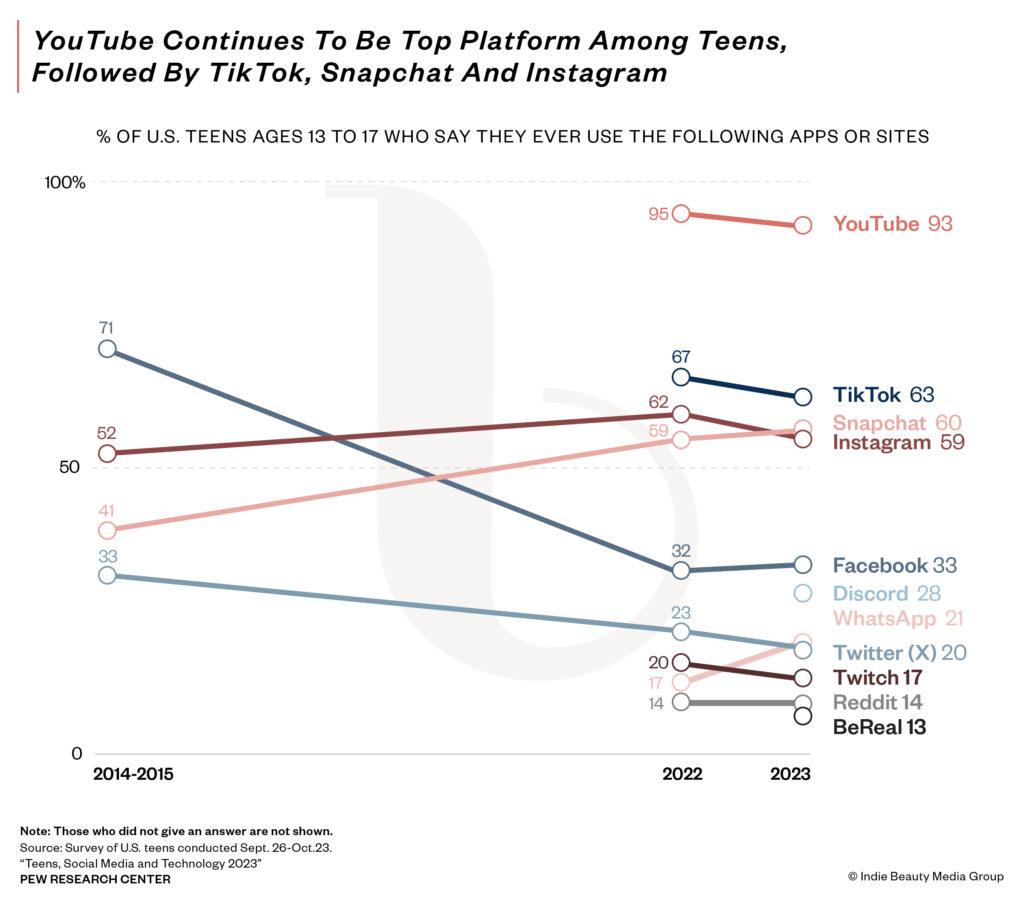
Still, YouTube reigns supreme with teenagers. In a Pew Research Center survey of 1,453 teens between the ages of 13 and 17, 93% reported they use YouTube versus 63% using TikTok, 60% using Snapchat and 69% using Instagram. There are 200 million-plus daily YouTube users in the U.S., and over 1 billion hours of video content are viewed globally each day on YouTube.
YouTube has been attempting to improve its commerce capabilities for years. It made a huge stride in 2022 when it partnered with Shopify to enable creators to sell products directly from their channels through storefronts, and it’s since rolled out updates to help brands harness affiliate-created content. For example, it established an affiliate hub connecting brands and creators and a feature called “Shopping Collections” allowing creators to curate products from brands for users to browse through.
Shorts, the short-form video feature that YouTube introduced in the U.S. in 2021 to rival TikTok, is in growth mode. According to data obtained from social media management platform Dash Hudson by the publication Women’s Wear Daily, views on Shorts increased by 24% last year compared to the fourth quarter of 2023. Meanwhile, views on TikTok and Instagram Reels notched respective declines of 18% and 3%.
Beauty brands registered higher viewer retention rates on Shorts than on TikTok last year, at 77% on Shorts compared to 29% on TikTok. Laneige, Glow Recipe, Fenty, Drunk Elephant, Elemis, Belif, Laura Geller and Milk Makeup were beauty brand performance leaders on Shorts last year.
BK Beauty started uploading to Shorts in the spring 2024 and has been working with YouTube Shopping for the better part of 2024 to reach new customers. “YouTube seems like the platform with the most potential in 2025,” says Jauregui. “We’re incredibly optimistic about the future of social commerce as more platforms release features that support content creators and their ability to accelerate commerce.”
Ann Krisha Buenaobra, content strategy consultant and former partnerships manager and growth strategist for beauty and lifestyle content at TikTok, notes that YouTube Shorts most closely mimics TikTok’s blended ecosystem of video and commerce, but maintains “nothing can really come close.”
She concludes that TikTok’s impact on the future of social commerce has been sealed regardless of how the ban plays out. “We can see across every social media platform TikTok’s impact, and we see that it works,” says Buenaobra. “I think, for the most part, we’ll still be creating, strategizing, marketing and consuming content in a similar manner should TikTok be banned.”
The players
5 mentionedMilk Makeup

Elemis
The Center
Kosas
Drunk Elephant