Your Questions About MOQs Answered
A they take those steps, they have to find vendors providing minimum order quantities (MOQs) they can afford. Working with vendors efficiently and carefully weighing the risks of large MOQs can be the difference between a profitable business and one bogged down by excessive costs.
Below, we investigate MOQs and what goes into them to guide brands as the make critical production and packaging decisions.
What Are MOQ Amounts?
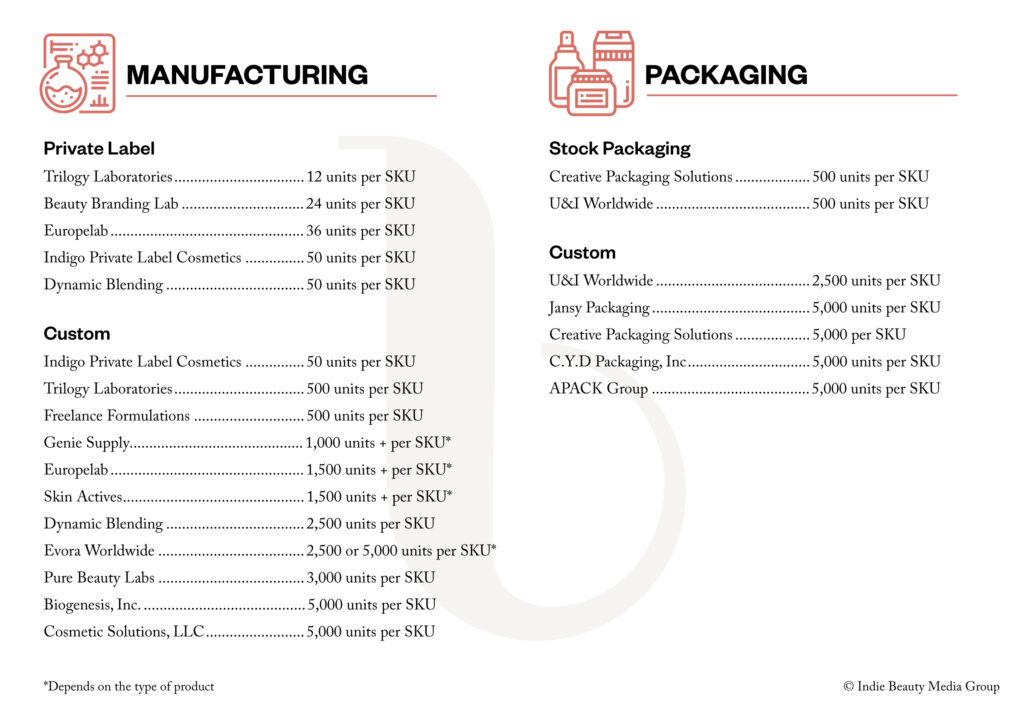
Across the beauty industry, MOQs range considerably. There are high, medium, low and very low MOQs. Manufacturers with high MOQs usually serve national brands that sell to massive retailers. High MOQs amount to tens of thousands of units per order. Manufacturers that offer mid-range MOQs tend to require 500 to 1,000 pieces per unit.
Low MOQs start at 250 units, and even lower MOQs are under 250 units. Brands that go this route should be aware that the cost per unit will be greater. As brands realize economies of scale and reach larger MOQs, costs diminish substantially.
MOQ Barriers To Entry
MOQs are established by manufacturers based on overstock, overhead, machinery, liquid assets and business volume, among other factors. The smaller the minimums, the more they eat into a brand’s profit margins. Brands have to budget for MOQs they can afford initially and plan for those quantities to change as their business matures.
Overstock
It’s important for brands to attempt to accurately forecast the number of products they’ll need to meet customer demand to avoid being awash in unsold stock. If a brand purchases an amount higher than it desires, it risks overstock or getting stuck with inventory it can’t unload.
That’s a sticky situation especially as overstocked goods depreciate, negating any savings a brand has accumulated from buying in bulk. Additionally, purchasing large amounts requires sufficient space to store them, possibly leading to elevated costs for heating, electricity, staff and rent.
Custom Packaging And Molds
Traditionally, suppliers have a selection of stock molds that are used industry-wide. However, as independent and niche brands proliferate, they must be distinct to make inroads with shoppers and retailers. Custom or bespoke packaging helps them be distinct. It’s available in various sizes, materials and finishes.
Custom packaging, though, presents obstacles for nascent brands. A manufacturer may have to devise a new tool for the custom shape and pass along the cost for it—generally $1,000 to $10,000—to brands. Brands will be charged on a one-off basis or the cost will be priced into product unit fees.
U&I Packaging offers primary and secondary packaging such as folding cartons, polyethylene terephthalate- or PET-molded forms and tissue papers. While a simple folding carton typically isn’t tied to strict MOQs, once aesthetic touches like foil stamping, spot varnish or embossing are sought, MOQs enter the picture.
“This is because there are setup costs for everything,” says Michael Lichtman a founding partner at U&I. “If you have a lot of bells and whistles on the folding carton, the setups will become more significant. Let’s say setups are $2,500 for a beautiful carton. If you run 20,000 cartons, that cost is only about 13 cents per unit. If you run 5,000 units, that setup is closer 50 cents per unit for the setup alone. The additional run cost also comes down with quantity.”
Stressing he’s only providing estimates and exact costs are determined by a brand’s specific requests, he figures folding carton projects carry MOQs of 2,500 units, but smaller quantities can be doable. Prices go from $1.75 per unit for 2,000 units to 35 cents per unit for 20,000 units.
Overhead And Machinery
Manufacturing facilities often operate 12-plus hours a day to maximize productivity by hitting a particular number of units per week. Stopping a production run to change machines and institute a new mold takes time. Manufacturers charge clients for that time in order to make up for the lost revenue it otherwise would generate.
Manufacturers may set MOQs to accomplish a 50% profit margin. For instance, if it takes 500 items to break even, they might set their minimum order quantity at 1,000 to achieve profit on each order. Of course, minimums might price some brands out, but they also allow vendors the option to pass on clients that may not be worthwhile for them.
Minimum Liquid Assets
For small brands with limited budgets, MOQs are major roadblocks. Purchasing from a supplier with high MOQs will tie up cash in inventory that may take ample time to recover, and independent brands may not have the luxury of a big enough bank account to float it for that time. That’s a huge risk and crucial constraint in picking a manufacturer.
Assessment Of Repeat Business
Due to the time and labor required to fulfill an order, particularly when there are special molds and new machinery, it makes sense that suppliers shy away from single orders. In evaluating a first-time order, they’ll examine clients’ business objectives and tend to avoid those they believe won’t reorder regularly. To persuade suppliers to take on a new brand, the brand has to educate them on their goals, expectations and aspirations for scale.
MOQ And Cost Specifics
Megan Cox, president at beauty manufacturer Genie Supply and founder of the brand Amalie Beauty, which she sold in 2018, says, “My early struggle as a founder informs almost every decision that we make here, including setting MOQs. Our aim is to be ten times better than our competitors in our founder-centric offerings, and you will see that reflected in our MOQs.”
For private label, Genie Supply offers a turnkey MOQ of 500 pieces per product. Slight modifications are feasible on turnkey projects. MOQs are 2,500 pieces per product for contract manufacturing, but drop to 1,000 pieces if a brand has performed some or all of their own product development. Cox points out that there are product formats that may fall outside of these MOQs. She says, “We do from time to time negotiate lower MOQs over a broad range of SKUs, but it’s difficult to negotiate much below the minimum without other levers that sweeten the deal in some way.”
At Beauty Branding Lab, the average MOQs are 48 pieces, with six tiers of quantities in increments of 24, and there’s a maximum order quantity of 576 pieces. “Each tier showcases a reduction in cost on the per item basis,” says Brianne Minton, an e-commerce specialist. She details that a lipstick that costs $19 at 24 units will cost $10 at 576 units. The prices encompass label printing and application.
In August last year, contract manufacturer Cosmetics Solutions partnered with Beauty Branding Lab to allow brands to order as few as 24 pieces of a stock product. The maximum a brand can order is 576 pieces per stockkeeping unit. Brands can get 24 pieces of a cleanser for $238 or a peptide serum for $478.
Brands can purchase an order through a trading company that will place an order on their behalf. The beauty of this path is that it enables brands to split MOQs between multiple buyers to lower the price for an individual brand. It can potentially reduce the risk of unnecessary goods that become overstock.
The players
5 mentionedBetter Being

Cosmetic Solutions
AS Beauty
Formulate
August