Squeezed Before The Writers And Actors' Strikes, Hollywood Makeup Artists And Hairstylists' Struggles Mount As They Drag On
For the hairstylists, makeup artists and nail technicians who work on press junkets or sets, tensions started in late 2022, and without an end in sight, they’re reaching a breaking point that’s affecting other parts of the beauty industry.
“During the last [WGA strike in 2007], we knew that it was coming, so the studios started doing [extra productions], and everybody was working all the way up until the strikes trying to stockpile all the shows,” says Elena Arroy, makeup artist for the movies “Top Gun: Maverick,” “The Hunger Games” and “Wonder Woman 1984,” and VP of IATSE 706, one of 362 unions that comprise the International Alliance of Theatrical Stage Employees, a collection of some 170,000 behind-the-scenes entertainment workers like makeup artists, hairstylists and wardrobe stylists.
This time, she recounts that the studios began canceling projects months ahead of the strikes to weaken the movement. “The studios knew, if we don’t give them any work in January, February or March, are they really going to go on strike in April or May? Are they going to be able to strike all summer?” says Arroy. “I’m afraid some people are not able to withstand this.”
With few exceptions, hairstylists and makeup artists dependent on television and movie production have been out of work for months. “I do understand why SAG-AFTRA and the WGA are striking, and I do support them, but it’s hard to be positive and upbeat as the days turn into weeks and then into months,” says Adruitha Lee, a union hairstylist and Academy Award winner for “Dallas Buyers Club.” “I certainly hope that everyone understands what is happening to the crews that cannot work because there is no work.”
Arroy says, “I’ve only worked three days this year. There are some makeup artists who haven’t worked at all this year…Two of my friends are now delivering Uber Eats and another is thinking of getting a job at Costco because they give you hours, especially around the holidays.” She adds that IATSE members must work 400 hours every six months to remain eligible for health insurance, so Arroy could lose her health insurance coverage. She says, “The strikes have impacted us all in a very difficult way.”
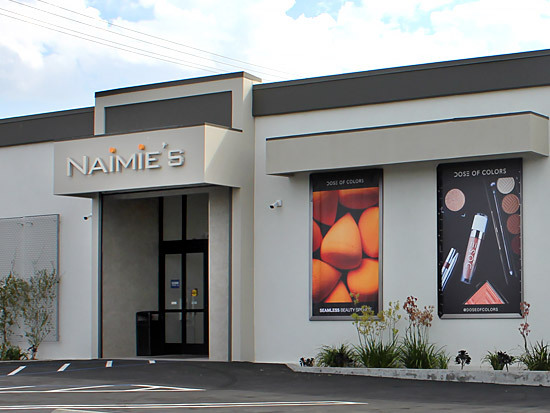
Beauty retailers reliant on the business of Hollywood are feeling the pinch as well. “Productions that would normally make large orders have gone silent, and artists who would normally pop in to replenish their kits have dwindled,” says Nicole Fischer, senior account manager at Naimie’s Beauty Supply, a retailer in Los Angeles geared toward professional makeup artists and hairstylists. “It trickles down to the vendors as well. We’ve had to cut our orders in half or tell them to try back next month.”
As part of the conditions of the strike, SAG-AFTRA’s members aren’t allowed to participate in promotions through events, photoshoots and interviews, leading even job opportunities for non-union beauty professionals to dry up. “I was just trying to recover from the pandemic, and this feels like a second round,” says non-union red carpet makeup artist Daphne Chantell. Nail artist Michelle Saunders, who’s clients have included Julia Roberts, Jennifer Hudson and Margot Robbie, says, “There are less phone calls and email requests for nail services in Hollywood because no one is promoting their film or project in alliance with the strike.”
Marissa Alfe, co-founder of PRTNRS, a talent agency that represents beauty, fashion and entertainment professionals, says, “Day-to-day bookings are dead.” Instead, she’s focused on brand partnerships to keep her clients’ lights on. She says the difference between the artists with large social followings, who have fared well with brand deals since the strikes started, and those that have stuck to traditional work, is feast and famine.
“The brands are saving us,” says Alfe, noting that, if artists want to work now and don’t have the social media audience numbers for brand deals, the best bet is Fashion Week, which she predicts will be packed with creatives from all sectors trying to recoup lost wages.
In advance of the strikes, wages for Hollywood beauty professionals were already shrinking. “Hearing what an artist used to get paid for a red carpet versus what we get paid now is shocking—truly shocking,” says Courtney Hart, a celebrity makeup artist who’s worked with Kristin Bell, Hilary Duff and Kaley Cuoco. “In general, streams pay less. They don’t seem to value artists as much. It seems to be them that try to get away with the worst [rates].”
In the past, Hart pegs a good rate for a red carpet event at $3,000 plus 20% for an artist’s agent fee. Today, the artist is lucky to be paid $1,500 inclusive of agent fees. “I’ve had streaming services come to me recently and try to get away with $250, which is less than I would pay an assistant,” says Hart. “I have been doing makeup for 15 years. It’s insulting.”
Moreover, artists are expected to cover a multitude of expenses. “I’ve worked at TIFF, Sundance—all the big festivals—and I have always paid for my travel, lodging and food,” says Hart. “Sometimes artists will book these trips before they even have jobs booked. It’s a hustle mentality where artists will have six people to a room…It’s how you get new clients and how you keep the ones that you have.”
Hart continues, “People have asked me, ‘Why doesn’t your client pay for you?,’ but it’s not their job. Would you expect an actor in a movie to pay for their hair and makeup in a movie?” We are a part of the process. We’re doing the marketing and the actors shouldn’t be paying. Sometimes you’re paid low rates, but your clients are important to you, so you suck it up.”
Struggles are mounting outside of Hollywood, too. “Nine out of 10 makeup artists I know are not working right now,” says Diana Estrada Hudson, a London-based makeup artist who’s worked on television shows and movies like “Bridgerton,” “Wonka” and “Loki.” “It’s shocking because post-pandemic the work was coming out of our ears—there weren’t enough artists—but now I know people who haven’t worked since January. It’s pandemic 2.0…Not only are we unemployed and financially scared, but we’re lost at sea because of the uncertainty.”
The scant work means competition is fierce for the remaining gigs. “People are taking steps back to get the work,” says Estrada Hudson. “Tensions are simmering because artists are going for jobs they weren’t interested in before.”
Many artists are worried that the issues motivating the strikes, artificial intelligence in particular, could impact their future livelihood. “I think everyone, no matter what your job is, will be dealing with the changes that are coming with AI,” says Lee. “I have a healthy fear of what can be done with AI and how it can eventually affect what I do.”
The possible reduction or complete removal of background actors is a key concern. Producers can scan background actors so their likenesses can be inserted into scenes long after they’re wrapped, leading to a diminishment of support services needed to prepare the background actors for scenes.
Estrada Hudson notes that on “Bridgerton,” for example, there were routinely 30 to 50 workers dedicated to background actors. Artists are responsible for everything from facial hair to the (sometimes fake) dirt that goes under a background actor’s fingernails to portray the appropriate location, time and situation of a scene. Estrada Hudson says, “Taking the [background actors] to be ‘scanned’ has always given me an uneasy feeling.”
Katie Machaiek, a union makeup artist on the television programs “The Rehearsal” and “S.W.A.T.,” says, “Eliminating actors eliminates more jobs than just the actors themselves. If AI moves forward, and background actors lose their jobs, the producers are also eliminating positions for wardrobe, hair, makeup, props and even catering to feed these people.”
But worries about AI aren’t universal. “New technology in special effects and photo editing throughout the years has not made my work obsolete, and I do not think AI will do that either,” says Ashley Joy Beck, a union makeup artist and commercial actress. “People will always appreciate makeup that makes them look some type of way in person, regardless of post effects.”
For artists fearful that the strikes will last until next year and wage reductions will be lasting, the name of the game is financial diversification. Hart says, “A lot of makeup artists are realizing that it’s very hard to fully support yourself by only being a makeup artist, so I think we’ll see more and more artists being businesspeople outside of the art.”
Beck started selling vintage clothing and jewelry in 2020 to make ends meet. She says, “I don’t know exactly how much longer I will be able to go this route, but thankfully I have enough non-union work just to stay afloat.”
To be useful when she’s not working, Beck has been volunteering with the Beauty Bus, an organization that provides free services in hospitals. “[Myself and] a lot of other [IATSE] 706ers are volunteering with them to provide makeup, haircuts and hand massages for cancer patients, their families and frontline workers at the busiest hospitals in LA,” she says. “Keeping my mind in a place of service to others is helping me make it through.”
The players
2 mentionedAS Beauty

Costco