
Why Consumers Are Leaving Public Feeds For The “Cozy Web”—And What Brands Should Do
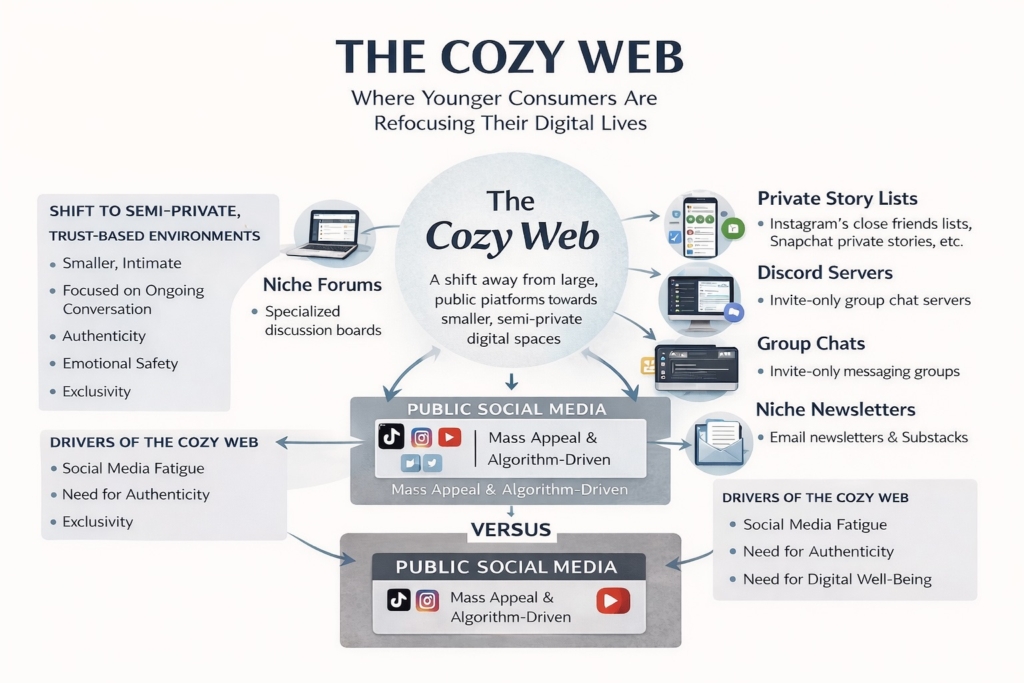
If so, you may be experiencing what’s known as the “cozy web.” Coined by writer Venkatesh Rao, creator of the blog Ribbonfarm, the term describes a shift away from large, public, algorithm-driven platforms toward smaller, more intimate digital spaces built on trust, not performance. Instead of broadcasting to mass audiences, younger consumers are gravitating toward group chats, private Story lists, Discord servers, niche newsletters and other semi-private environments where authenticity, emotional safety and ongoing conversation trump visibility or reach.
Market research firm YPulse and publication AdAge have explored the concept to explain how younger consumers are reorganizing their digital lives amid social media fatigue. In a recent email briefing, YPulse wrote, “Many now keep two versions of themselves online: one curated public persona and one semi-private account where they can be real.” While social media platforms remain the top place 18- to 24-year-olds find connection, YPulse data shows they’re also the most likely to say social media makes them feel worse about themselves. Private spaces, by contrast, offer belonging without the pressure of a post that can be viewed, judged or resurfaced weeks or months later.
Importantly, the retreat to the “cozy web” isn’t a rejection of digital life altogether. According to Pew Research Center, social media usage among young people remains high, but attitudes toward it are souring. Polled in 2025, 48% of U.S. teens say social media has a mostly negative effect on people their age, up from 32% in 2022, even as most still credit platforms with helping them stay connected to friends. The tension between connection and comparison is pushing younger consumers to redraw boundaries around where and with whom they show up online.
For beauty and wellness brands, the implications are significant. Discovery may still happen on platforms like TikTok, Instagram and YouTube, but trust, loyalty and influence are increasingly forged in quieter, more intentional spaces. That shift is forcing brands to rethink how they form relationships with their audiences.
To understand what this transition means in practice, Beauty Independent spoke with brand strategists, agency leaders and consumer-insights experts about whether the “cozy web” is real, how it’s reshaping digital behavior, and where beauty and wellness brands should be showing up next.
Despite the pullback from public posting, experts caution that the “cozy web” shouldn’t be read as a sign that social media is irrelevant or that young consumers are logging off en masse. “Rising generations are not anti-digital; they’re anti-exhaustion,” says Emily Safian-Demers, VP of insights at Front Row. “Even as a minority opts for extreme versions of digital retreat (e.g., dumb phones or neo-Luddite lifestyles), most consumers are simply seeking balance and digital wellbeing. They want spaces that feel more human.”
Given the continued presence of consumers on major platforms, Shelly Socol, CEO and co-founder of 1r Agency, argues that public feeds still play an important role for brands, functioning as a storefront for discovery, authority and education. “The takeaway is not ‘post less.’ It is ‘perform less,’” she says. “For beauty brands, that means being more intentional about where different types of content live. Public feeds still matter for reach and credibility. They are the storefront, but the real relationship gets built elsewhere.”
Brand marketing and communications consultant Stacey Levine echoes that view. “The ‘cozy web’ phenomenon is absolutely real and valid, but it doesn’t mean we lose the value of social media,” she says. “Brands still need a social presence the same way they need a website. It’s a nonnegotiable home base.”
The shift to smaller online corners reflects growing consumer fatigue with highly curated, permanent public feeds. “What’s changing isn’t attention, it’s exposure,” says Levine. “They want connection without comparison and visibility without surveillance.”
As a result, deeper engagement is increasingly moving into private or semi-private environments such as Subreddits, Substack newsletters, Instagram broadcast channels and the Close Friends feature, SMS programs and email. In these spaces, brands are being forced to reconsider how they define success. Traditional engagement signals, including likes, comments and polished user-generated content, are becoming weaker indicators of affinity. Metrics such as replies, saves, repeat participation and retention are emerging as more meaningful proxies for trust and resonance.
As the “cozy web” transition takes hold, brands’ roles on social media are transitioning as well. “Brands need to be remembered, not just noticed,” says Socol. “That requires acting less like broadcasters and more like hosts.”
Experts suggest brands need to reverse how they think about engagement. The question is no longer how to pull consumers in online, but what brands can meaningfully contribute once they’re there.
Socol says, “Instead of asking, how do we get them to seek us out? The more important question is, what can we offer that genuinely adds value to their lives? That value might be education, emotional support, shared experience or simply a space that feels safe and non-performative. Whether it’s a thoughtfully moderated private community, an in-person gathering with no purchase expectation or content designed to be useful rather than aspirational, the most effective brands are acting less like broadcasters and more like hosts.”
Safian-Demers advises brands to reexamine both tone and format, arguing that polish should be downplayed. As feeds become saturated with ads and artificial intelligence-generated content, overly aestheticized storytelling can feel distancing. In its place, more candid, process-driven content that mirrors how people actually communicate with friends is resonating, particularly in beauty, where routines, experimentation and imperfection are central to the category.
Respect for digital wellbeing is also emerging as a core expectation. Younger consumers are sensitive to how brands enter their lives, rewarding those that avoid constant selling in favor of pause, care or utility. As AI-generated content proliferates, Safian-Demers asserts that real voices, founder perspectives, lived routines and unfiltered experiences function as trust signals, not liabilities to be smoothed out.
Brand marketing consultant Cecilia Turck underscores the tension brands must navigate. She says brands “need to serve connection-first, engaging storytelling. Easier said than done as brands are stretched between reach at scale on one hand and personalized connection on the other. Volume or value? Both, says gen Z…As gen Z are trying to find a harmonious way to live on social media, brands need to find a harmonious way to respond to their ambiguity.”

Several experts highlighted small, in-person gatherings as an effective way to translate the “cozy web” ethos into real-world connection. These gatherings can include workshops, wellness walks, product education sessions and community meetups that are not centered on spectacle or social posting. The goal isn’t to spark virality, but to foster conversation, community and trust.
Levine says these events should mirror what consumers are gravitating toward online: spaces where they can show up without performing. She points to Cocokind and Refy as examples of brands moving away from large pop-ups designed for social amplification in favor of more intimate experiences. They’ve taken limited groups of customers on brand trips modeled after conventional influencer excursions, turning them into experiences consumers can participate in and not just observe from afar.
Recently, Levine notes that E.l.f. Beauty hosted a consumer night out in New York City to celebrate its upcoming fragrance collaboration with H&M. Outside of beauty, accessories brand Susan Alexandra regularly hosts bead nights and other small community events at its New York store, often attended by founder Susan Korn.