The Speed Trap: How Fast Beauty Has Compromised Product Quality
The skincare brand The Inkey List boasted to Women’s Wear Daily that it could bring a product to market in 18 weeks, shaving off months, if not years, from the prevailing product development timetable of its conglomerate counterparts. E.l.f. Cosmetics told the publication it had progressed from 40 launches yearly at an average time-to-market of 32 weeks to 120 launches yearly at an average time-to-market of 22 weeks.
The success of fast fashion, adoption of prolonged beauty routines, whiplash of trends engendered by social media, rise of e-commerce platforms without retailers’ rigid reset schedules and onslaught of indie beauty brands attempting to outpace lumbering larger competitors were factors in product development acceleration. And speed spelled sales. E.l.f. Cosmetics’ sales have more than doubled since 2018 to hit $579 million its last fiscal year, and The Inkey List is reportedly reaching around $100 million in revenues.
The beauty industry hasn’t slowed down. If anything, it’s flooring the gas pedal on product development. Lauren Stanek, VP of business development at manufacturer Elevation Labs, points to a spike in demand during the pandemic as an expeditor. “Everyone was at home. They wanted to do self-care. They were on TikTok and Instagram more, and there was an explosion in the industry at the time, which was great for those of us in the industry,” she says. “That triggered a lot of what we are seeing now in terms of things needing to be at a faster pace. I’ve seen the timelines get more crunched.”
Pre-pandemic at Elevation Labs, Stanek figures the regular timespan from the start of product development to the delivery of a product to a brand was nine months to a year. Now, six months has become common. At factory and agency Genie Supply, founder Megan Cox says, “For custom formulations, you are looking at an absolute minimum of two months and maximum maybe six months of development and three to four months in testing. You are talking six months to a year before you are ready for manufacturing. That’s too long for how quickly people move through products these days.”
Warren Becker, executive chair at manufacturer Cosmetic Solutions, says, “We deliver reorders in six to eight weeks, and if we can commercialize a new product in three to six months, we are happy with that.” He suggests the rapidity is important for brands to pounce on market opportunities. “Skincare is becoming much more fashion-focused like makeup, where the shades are changing every season,” says Becker. “We still have brands that are planning 24, 25, 26 [months]. We are telling them you have to be nimble because something is going to happen in the next 12 months, and if you don’t have a partner that can help you with that, you are going to miss out.”
At manufacturer mSEED Group, co-founder and CMO Anthony Standifer tells brands that three months isn’t feasible for product customization. He describes six to nine months as “a fast timeline” and a year doable. “The expectation for speed has increased and that is a function of the number of people playing in the market. The number of entrepreneurs has exponentially grown year over year,” he says. “People want things fast, they want them cheap, and they want them at the highest quality. I get that, but I also give realistic expectations that speed is very difficult, particularly when you are talking about innovation and you want to maintain great quality.”
Many beauty manufacturing and product development insiders believe the beauty industry is reaching a breaking point. They argue that taking products to market at warp speed is leading to poor product quality and, despite calls for sustainability, the beauty industry is churning out a greater amount of merchandise today that’s shoddier than ever. According to the market research firm Circana, the volume of haircare and skincare product launches in the United States rose 20% and 18% this year as of August. While it’s difficult to ascertain the extent of subpar product quality and tie it directly to truncated product development timelines, reports of product separation, curdling, discoloration and possible mold shared on social media are mounting.
Robyn Watkins, founder of product development agency Holistic Beauty Group, doesn’t hesitate to connect the issues to fast beauty. “In the world of beauty, the pursuit of speed can often compromise the desired outcome of quality,” she told Beauty Independent for an article earlier this year on product quality. “The industry is currently experiencing a quality crisis largely attributed to the prioritization of timelines over the long-term impact of the product.”
Cox singles out TikTok as a propellant of the quality crisis. “Something will blow up on TikTok, and then you have to create additional products quickly,” she says, emphasizing, “Now that we are used to instant gratification that doesn’t mean manufacturing can operate under the same constraints. People want to drag and drop, and they are not thinking about that there are real people making these products.”
The beauty industry isn’t alone in facing a quality breakdown. A piece in the publication Vox explores the deterioration of everything from fashion to electronics. In it, writer Izzie Ramirez explains the nature of contemporary consumerism and manufacturing—microtrends plus the avoidance of high-cost labor, material and machinery modifications, and the prizing of appearance over durability—has made stuff worse. In a story for The Atlantic magazine entitled, “Your Sweaters Are Garbage,” journalist Amanda Mull details that synthetic fibers, cheaper retail prices that don’t maintain skilled garment workers and trade deregulation have wrecked sweater quality.
Each product category has specific dynamics causing quality to degrade. In the beauty industry, Cox says brands “are willing to take a lot of shortcuts in order to push products out faster,” especially pertaining to product testing. Two main beauty product tests are stability tests to verify a product keeps its form and determine shelf life, and preservative efficacy tests to see if bacteria, yeast and mold grows in a formula. Genie Supply pegs the timeline for stability testing at eight to 24 weeks, and the timeline for preservative efficacy testing at five to six weeks. Other tests evaluate packaging combability, heavy metals and allergic reactions.
“Some of these tests can be easy corners to cut in development to save on time and get to market faster. From a risk assessment standpoint, I always have to wonder, is it really worth saving an extra couple of weeks?” asks Stanek. “With the emergence of social media and all the information at everyone’s fingertips, we are seeing some consumer concerns end up being at the forefront of everyone’s mind because it can be all over social media.”
Christina Mahar, CEO of Craft Beauty Lab, says her manufacturer tests a formula for 12 to 18 weeks prior to ordering ingredients and producing a product, but “that 18 weeks is usually a deal-breaker for smaller brands…When you’re cutting out some portion of that, that is where you can get yourself into trouble. We try to have a really upfront conversation around that.” Of course, small brands tend to have severe cash limitations, and product testing can cost hundreds or thousands of dollars that may be tricky for them to cover. Genie Supply approximates stability testing can set a brand back $500 to $4,000.
Perusing beauty assortments at retailers, Cox regularly spots the consequences of skipping or abbreviating product development steps. “Major brands that are in Sephora have products with a six-month shelf life. How does that make sense in a retail setting?” she says. “I find it hard to believe that a retailer would take makeup with less than a six-month shelf life. That’s from when it’s manufactured, not just the time it was received.”
Corners are being cut as beauty brands are shifting away from longstanding preservatives to options deemed cleaner, but that require adequate testing to examine how they stand up in formulations. Becker, who contends ingredient shifts rather than speed is the reason for product quality issues, says manufacturers are “trying to achieve textures of the past with ingredients of the future.” Cox says, “There’s lot of pressure on contract manufacturers not to use certain preservatives. Even if you have something else that’s clean, it might act differently and the efficacy testing might be on the borderline. There is a lot of pressure to keep moving, and there will be more cases where there is mold because of it.”
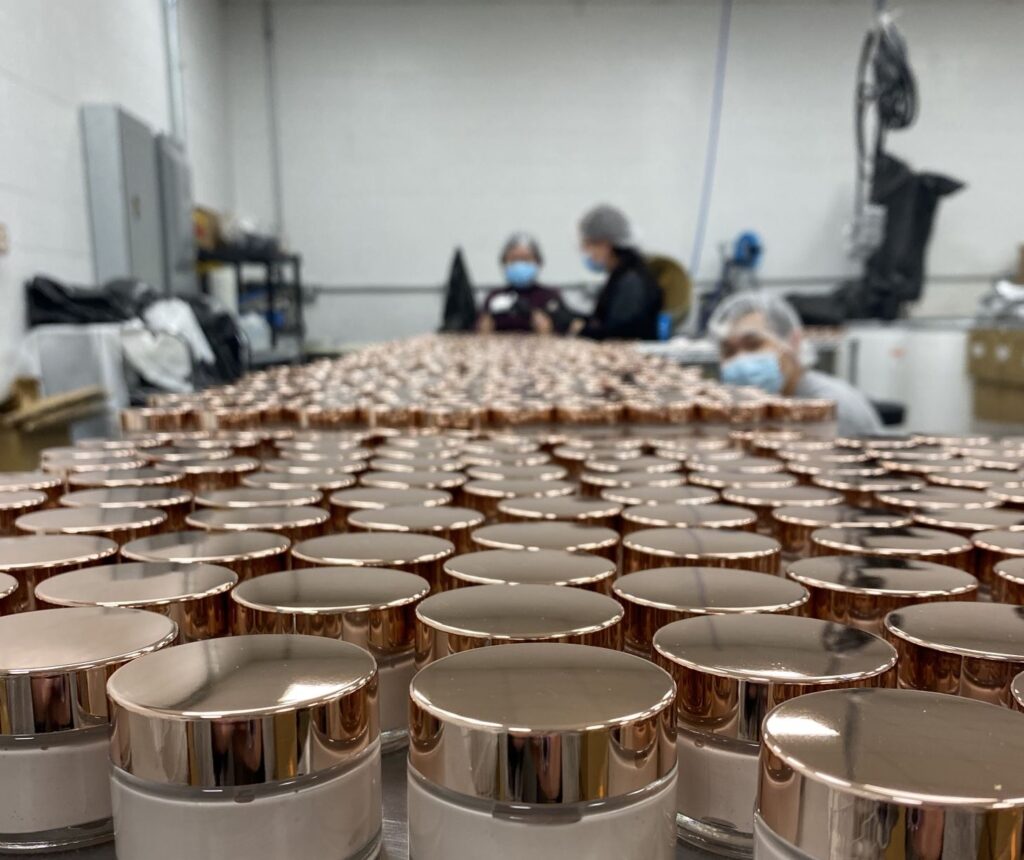
Convinced that brands aren’t going to temper the pace of product development, some manufacturers are strategizing to simultaneously satisfy the drive for speed and produce safe, quality products. Genie Supply can run an accelerated stability test on samples to understand formula stability early in the product development process. Cox says, “We have tried everywhere we can to compress the testing timeline without taking on additional risk of it failing testing or in production.”
Cosmetic Solutions has boosted in-house capabilities in areas such as lab testing and packaging sourcing to diminish product development timelines and amassed a library of 300 stock formulas that have already been fully vetted. Becker says, “You have to have the quality systems in place to go quickly. We try to move quickly, but never at the expense of quality.”
Stanek senses brands may be tiring of the product development race. Were that to be true, there may be hope that the beauty industry’s quality problem could dissipate. “Post-pandemic, which we are still in, it was all about quantity of launches, we have to launch something new every quarter and seek excitement on social media,” says Stanek. “Now, I’m seeing a back pedal of that, it’s about quality and not quantity. With that trend, we could move back to somewhat slower timelines where brands are doing less launches a year, but they are more higher quality launches, and they can put more marketing dollars behind their launches.”
The players
5 mentionedAugust

Formulate
The Inkey List
AS Beauty
Cosmetic Solutions