Seeking A Cost-Effective Alternative To Digital Ads, Beauty Brands Hit The Road With Truck Media
The roadtripping comes as brands are looking to diversify their advertising spend in the face of elevated digital advertising costs and get the most bang for their buck as the price of doing business has gone up across the board. And it comes as brands are looking to support retail partners, which are ever more crucial to their sales and tremendously competitive as e-commerce has become a harder proposition.
According to Anna Bager, president and CEO of Out of Home Advertising Association of America (OAAA), OOH advertising cost per thousand (CPM) is lower than almost every other form of competitive media. Crosswalk Media founder Brian Hands says that a delivery truck used by his company to advertise costs one-tenth the amount of a billboard or large-format transit advertising. Geometria, which handles mobile billboard advertising, charges $170 per hour for a truck. Adgile Media Group, a truck-side advertising company that’s worked with Tower 21, Topicals, Glossier, Crown Affair and Saie, offers a $30,000 test-and-learn campaign encompassing several trucks for multiple months.
“Digital advertising is getting more expensive and less effective, and consumers are digitally fatigued,” says Hands. “Commercial delivery trucks present a great opportunity to give your brand a physical presence in the real world and reach a much broader audience for a fraction of the cost, which is super important in the current environment.”
As brands experiment with offscreen advertising, OOH increased 20.7% in 2022, according to OAAA. In particular, transit OOH grew 49% last year and is up 2% through the first half of this year. “The OOH medium serves as an efficient, effective and engaging conduit for brands looking to reach and earn the attention of on-the-go consumers in an age of distraction and digital fatigue,” says Bager. “Mobile billboards offer a unique value proposition and complement our overall OOH media offerings in that they are able to reach areas where fixed OOH placements are not located or may be restricted. Additionally, they are excellent for event marketing (conventions, concerts, sports, special sales), and for sample distribution at stores or other locations.”
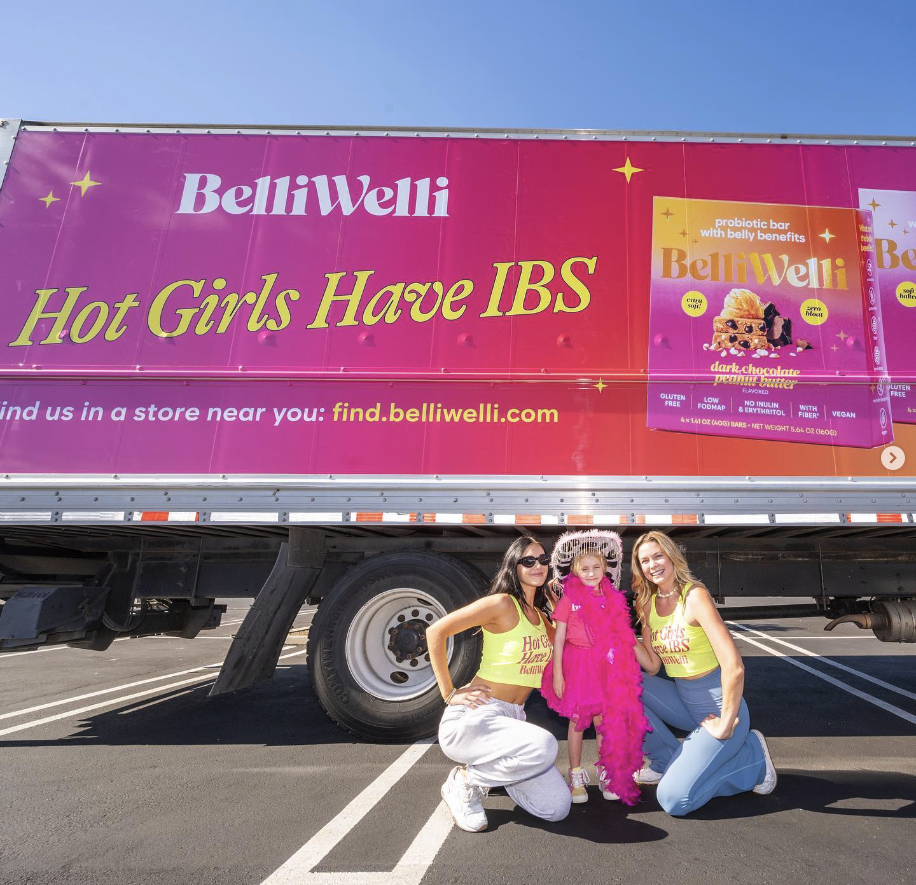
Cost was an important factor for the snack brand BelliWelli. Founder Katie Wilson estimates that OOH campaigns make up 10% of its marketing budget. BelliWelli launched a “Hot Girls Have IBS” billboard campaign two years ago, which Wilson characterizes as “the best money we ever spent on the brand.” In September, BelliWelli initiated a truck campaign with creative from its billboard campaign that will run through Dec. 17 to coincide with its nationwide expansion at Target and 1,000 new retail doors at retailers such as Sprouts, Kings and Fresh Thyme. The campaign involves trucks in Los Angeles, Dallas and Chicago.
While Wilson didn’t provide exact figures, she shares that leasing three trucks for 12 weeks with Adgile is about the cost of a single billboard. She says, “It’s more affordable, and I really liked the idea that we could be in three different markets. For the billboard, you’re limited to one.”
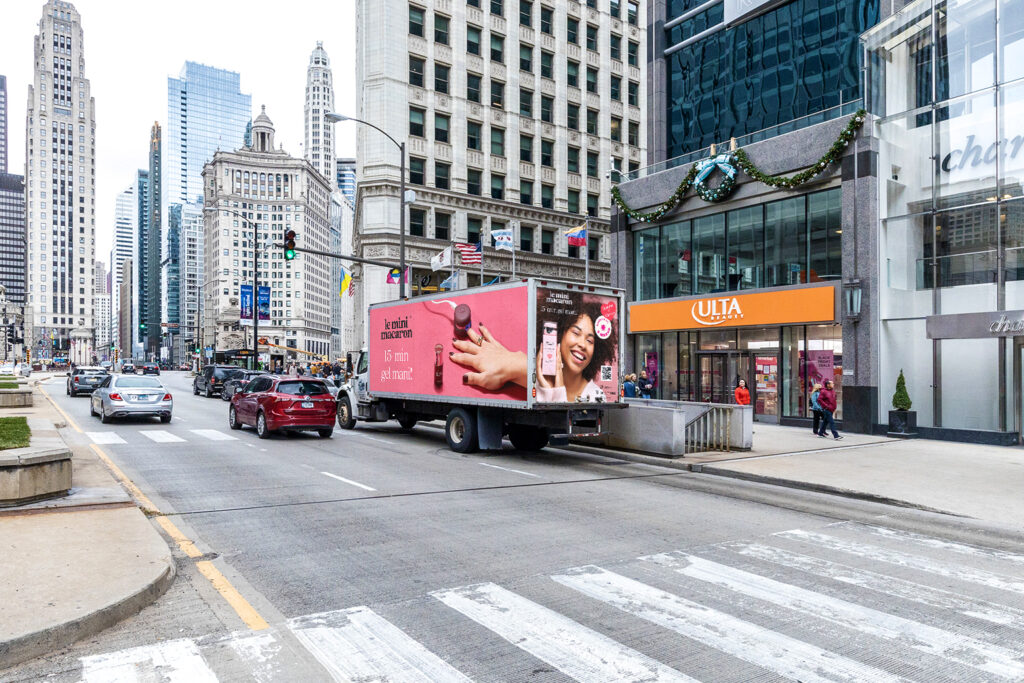
Le Mini Macaron opted for OOH truck advertising in October 2022 to support its partnerships with Target and Ulta Beauty. Co-founder Christina Kao chose to put the vehicles in New York City and Chicago, where the nail product brand indexes high with consumers. She specifically chose routes that would pass by specific retail storefronts. Kao says, “It was important to drive messaging close to the point of sale, so we’d be top-of-mind among shoppers.”
Co-founder Camille Bell took a similar approach with Pound Cake’s one-truck campaign that launched Oct. 16 this year in New York City in tandem with the makeup brand’s Ulta debut. Drivers were asked to pass by three stores where the brand is stocked. Bell says, “We wanted to get as much visibility surrounding our launch as possible.”
Bell considered purchasing a billboard, but went with truck advertising because she was confident there would be a better chance people were going to see it. She says, “They’re on the ground actually at eye level with folks constantly moving around the city as opposed to a billboard where, if you happen to look up real quick, you’ll see it.”
Still, it’s hard to grab people’s attention in a city where visual stimulation can be overwhelming. Kao says the key to cutting through the noise is “high-impact, breakthrough creative.” Adgile co-founder Tom Shea mentions that vibrant colors like red and purple tend to stand out on trucks. Hands advises brands to have a call to action.
“Whether that’s in the case of having a QR code or a URL or telling someone to visit a retail location where your product is available, I think that’s all important,” says Hands. “If you’re going to buy large format, be big, be bold and really take advantage of the fact that it’s a differentiated canvas than what’s out there in terms of traditional out-of-home options.”
Wilson recommends brands test creative before putting it on the side of a truck. She says a good campaign has to be “noticeable, shocking, but on-brand, which all sound like obvious things, but I think getting creative is harder than anyone ever imagines.” She cautions, “I don’t think out-of-home is amazing if you don’t have the right campaign. I would never have spent money straight out the gate on a truck if I wasn’t already pretty confident in our out-of-home marketing message.”
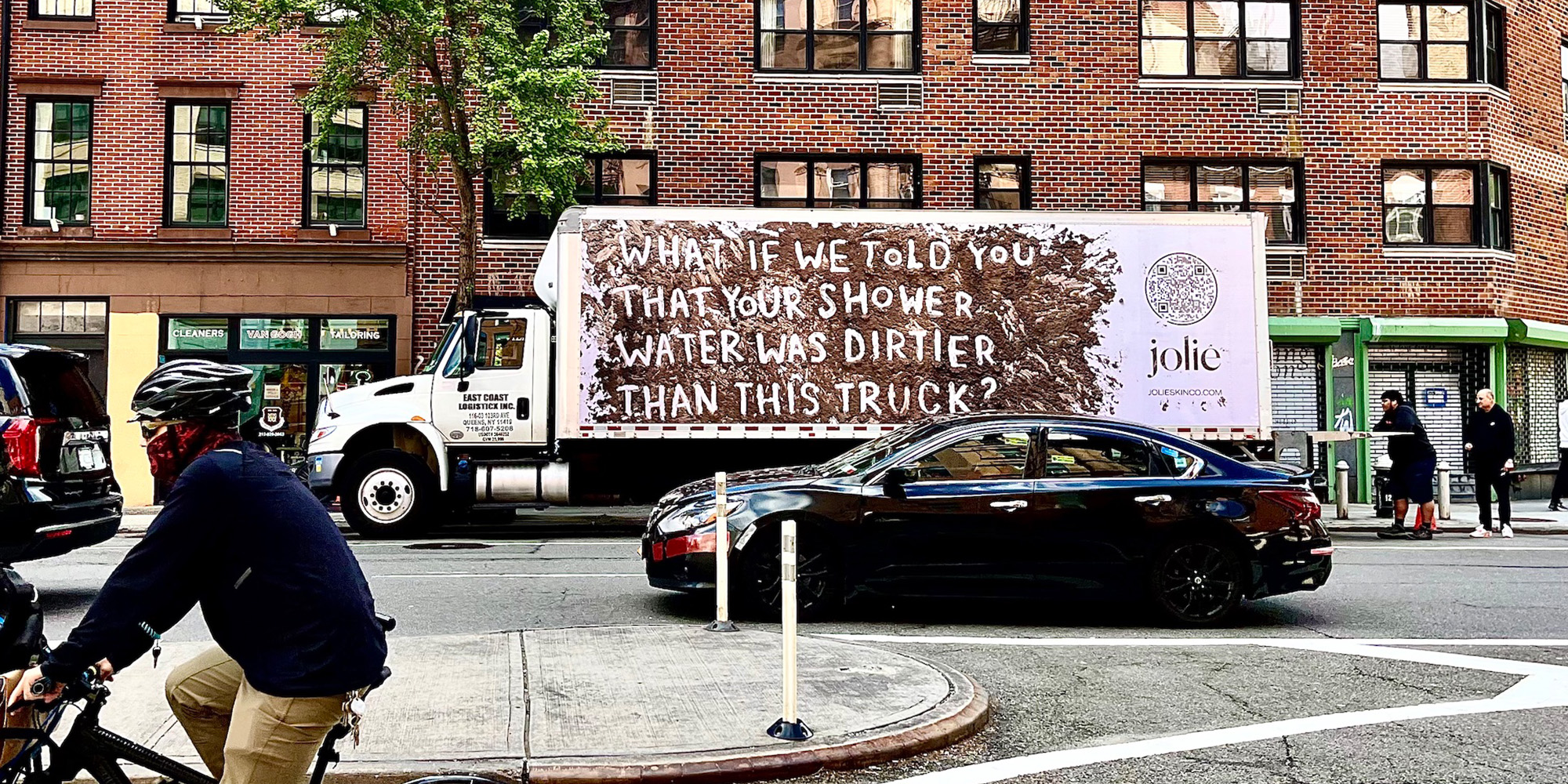
In May, shower head filter brand Jolie asked the question “What if we told you your shower water is dirtier than this truck?” on five trucks that appeared dirty as they toured around New York City. Co-founder Arjan Singh wanted the brand’s first truck campaign to be both visually arresting and thought-provoking. Jolie went with a question as opposed to a statement because he thought the latter would be off-putting. A question sparks conversation, says Singh. Jolie’s truck campaign featured a QR code that has been scanned close to 1,000 times.
It can be hard to measure how effective OOH campaigns are in attracting customers. Bell says Pound Cake’s sales have doubled each week since launching at Ulta, but isn’t sure how much credit is due to the brand’s one truck in New York. Le Mini Macaron registered traffic and sales bumps in Chicago and New York City when the brand deployed truck advertising. “The denser the market, the greater the impressions and returns,” says Kao.
Truck advertising companies like Adgile and Crosswalk install GPS devices in trucks. Coordinates from the devices are sent to third-party measurement and attribution partners every two to five seconds. A geofence is created around trucks to track anonymized cell phone identifications that fall within a radius of the trucks. By monitoring the IDs, companies can detect how many people who may have viewed the trucks visit a brand’s website, and they can be compared to a control group of people who didn’t view the trucks.
Jolie worked with Crosswalk on its campaign, and Hands discloses that, in the first six months of it, the brand’s five trucks generated roughly 25 million impressions or about 700,000 impressions a month per truck. He believes performance is strongest from truck campaigns when the campaigns run for six months or more.
“The customer needs to be seeing that truck like seven, eight, nine, 10 times before they’re going to take action,” says Hands. “I always encourage folks, if you’re going to run a test campaign, you should really try and run it for at least four months so you can really see the impact that that frequency is going to have. The further we get away from the launch date, the more you can start to see the lift coming through on their end. And, from a pricing standpoint, we can always deliver better value if we are going to do a longer duration campaign as well.”
For Jolie’s campaign, Singh is most interested in how many people are talking about the brand. He gets a text at least once a week from someone sharing a photo of the truck. When its trucks were initially deployed, Jolie hosted a giveaway where the first five people who spotted the truck and posted about it on their social media received a free shower head. Winners were selected within an hour.
“It’s difficult to say, OK, we launched five trucks and then we immediately see a lift in sales,” says Singh. “It’s more of a gut feeling of the momentum and conversation that’s created around the truck that has given us the comfort that it’s driving value, and it was very clear pretty quickly that that was the case.”
Wilson stresses the ability to share the creative content of OOH campaigns is vital to those campaigns’ success. BelliWelli selects billboards that are on the street specifically so people can take selfies. Wilson estimates that its billboard campaign has been shared over 1 million times and its truck campaign has been shared a couple of hundred times. Impressions wise, at the end of 10 weeks, the brand saw more than 1 million from the campaign.
“It’s the kind of content that you take a photo of and share with your group chat, and we’ve seen that time and time and time again,” says Wilson. Of truck advertising in particular, she adds, “It’s probably too early to say, but so far it doesn’t feel like there’s that same viral share tendency that there is with the billboard.”
The players
5 mentionedCrown Affair

Better Being
Radius
Tower 28
Glossier