A New Wave Of Brands Is Shaking Up The Wig, Weave And Extension Segment
“We were kind of like the stepchild of the industry for decades, and now we are really becoming a major player in not just the hair extension space, but just in beauty period,” she says. “A lot of times, they like to separate hair extensions from beauty, but it’s like, ‘No, this is a beauty product.’ It’s a hair accessory.”
Most people don’t think Gatlin is crazy anymore. The popularity of wigs, weaves and extensions has soared due in part to their visibility on Black women celebrities, digital advancements and updated products. Globally, data intelligence firm Arizton projects the segment will accelerate at a compound annual growth rate of 13% to reach $13.3 billion in sales by 2024.
Drawn by the segment’s business potential, investors have been turning their attention to it. RadSwan and Waeve have raised $2 million in seed funding each. Upgrade and Rebundle have pulled in $1.7 million and $1.4 million, respectively. These brands and others are propelling the extensions, wigs and weaves market through technology, accessibility and brick-and-mortar expansion.
Digital Advancements
Too much of a good thing can lead to decision paralysis. That’s what Isoken Igbinedion realized a lot of women were experiencing as they shopped for wigs. “There are really up to 12,000 different combinations of wig types that you can end up purchasing, and they all have different implications for how you use it, how durable it is and whether it fits you correctly,” she says. Once customers pick out their goldilocks wigs, they’re faced with the challenge of installing them. They can spend hours on YouTube to learn how installation or wait for a professional service.
Along with three co-founders, Igbinedion developed Hairtelligence, which is currently beta testing and set to go live April 1, to make wig shopping easier by tapping artificial intelligence to create custom-fitted wigs. The technology invites users to take four selfies and, harnessing the selfies, it captures the dimensions of hairlines, head shapes and sizes, and skin tones. Igbinedion says the technology was previously used by the government for search and rescue purposes.
Hairtelligence customers can choose from five human hair styles—blonde body wave, deep wave, body wave, straight and kinky straight—and four lengths. The wigs priced from $545 to $1,125 are ready within seven to 10 business days. Igbinedion says, “You take it out of the box, your hair is prepared, you put it on and you’re ready to go.” For installation, the hair underneath a wig often has to be braided down, and Igbinedion recognizes that not all women know how to do that. Hairtelligence offers step-by-step videos on the process available via a QR code in wig boxes, and virtual consultations are available for customers desiring one-on-one guidance.
Based on the customers that have tested Hairtelligence so far, it’s achieved 90% sizing accuracy and 99% skin-tone matching accuracy. Customers have five days to return wigs. If there are issues, Igbinedion says the company will remake wigs for free. She stresses Hairtelligence aims to deliver stellar customer service. Igbenedion says, “That’s something that’s really missing right now in the industry.”
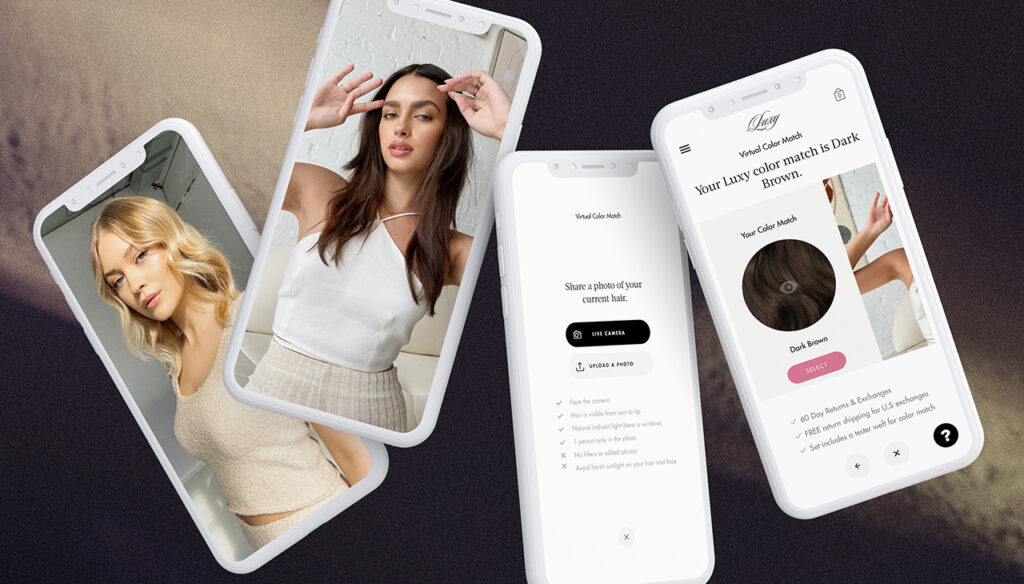
Hair extensions brand Luxy Hair introduced AI technology last October to improve shopping for its 600-plus hair extensions. It partnered with AlgoFace Inc. to launch a proprietary software assisting with hair color matching. Customers can either take a live photo or upload an existing image, and the tool identifies the most accurate shades and offers up products that match. Prior to the AI tool, inaccurate color matching resulted in a lofty level of returns.
“It was one of the biggest complaints and one of the biggest pain points in the shopping experience,” says Amy Sveda, president of Luxy Hair. “AlgoFace helps to reduce the guesswork, simplify the process and lessen the need for high-touch customer service so that people feel like they have a little bit more control and understanding as they navigate the brand.”
Sveda divulges the color-matching tool is about 90% accurate. She anticipates that percentage will jump to 99% as more people use it. Customers who have already used it convert at a greater rate than those who don’t. Next, Luxy Hair is exploring try-ons where customers can virtually view extensions on their heads. Eventually, the tool will recommend color match options and extension types. Sveda says, “The more that we can really make the experience hyper-personalized and build that rapport, the better, and I think some of these tools will allow us to be able to create more loyalty, repeat interactions and trust.”
Convenience and Accessibility
When Gatlin started noticing Latched and Hooked customers were buying the same braiding hair over and over again, a subscription service seemed like an obvious move. “There are all sorts of products that are on autopilot: Deodorant, razors and, when you think about Black women and about how hair is such a pivotal product for us and in heavy rotation in our beauty routines, it felt like a natural thing to do,” she says.
Every month, subscribers to Latched and Hooked’s Build Your Own Braid Box choose a maximum of six non-stretched or pre-stretched braiding hair packs offered in varying colors. The Build Your Own Braid Box allows the brand to get customers what they want, and it helps the brand with forecasting. “It made it easier for us to keep our inventory where it needs to be to satisfy that customer demand,” says Gatlin.
Silk or Lace is another brand applying a model successful in other industries to the weave and wig space. In its case, it’s resell. While wigs, weaves and extensions are most commonly worn by Black women, Suran Yoo found herself exploring them after suffering from hair loss. She started Instagram account The Strandie, where she shared her experiences wearing wigs and cultivated a community. “People are struggling to find a great hairpiece or something that they can feel like themselves and confident in,” says Yoo.
Yoo initially launched Silk or Lace as a marketplace with wig and hairpiece brands. Shortly after its launch, the pandemic erupted. “Supply chain was a hot mess, and brands were really struggling to get inventory in,” recounts Yoo. “As a marketplace, that really hit us because the value that we provide is being able to have inventory to shop.” She recalled her experiences looking for wigs online and says she concluded “every single woman that has bought a hairpiece online has one that didn’t work out for them sitting in their closet, and so I thought we can we build an inventory that way.”
Yoo compares Silk or Lace’s concierge service to The Real Real. Customers submit products through it, and Yoo inspects, styles and posts them. “I’m putting the piece on my head and giving my personal take on each and every one,” she says. “At this point, for resale concierge, we’ve gone through almost 800 pieces, and so we do feel confident in seeing pictures to be able to gauge and have a good sense of the pieces quality.”
Along with the concierge service, Silk or Lace has a DIY component that Yoo likens to Poshmark. DIY customers post pictures and handle their items themselves. They’re required to send pictures of the inside cap, the hairline and the piece on a head or mannequin. Silk or Lace charges a 10% commission fee for new brands on the site. The commission for the resale platform ranges from 15% to 25% percent.
Resale accounts for 60% of Silk or Lace’s revenues. It enables products to be relatively accessible, but Yoo recognizes prices can still be out of range for some. New hairpieces are priced between $700 and $1,000, and new wigs are priced up to $2,000. Resale pieces are generally $400 to $900. Silk or Lace recently launched a line of in-house synthetic wigs as affordable alternatives. They start at $95.
A majority of Silk or Lace’s target customers have hair loss. It’s a group that’s mounting because of stress exacerbated by the pandemic. As people scour the web for biotin products, Yoo hopes they head over to Silk or Lace. “I want to have Silk or Lace be a resource or even just a consideration in their set of solutions,” she says.
Brick-and-Mortar Expansion
With $1,500, Alexandra Cristin, founder and CEO of Glam Seamless, launched one of the first direct-to-consumer hair extension marketplaces in 2012. Five years later, she opened a freestanding salon in New York City and, last year, she opened one in Los Angeles. Salons are places Glam Seamless can gain valuable feedback from customers and, today, they account for 35% of its business.
“After having an online business for six years, we wanted a new marketing channel and new experiential way to connect with the customer,” says Cristin. “Retail is an investment, one that connects you with the customer in the most intimate way.”
Other wig and extension brands have followed suit. Last year, Upgrade Boutique, an online marketplace for custom wigs and extensions, opened a 4,000-square-foot co-working location where stylists can rent space to service clients. The location has a lounge, cafe and wig bar. “We noticed this disconnect between our brand, which is really premium, and where some of the stylists were working,” founder Britney Winters told Beauty Independent in a 2021 interview. “We wanted to create a space that was luxe, that was welcoming and inviting to give the stylist a nice place to work, but also [gives] the customers a full experience that matched their online experience.”
Waeve is branching into brick-and-mortar, too. After hosting a successful pop-up shop in Boston, co-founder Mary Imevbore was inundated with requests for wig installations. The brand offered quick wig installs in the store, but decided to open a separate salon space “where we could provide a true end-to-end experience,” says Imevbore.
The physical space allows Waeve to introduce people to the brand intimately, and it makes wigs less intimidating to beginners. At the space, stylists will cut lace to fit customers’ hairlines and cut or color wigs to their preferences. “We’ve done and are doing a lot to make the online experience seamless, but nothing beats having someone right there with you, installing it for you and able to answer any of your questions,” says Imevbore. “This allows us to appeal to a customer who might need that first IRL touchpoint before feeling confident enough to order from us online.”
Wigs and extensions haven’t made great strides at large retailers to date. Wig and extension brand Mayvenn Hair opened pop-up shops in select Walmart doors in Texas, and extension brand Insert Name Here is stocked at Ulta Beauty, but there’s little representation of wigs and extensions beyond those brands. Gatlin asserts that should change because retailers are leaving money on the table by not bringing in brands like hers. She says, “Customers can’t buy this product and they have to go somewhere else to get it. So, instead of making them buy their shampoo, conditioner, twisting butter and flat irons from one place and then travel across the way to a beauty supply store to have an unpleasant shopping experience, why not give us some shelf space?”
The players
5 mentionedAS Beauty

Better Being
Under Your Skin
Rebundle
Too Faced