Beauty's New Value Equation: Price Sensitivity Shifts To Performance Sensitivity
According to market research firm Circana, prestige beauty sales rose 4% to $36 billion in 2025, and mass beauty sales increased 5% to $72.7 billion, with dollar and unit growth tracking closely in both segments for the first time in years. Unit sales rose 3% in prestige and 2% in mass, indicating steady demand throughout price tiers.
“We have got a consumer that is leaning into value from the perspective of cost, which is what most people think of when they think value, but they also think of value in other ways, finding value through different sizes and longer-lasting products,” says Larissa Jensen, SVP and global beauty industry advisor at Circana. “There’s an evolution in how consumers are approaching value, and it’s really giving a lift to both sides of the market.”
Similar to Circana, market research firm NielsenIQ’s read on the beauty market affirms resilience. Over the 52 weeks ended Dec. 27, the firm estimates beauty sales climbed 11.4% in value and 8% in units to $123.6 billion, with price per unit rising 3%, revealing consumers’ appetite for spending on beauty products amid persistent inflation and mixed sentiment about the broader economy.
NIQ’s channel data illustrates how consumers are recalibrating value rather than retreating from beauty spending altogether. Beauty sales in mass retail were up 2.5%, and beauty specialty retailers advanced 5.2%, suggesting shoppers are selectively trading up even as they moderate everyday spending. Amazon was the largest retail player in beauty, capturing 23.4% of sales and accelerating 23%, and TikTok Shop’s beauty sales surged more than 100% as shoppers were primed by convenience, discovery and social influence.
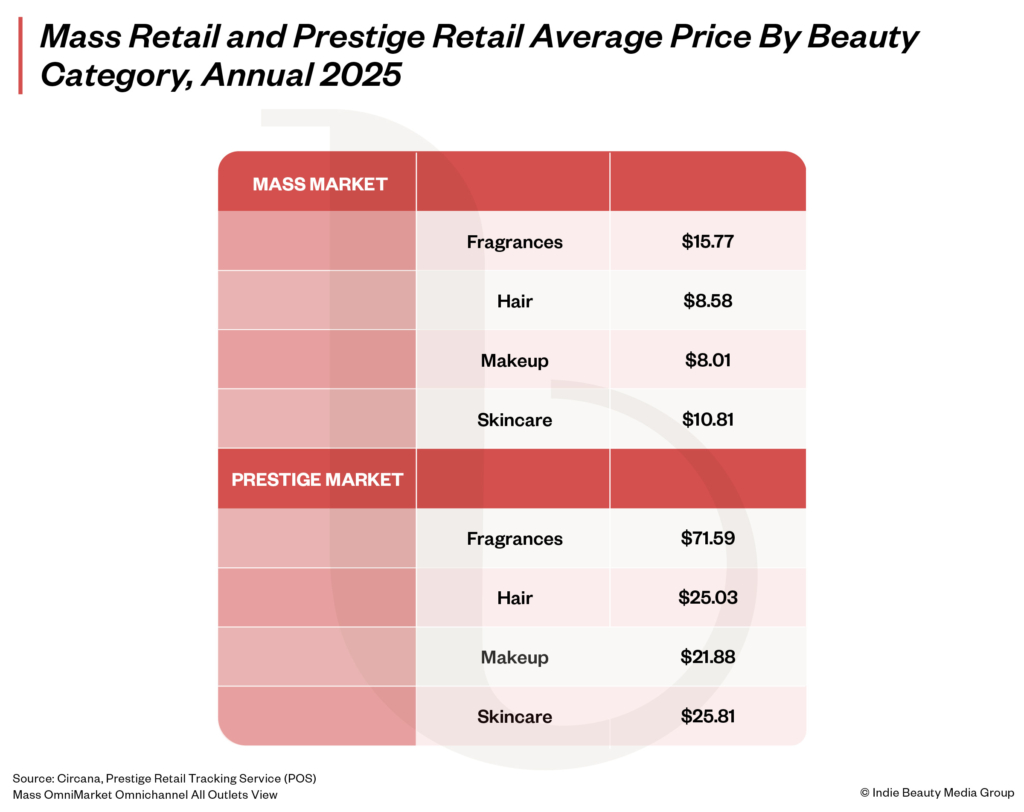
Circana’s data shows that pricing trends aren’t uniform across beauty categories, illustrating how consumers are reconceptualizing value rather than simply spending less. Jensen highlights premiumization continuing in fragrance, haircare and makeup, where higher average prices convey luxury positioning, professional expertise and elevated product experiences. The prices of prestige fragrances averaged $71.59 in 2025 compared to $15.77 for mass fragrances, underscoring consumers’ willingness to pay for concentration, experience and brand equity.
Skincare, however, is moving differently. Although prestige skincare still commands a higher average price at $25.81 versus $10.81 in mass, overall category pricing has softened as shoppers increasingly choose lower-priced products they still perceive as effective, a shift driven by assortment mix rather than widespread discounting.
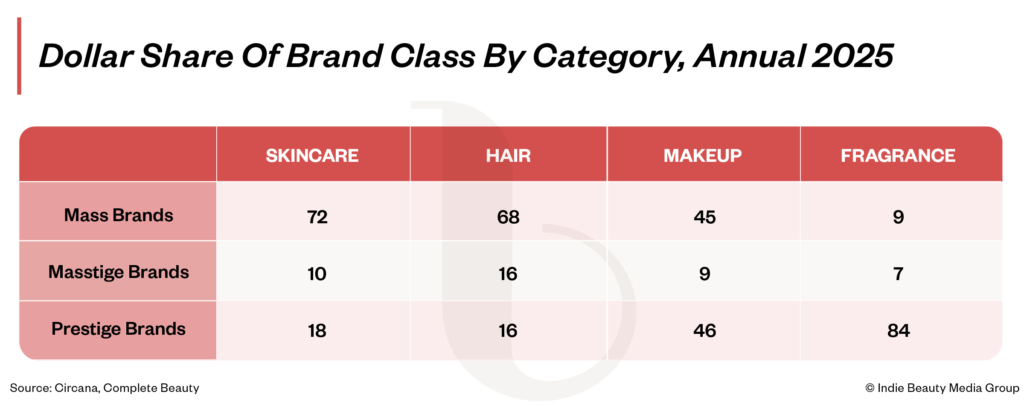
Skincare is heavily mass-dominated, with mass brands accounting for roughly 72% of skincare dollar share, compared to 18% for prestige and 10% for masstige. In haircare, mass brands account for 68% of dollar share; in makeup, 45%; and in fragrance, just 9%, where prestige brands are clear leaders. Skincare growth is accelerating in masstige at the premium end of mass and the value tier within prestige, reinforcing the idea that shoppers are seeking efficacy at more accessible price points.
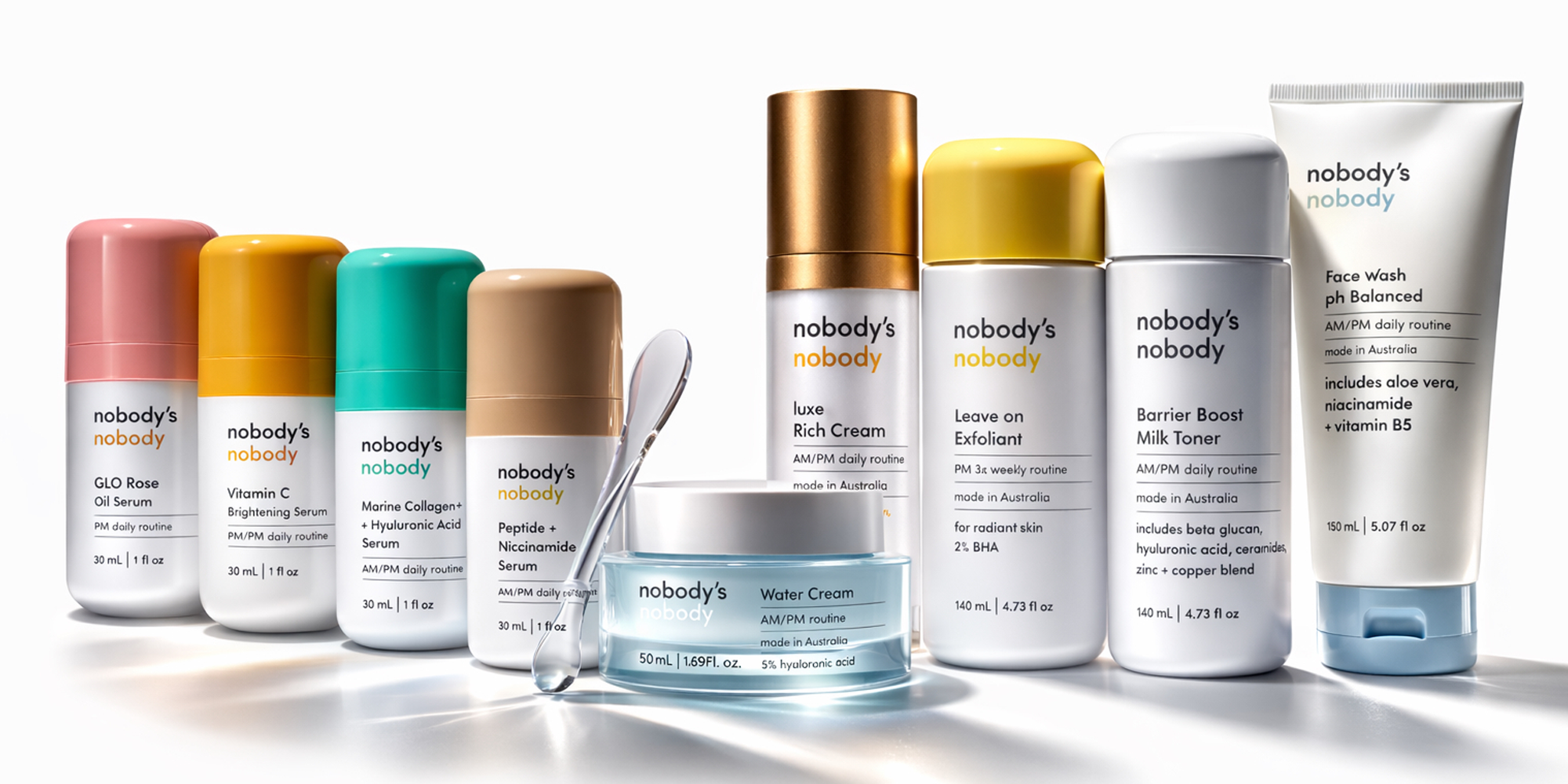
Retailers are leaning into that dynamic, with Target recently onboarding brands such as Minimalist, Nobody’s Nobody and GoPure in the category. Consumers are gravitating toward targeted treatments and anti-aging products, including wrinkle-focused serums that promise measurable results.
“The movement toward more targeted treatments in skincare makes sense when you think of the ‘skinification’ of everything,” says Jensen. “With skincare ingredients in everything now, whether it’s fragrance, haircare with scalp care, in that regard, we have seen how skincare has moved toward more specific types of products.”
Masstige skincare’s consumer resonance reflects a belief that price no longer equates to effectiveness. In a recent Circana survey, only 14% of consumers said higher prices always indicate better quality when purchasing beauty products, while 58% said it depends, implying price isn’t a default proxy for product performance. Consumers are weighing ingredients, benefits and brand credibility alongside price in a nuanced decision-making process that allows them to trade up in some categories and down in others without determining they’re sacrificing quality.
The sharper perception of value is happening against a backdrop of elevated prices overall. The Consumer Price Index, the measure of average price change over time, rose 2.4% year-over-year in January, and many Americans worry about high prices eroding their personal finances. In that context, discretionary spending on beauty products is under a more intense microscope.
Of course, personal spending scrutiny isn’t equal across income levels. NIQ data shows high-income shoppers are responsible for most of beauty’s growth and make up roughly half of category sales. Lower-income consumers are cutting back on store trips and switching to online shopping. Circana’s data paints a more distributed story. “Basically, all income cohorts are contributing an equal amount to [beauty industry] growth,” Jensen told Business of Fashion in January.
The spending calculus varies considerably by category. If skincare is democratizing efficacy, the patterns in fragrance demonstrate how premium attributes can themselves become a form of value. Jensen spotlights luxury signifiers such as the look, feel and scent profile of fragrances as important in both prestige and mass, where dupe-inspired brands such as Dossier and Fine’ry are drawing from consumers’ high-end tastes despite limited budgets. Luxury minis are doing particularly well, as are body sprays, which provide a lower-cost entry point into fragrance without undercutting brand cachet.
Jensen adds that product longevity has become a key marker of value. Long-lasting fragrances are highly sought-after, with products at higher concentration levels that require fewer applications particularly prized by consumers. “There’s value because it lasts,” says Jensen. “If there’s a product that actually does what it promises in terms of being long-lasting, whether it’s with makeup, hair or fragrance benefits, then it works, and it is something that consumers are coming back to.”
In makeup, multifunctionality has emerged as a crucial value theme. Hybrid formats blending color and skincare benefits such as tinted moisturizers with sun protection or lip treatments infused with skincare ingredients are strong sales drivers. Brands are pushing multifunctionality further through dual-sided products and clinical claims tied to skin improvement. The appeal is straightforward: a product that delivers coverage, protection and treatment reduces the need for multiple purchases.
In a LinkedIn post, Jensen writes, “Innovation remains the engine. Formats that blur categories and elevate routine moments will win attention and loyalty.”
Although mass brands are responsible for the majority of dollar share in haircare, prestige haircare is outperforming in growth, fueled by salon-backed and expert-led brands. In a category closely tied to professional authority and problem-solving, consumers appear more open to trade up. Interest in scalp care and treatment products aligns with a desire for results-oriented formulations and perceived expertise.
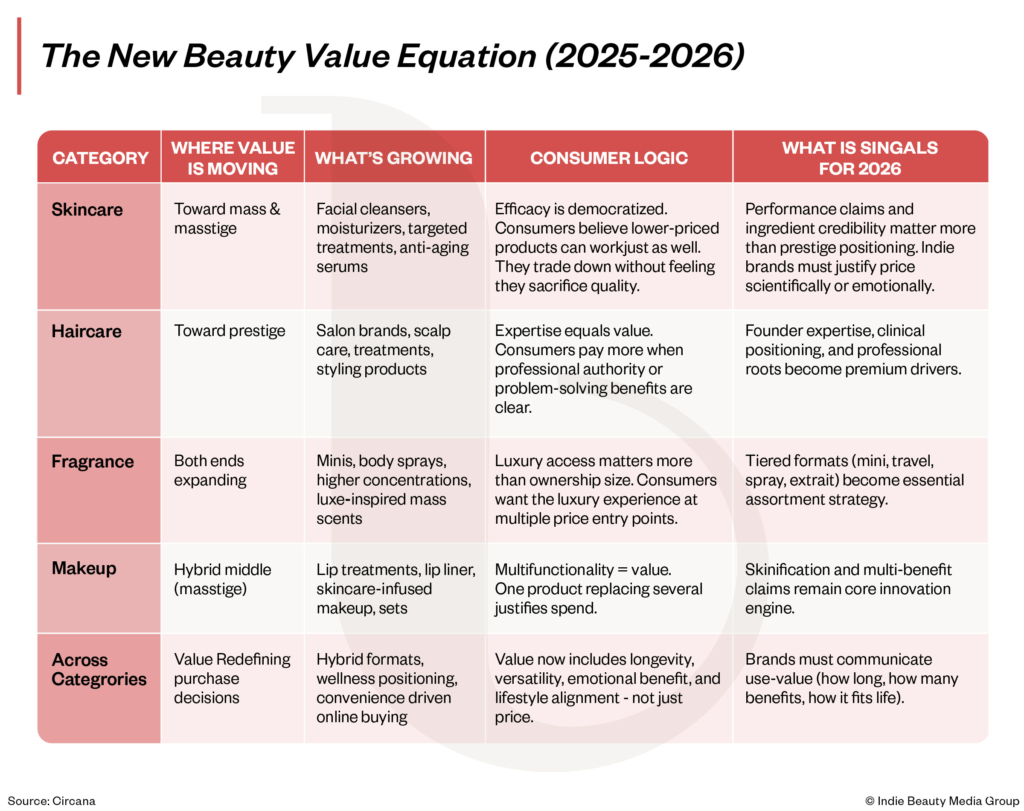
Taken together, the category shifts show that there’s no definitive mass-versus-prestige divide in consumers’ evaluation of beauty purchases. Instead, consumers are assembling routines across the pricing spectrum, prioritizing performance, emotional payoff and versatility, allowing value and premiumization to expand simultaneously.
“Accessible indulgences for the win,” writes Jensen on LinkedIn. “Both value and premiumization are rising in tandem, driving brands to deliver premium-feeling benefits at every price point.”