Beauty Formula Pricing Still Runs On Excel. Sleek Flow Labs Wants To Change That
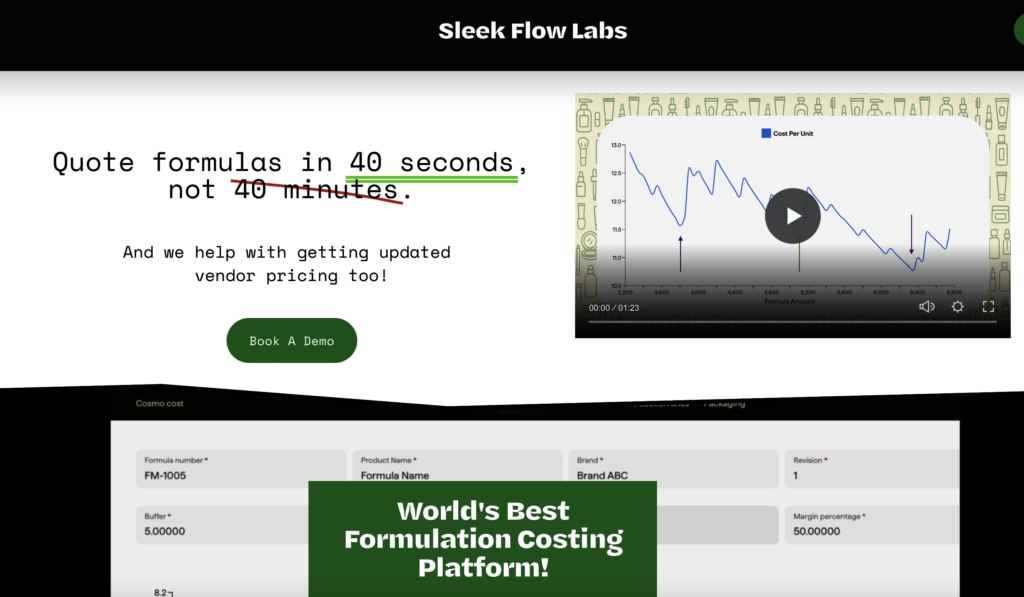
Sleek Flow Labs, a startup launched last year by Paul Ginzburg, former VP of operations at Good Face Project, aims to modernize that process with cloud-based software that automatically calculates quotes based on a variety of inputs such as raw material, packaging, labor and overhead costs. The software promises to deliver faster, more accurate quotes and reduce a process that often takes days down to seconds.
“I had someone tell me, ‘I love Excel, but you shouldn’t run business in Excel,’ and I was like, ‘Thank you. This is what I’m excited about,’” says Ginzburg. “When we quote formulas, we take all the raw materials, we look across price breaks, lead times, pack sizes, excess liability, packaging, labor, overhead and do a full evaluation across multiple vendors. We understand if something is unique to a customer. We take the assessment out of Excel into a platform.”
He argues the reliance on old-school spreadsheets isn’t just cumbersome; it’s costly. Prior to implementing Sleek Flow Labs’ software, Samantha Burd, co-owner of Lady Burd, estimates quoting errors cost her private-label cosmetics manufacturing company more than $150,000 last year alone due to missed bill-of-materials items and human error.
Tom Raffy, president of private-label haircare and skincare manufacturer GAR Labs, recounts, “About 10-plus years ago, I was quickly pricing one of our largest customers, and I made what I thought was a simple copy-and-paste error, but that mistake ended up costing us $400,000 before it was caught many months later. I have to tell that copy-and-paste error nearly sank the company. That’s when we realized how critical a mistake-proof pricing program must be. Back then, we were forced to invest heavily in building our own pricing program because nothing existed at the time, but finally Sleek Flow Labs is now delivering a well-thought-out mistake-proof pricing program, making it now hard to imagine trying to run a business without a program like this.”
GAR Labs and Lady Burd’s experiences aren’t isolated. “I hear horror stories all the time. People say, ‘I was on my fourth production run doing a hundred thousand units, and we were losing money and didn’t know,’” says Ginzburg. “I had one company tell me they were at risk of going under because they signed a giant in the industry and promised a price contractually, and it took an accountant close to nine months to call and say, ‘We are bleeding money and don’t know why,’ and then they figured out they just misquoted because of a typo in Excel.”
Sleek Flow Labs has more than 30 clients, and companies tapping its software in addition to Lady Burd and GAR Labs include Product Society, Trademark Cosmetics and Salvona. The software is sold as a SaaS platform with subscription pricing based on company size and quoting volume. Access is generally priced below $10,000 per year.
Although SaaS providers have recently faced pressure as generative artificial intelligence makes it easier for companies to construct bespoke internal tools, beauty manufacturers don’t appear inclined to erect their own formula-costing systems, having primarily relied on spreadsheets to date. In a frequently overlooked cost driver, Sleek Flow Labs is helping them better manage excess raw materials, which can quietly chip away at margins when unused ingredients are left over from production runs. Ginzburg notes that contract manufacturers typically operate at margins of 20% to 50% on the formula itself.
“What they’re doing today is seeing a line item for formula excess, and if it’s high, they’ll put it on the invoice and require a down payment on that material that will be applied toward future credit. That way they’re not sitting on the liability,” he explains. “I had someone come to me with over $1 million in excess liability because a customer walked away. Now, it’s a legal battle and a relationship issue.”
At most manufacturers, Ginzburg finds that there isn’t a dedicated person handling formula costing. If employees happen to be skilled at it, their talents tend to be deployed elsewhere. Still, Ginzburg emphasizes Sleek Flow Labs’ goal isn’t to replace the people responsible for sourcing and formulation decisions, but to give them better tools. The software handles the calculations while employees can focus on vetting vendors, ingredients and production strategies.
At Good Face Project, a formulation, regulation and innovation platform that’s raised about $8 million in capital, Ginzburg, who has a mechanical engineering background, was active in fundraising. In his new venture, he’s stayed away from institutional investors so far, but is fielding interest from angels. Funding the business hasn’t been an issue as Sleek Flow Labs had clients signed up pre-launch to instigate cash flow.
Ginzburg believes Sleek Flow Labs’ capabilities can expand in several directions to grow its business and those of its clients. At the moment, it’s engaged in special projects with select clients to explore those opportunities. One area of development is creating dashboards that give manufacturers a real-time view of their business.
“We’ve set up dashboards for customers who just want to know the health and the pulse of their business,” says Ginzburg. “To run a report like this would be very time-consuming, so they might do it once a quarter during financial reviews. Now they can look at it live and see how specific products or categories are performing.”