8 AI-Powered Startups Helping Beauty Brands Cut Costs And Grow Smarter
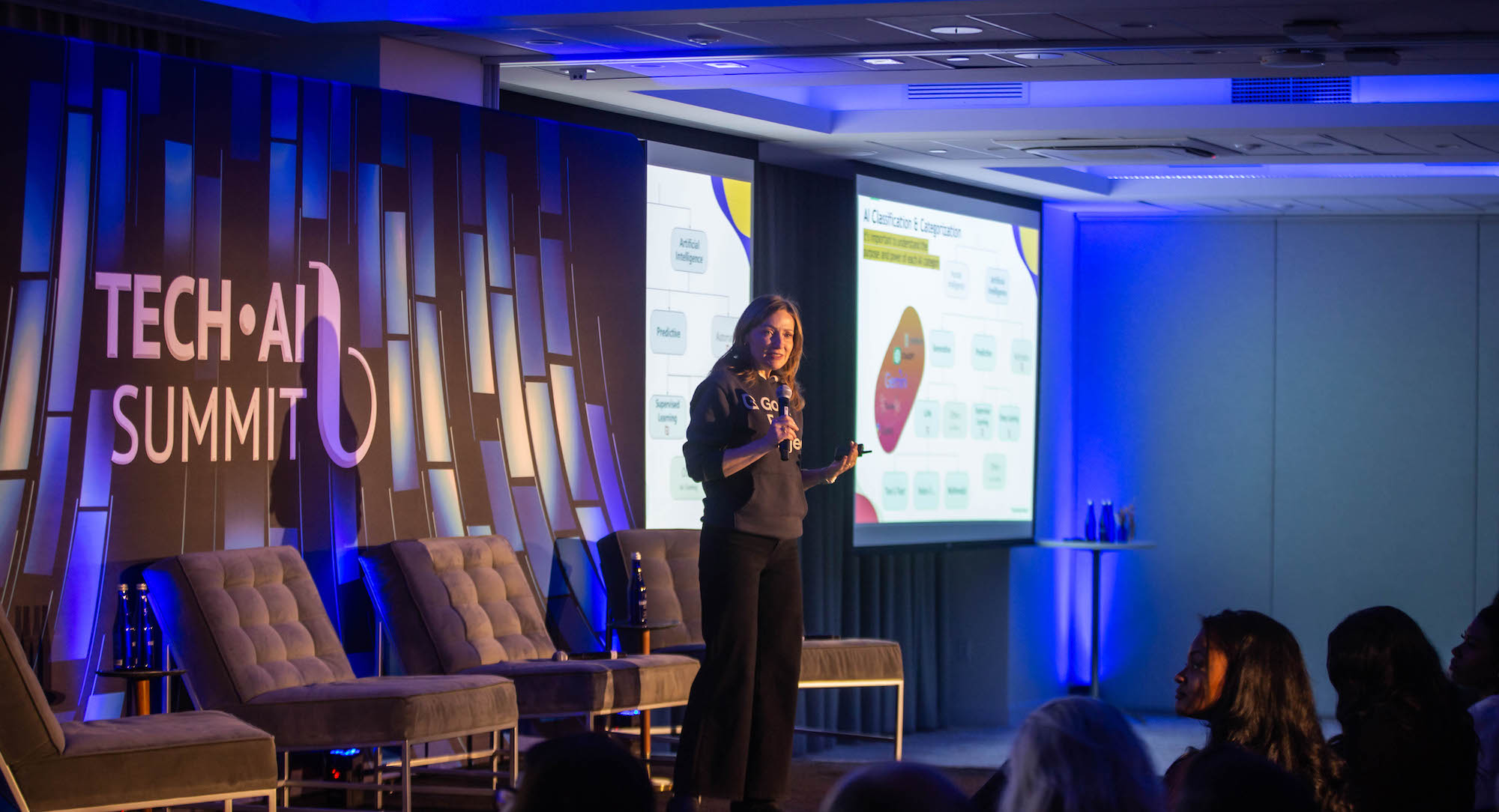
“What we can do today with AI is mind-blowing,” declared serial entrepreneur Divya Gugnani, founder of 5 Sens, co-founder of Wander Beauty and founder of investment firm Concept To Co, on stage last Monday at Beauty Independent’s Tech*AI Summit in New York City. “People are the No. 1 asset of any company. That is my genuine belief, but AI tools amplify those people in ways that are unimaginable and create areas of growth and opportunity for them.”
Tech*AI Summit featured panel discussions with beauty, wellness and personal care participants like Gugnani, DIBS Beauty CEO Jeff Lee, Glamnetic co-founder Kevin Gould and Geltor co-founder and CEO Alex Lorestani discussing how they leverage AI to improve marketing, ingredient and product innovation and more. Throughout the one-day event, there were also sponsored presentations from AI-driven professional services companies.
Spanning the entire beauty value chain, including finance, operations, content creation, retail management and ingredient intelligence, these startups, often backed by a cadre of impressive venture funds, are laying the AI foundation for companies such as L’Oréal, Rhode, Kin Euphorics and Cos Bar. We’ve highlighted eight below.
Sales and Marketing
Nines
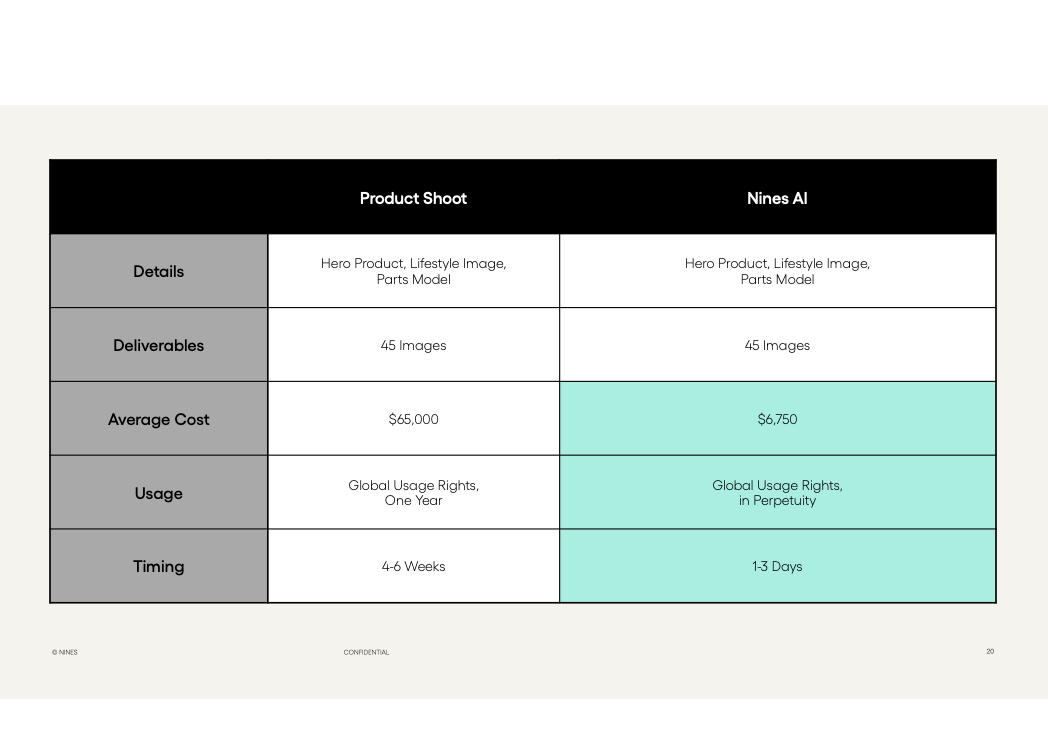
How do you reduce the cost of producing high-quality creative from $65,000 to $6,750? Nines AI.
Quynh Mai, founder of global creative agency Qulture, partnered with Nines founder and CEO Mindy Budgor to build Nines into a brand-trained AI content and commerce platform for fashion and beauty companies. After creating high-end visual work for world-class brands such as Ralph Lauren and Prada at premium price points, Mai knew there had to be a more efficient way to deliver the same level of quality and consistency across a brand’s universe.
In 2025, she set out to create a platform that could generate content faster and more cost-effectively without compromising creative standards. “I wanted my cake, I wanted to eat it too, and I wanted to lose weight at the same time,” Mai joked during her presentation at Tech*AI Summit.
Initially, she assumed the solution would be straightforward, given the explosion of AI-powered content creation tools on the market. But after demoing dozens of platforms, she found that most offerings fell short of her vision.
Nines begins with human-led creative direction, which is used to train the platform’s AI to develop a bespoke “AI brain” for each brand. “We teach it what it is about your brand that makes it specific,” says Mai. “What’s your artistry? What’s the skin tone? What’s the model look? What’s the background? What’s the lighting? So that it can actually create your look at scale.”
The result is AI-generated imagery that can be deployed across marketing, e-commerce and clienteling channels and produced faster at a fraction of the usual cost.
Statusphere
Content creator turned entrepreneur Kristen Wiley founded Statusphere to help brands scale microinfluencer marketing. The content creation landscape is largely unrecognizable from when Wiley launched her blog in 2010, and she has had a front-row seat to the evolution of what has become a critical marketing function.
According to Wiley, Statusphere is the only platform capable of getting more than 1,000 people posting about a brand or product with less than an hour of setup. The company does not create AI-generated content. Instead, it uses AI to automate large-scale creator programs, including influencer recruiting and vetting, contracting, payments, compliance, tracking and rights management.
In 2026, Wiley is particularly bullish on human-generated content, with the challenge being how to distribute that content to as many people as possible. Statusphere’s platform is designed to do exactly that.
During her presentation at Tech*AI Summit, Wiley shared a case study involving a global cosmetics brand that partnered with Statusphere for a recent product launch. As part of the campaign, the brand increased product-related searches on TikTok by more than 117% by activating 750 creators using targeted keyword strategies. The brand also saw a 70% increase in Google search interest for the product.
The launch ultimately sold out and became the brand’s top-performing product debut of the year. Wiley closed her presentation by saying, “It’s time we start thinking about the creator’s journey differently and the creator’s role in social SEO and GEO differently, because you can really leverage them to make a real impact.”
Inference Beauty
Plug-and-play e-commerce software Inference Beauty uses AI to help consumer brands and retailers elevate shoppers’ online experience with services that fall under three pillars—personalization, discovery and transparency—to shore up bottom lines. Skindays harnessed Inference’s personalization features and saw its email signups jump 12%, giving the British retailer invaluable first-party data. Inference also reports that its customers register 30% increases in conversion rates and basket value per order from its tools.
Inference founder Estella Benz highlights that Net-a-Porter has experienced a 700% spike in ingredient-forward search since 2020. She details that product return rates drop 20% when Inference’s customers incorporate its ingredient transparency technology.
“People are no longer buying products and brands,” said Benz at the Tech*AI Summit. “They’re buying ingredient-forward products that go into their routine. They’re educated. So, step up the game in transparency. Explain ingredients and really show [consumers] all the information they need to buy a product.”
Swan Beauty
What if the mirror you used while trying beauty products in store could give you product recommendations perfectly picked for your unique needs? Swan Beauty’s new AI-powered smart mirror is doing just that. The $795 mirror, primarily a consumer product but being used by retailers like Cos Bar, is equipped with an AI skin analyzer that tracks seven concerns over time, including wrinkles, pigmentation, texture and acne. It also offers a skincare routine builder and a makeup guide that uses AR face mapping to help even a color cosmetics neophyte with precise application.
Business Operations
Glimpse
CEO Akash Raju, who founded retail deduction management service Glimpse with Anuj Mehta and Kushal Negi, kicked off his Tech*AI Summit presentation with an alarming stat: Invalid chargebacks can account for 1% to 1.5% of a consumer packaged goods brand’s net revenue. Glimpse uses AI to automate deduction tracking, dispute resolution and reconciliation to recover lost revenue and reduce administrative work.
Glimpse reports its service results in an 80% reduction in labor hours associated with deductions management and 16X to 21X projected return on investment for its customers. The company closed an oversubscribed $10 million series A funding round last year led by 8VC, with participation from existing investors YCombinator and Origin Ventures, among others.
Drivepoint
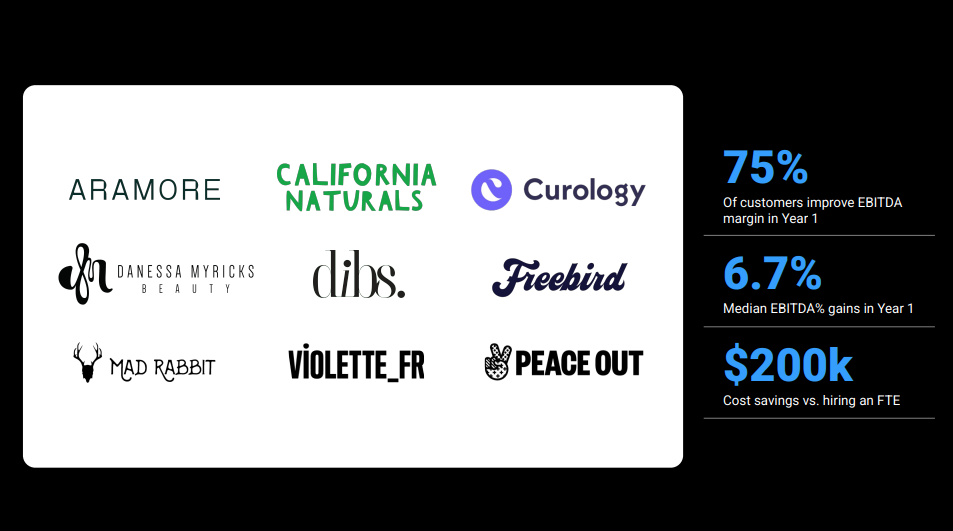
Drivepoint focuses on financial modeling, forecasting and scenario planning for consumer brands in the $10 million to $100 million range. A number of its customers were represented on the Tech*AI Summit stage, including DIBS and Geologie. Geologie co-founder Dave Skaff shared that the men’s brand was one of Drivepoint’s first customers and the platform was integral to making sense of Geologie’s complicated business model. Lee mentioned that Drivepoint assisted DIBS in reworking its supply chain after President Donald Trump’s tariff hikes, saving the makeup brand $3.9 million in tariff charges in a year.
Drivepoint also works with the brands Salt & Stone, Mad Rabbit and Violette_FR. It’s raised $15 million in funding over several rounds, including a $7 million series A late last year led by technology-focused venture capital firm Vocap Partners.
Cin7
Cin7 provides cloud-based inventory and order management solutions for end-to-end inventory and order management to streamline supply chain operations across retail, wholesale and e-commerce channels. The global software company works with over 8,500 businesses worldwide, including The Lip Bar and Sagely Naturals. Cin7 is backed by software-focused private equity firm Rubicon Technology Partners.
Product Innovation and Regulatory Compliance
The Good Face Project
AI-powered product development and regulatory hub The Good Face Project’s list of beauty brand customers includes top names like Summer Fridays, E.l.f. Beauty, Laura Mercier, Byoma, Medik8 and Nutrafol. Using the startup’s internal chatbot Chemical AI Research Assistant, which it calls CARA, brands can identify different ways to formulate a product, screen a formula for 113 ingredient standards in less than four seconds and identify chemicals with increased risk through predictive technology.
CEO Iva Teixeira explains, “Brand teams embed all stages of the innovation cycle in an intuitive interface that enables real-time formula and product portfolio analysis.”
The Good Face Project, which raised $5.65 million in funding in 2022, including from VMG Partners’ venture capital arm VMG Catalyst, enables brands to stay ahead of relevant regulatory developments. For instance, in the United States, the signing of the Modernization of Cosmetics Regulation Act (MoCRA) ushered in a new framework for how brands must document, disclose and defend cosmetics product safety in the country.