American beauty shoppers have spoken: They want K-beauty. The question that isn’t settled is where they want to buy it.
CJ Group-owned Olive Young, South Korea’s dominant beauty retailer with 1,380 stores and $4.2 billion in sales, has arrived in the United States as K-Beauty experiences an unprecedented run in the country. The segment is growing faster than much of the beauty industry, introducing consumers to formerly unfamiliar ingredients like PDRN and spicules, expanding beyond skincare into adjacent categories and forcing retailers into a high-stakes battle for K-Beauty dollars.
Market research firm NielsenIQ estimates K-Beauty sales in the U.S. reached $2.4 billion in the 52 weeks ended Jan. 24, 2026, up 46.7% year over year. By comparison, the broader beauty industry largely posted single-digit growth. K-Beauty consumers are a particularly affluent, engaged and diverse group, spending an average of $1,234 annually on beauty and personal care products, $280 more than the average buyer, according to NIQ.
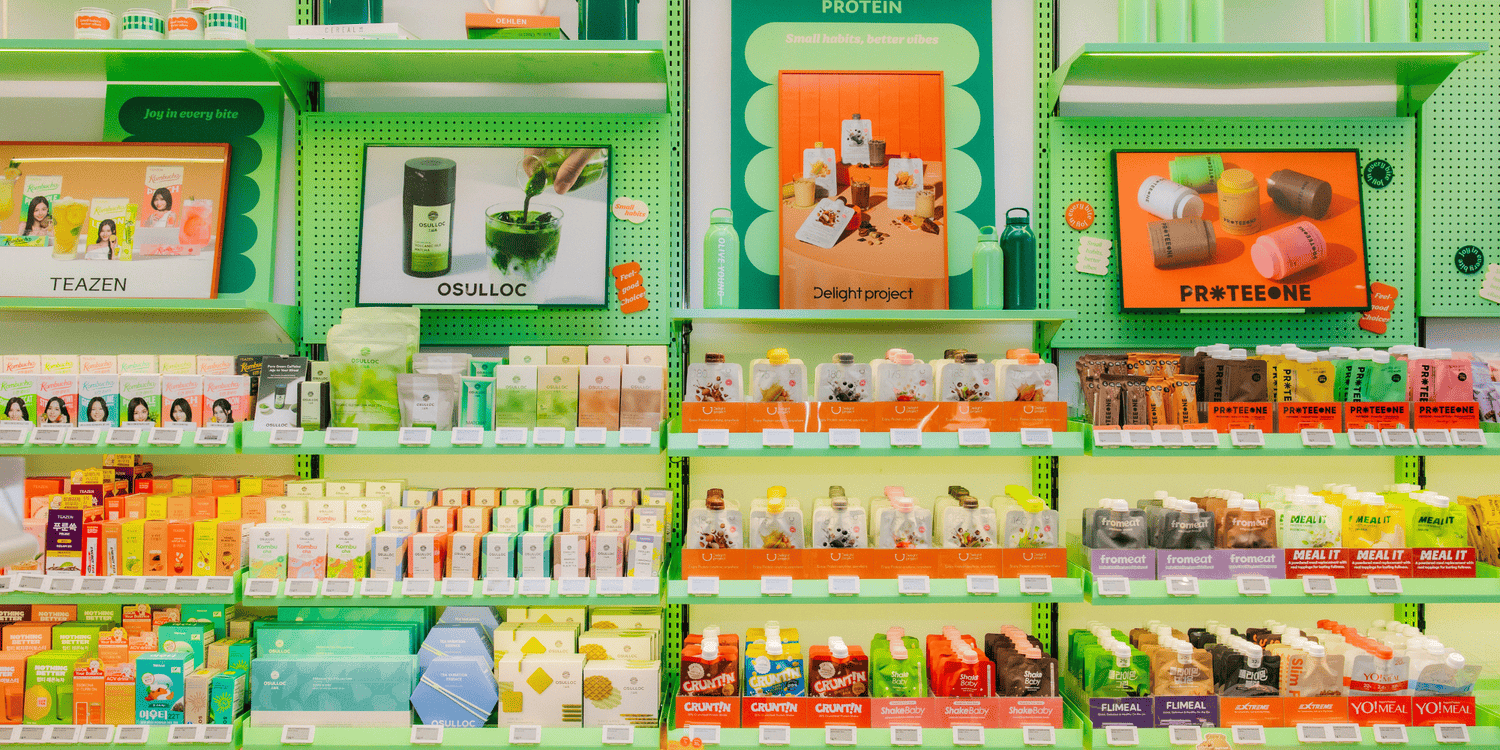
Women’s Wear Daily reported that 6,000 people flocked to the 8,647-square-foot store between Friday and Saturday, with some camping out overnight to get a glimpse of its 5,000 products from 400 brands. Olive Young plans to refresh merchandise every two to three weeks, a pace far faster than most U.S. beauty retailers. The chain hopes to replicate that excitement as it plants at least five new locations in the U.S. over the next year.
But Olive Young isn’t entering untouched territory. Long before its U.S. retail premiere, Sephora, Ulta Beauty, Target, Walmart, a growing group of K-Beauty specialists such as Sukoshi Mart, which plans to open roughly 40 stores in the U.S. this year, and others rushed to expand their K-Beauty assortments and establish themselves as destinations for K-Beauty brands. Now, the battle is shifting from carrying K-Beauty to owning it.
Alexzndra Sylvia, beauty and wellness partner at Mercenary Beauty and former head of beauty at Urban Outfitters, says, “Everyone’s going to feel a crunch now.” She adds, “The whole ‘TikTok blows up, you buy it on Amazon’ dynamic may shift to TikTok, then Olive Young and then Sephora, Ulta and Target curate from the Olive Young bestsellers.”
Who Will Own K-Beauty Retail?
K-Beauty shoppers are certainly buying on Amazon. According to market research and data analytics firm YipitData, Amazon accounts for 53% of the segment’s sales this year, up from 45% in 2024. Beauty e-commerce agency Navigo finds that Medicube rules beauty sales on the platform, driving 14.1% of sales across the entire beauty and personal care category. Last year, beauty sales on Amazon increased 19% to reach $34.5 billion, according to marketplace agency Front Row. Biodance, Cosrx, Laneige and Anua are additional K-Beauty drivers on Amazon.
TikTok Shop is gaining ground. By March 2026, it and Ulta each accounted for 11% of U.S. K-Beauty sales, surpassing Sephora’s 8% share, according to YipitData. Data from the government of South Korea shows the U.S. as the country’s top cosmetics export market in the first quarter of the year, with exports rising 19% from the previous year to reach a record $3.1 billion.
Dr. Melaxin and Medicube were the top two performing beauty brands on TikTok Shop during the first quarter of the year, racking up $46.3 million and $44.3 million in sales, respectively. According to TikTok, K-Beauty outpaced TikTok Shop’s growth between January and early November last year, with K-beauty experiencing 132% yearly sales growth to TikTok’s 120%.
Despite the powerful influence of digital platforms, industry experts contend the more interesting battle for K-Beauty is unfolding in physical retail, where retailers are competing to become the leading discovery destination for the next generation of Korean brands. Andrew Ross, senior advisor and venture partner at investment firm XRC Ventures, argues that the retailers best at picking viral brands that stand the test of time will have a leg up.
He says, “The winner is likely the one that plays the ‘Uno reverse’ tactic on Amazon and TikTok Shop the best, using them as a signal to identify which products or brands have legs beyond a single trial dopamine hit and which the broader population might want to try in person.”
Tina Bou-Saba, beauty and wellness investor and founder of CXT Investments, thinks Olive Young’s U.S. debut doesn’t guarantee it will emerge as the K-Beauty retail champion. “We don’t know how Olive Young will actually do executing in the U.S. market,” she says. “We know that there is demand. I have no doubt that their early stores will have the proverbial lines out the door…but there are many cases of this not working because execution is harder than telling a story, but I feel like, to some extent, it’s kind of like theirs to lose.”
Bou-Saba points to Ulta’s broad pricing architecture as a key advantage. “K-Beauty sits between drugstore and specialty,” she says. “Ulta’s business model has always been predicated on a broader mix of price points, so K-beauty is less tricky for them.”
Lane Barrocas, a beauty retail consultant, agrees that Ulta has a current K-Beauty advantage, although it could be temporary. “K‑Beauty in the U.S. is overwhelmingly mass-tier, TikTok‑driven and replenishment‑heavy, and Ulta is the only national retailer structurally aligned with that model,” he says. “Olive Young’s…scale, speed and assortment strategy will determine how quickly the landscape shifts over the next three to five years though.”
As a prestige beauty retailer, Sephora has a complicated balancing act. South Korean beauty products are generally lower priced, making them a less natural fit within the retailer’s prestige framework. That explains why Sephora surprised many in the industry earlier this year when it announced a partnership with Olive Young that’s set to bring curated K-Beauty assortments to 600 of its stores beginning this fall.
“It doesn’t make a lot of sense to me why their No. 1 competitor internationally is now curating for them in their store,” says Sylvia. Bou-Saba says, “If Olive Young executes well in the U.S., Sephora is effectively putting its stamp of approval on Olive Young. They’re telling millions of beauty shoppers that Olive Young is good.”
Sylvia maintains that discovery-oriented retailers like Urban Outfitters, Anthropologie and Revolve have historically been a few of the sharpest curators of emerging K-Beauty brands because their merchandising approaches prioritize novelty, trends and brand incubation. Those retailers are especially vulnerable if Olive Young successfully scales up its U.S. business.
Difference
Olive Young gives American beauty shoppers plenty to be curious about. Unlike formats customary in American beauty stores, it organizes much of its assortment around consumer concerns, routines and trends like barrier repair, cooling skincare or inner beauty rather than brands.
“Olive Young is less about being a traditional beauty retailer and more about discovery,” says Priscilla Myungji Kang, merchandising team lead for Olive Young. “The focus of our store is to make discovering new products and building beauty routines easy and approachable.”
K-Beauty mainstays like Medicube, Dr. Althea, Biodance, Anua and Mediheal are available in Olive Young’s Pasadena store. They’re mixed in with a small assortment of known Western brands like CeraVe, Kiehl’s, Lancôme, La Roche-Posay, Sol de Janeiro, Supergoop, The Ordinary, Touchland and Urban Decay as the retailer positions itself as a broader discovery platform that extends beyond K-Beauty.
“Olive Young’s strength has never been limited to incubating and introducing K-Beauty brands,” says Kang. “In Korea, we have also built strong expertise in curating globally popular brands including those from the U.S. and other international markets for Korean consumers.”
David Klar, CEO of Klar & Co., a company that’s developed K-Beauty products for U.S. retailers, believes that Olive Young will resonate with American K-beauty enthusiasts, but it will take time and substantial investment into a bigger fleet of stores before it poses a significant threat to retailers like Sephora and Ulta.
“Independent brick-and-mortar at scale in the U.S. is a long game, and one that even well-capitalized retailers have struggled with,” he says. “We’ve heard directly from Korean vendors that the internal Olive Young team initially wanted to launch in Asian markets first, which tells you something about how they view the U.S. complexity.”
Kang acknowledges that the U.S. presents a fundamentally different consumer landscape than Olive Young is used to. However, she sees a common thread between the markets: discovery-driven shopping fueled by social media, creator content and online communities.
Kang says, “Our focus will be on leveraging consumer data from our platforms to stay in sync with evolving local trends, ensuring we continue to introduce meaningful selections that resonate directly with American shoppers.”
But the challenges don’t stop at the market landscape. Supply chain and vendor issues are another hurdle. “To get into Olive Young in Korea, brands typically have to work through Olive Young-appointed vendor brokers. They don’t supply Olive Young directly,” says Klar. “Add in high marketing and slotting fees, and many brands have actually pulled back from Olive Young’s physical stores and shifted to OY’s online platform instead. That’s a real tension as they try to build a compelling in-store assortment here.”
Still, Klar spotlights Olive Young’s speed-to-market as a clear draw for consumers. He says, “Sephora and Ulta have set planograms that only shift once or twice per year in general, so that makes Olive Young a more compelling place to check out what’s new and to better keep up with how quickly things go viral on TikTok and social media.”