Following The Acquisitions Of Medik8 And Wild, These British Brands Could Be Next

According to Mergermarket data compiled by investment bank DC Advisory, six of the 27 beauty transactions announced year-to-date involve European assets, and half of those involve British companies. Last year, nearly one-third of the transactions involved Europe, the second most active region behind North America.
The British invasion of beauty M&A is somewhat surprising as the U.K. has been enmeshed in a cost-of-living crisis, the domestic political mood is sour, economic growth has been slow, and the beauty ecosystem has rarely produced internationally scalable brands. But British consumers are steady beauty shoppers and have been early to embrace macro trends such as sustainability, and retailers in the country are providing greater outlets for emerging beauty brands to show their chops. Boots and Harrods are extending their beauty footprints, and the battle between Sephora and Space NK, now owned by Ulta Beauty, is heating up.
Investor interest in the U.K. has also picked up in part because funds are hedging against American uncertainty. The British Private Equity and Venture Capital Association estimates there was roughly $37.3 billion of private equity and venture capital funding invested in U.K. businesses last year, a 44% increase from around $25.9 billion in 2023. The U.K. beauty market was valued at nearly $36 billion in 2024 and is projected to advance at a compound annual growth rate of 3% to 4% from 2025 to 2030, per MarkWide Research, making it the fourth-largest beauty market worldwide behind the United States, China and Japan.
Compared to the U.S., Sam Kaplan, a partner at Paris-based VC firm Five Seasons Ventures and London resident, asserts the U.K.’s less crowded beauty market appeals to large beauty companies considering it a launchpad for international expansion. “What U.K. brands have is a nice combination of room to breathe, particularly post-product-market fit, but also clear access to the U.S. market,” he says, adding, “These larger corporates are looking at the U.K. in some ways as the 51st state with a lot more innovation.”
Kaplan points to Ulta’s acquisition of Space NK as a prime example. He explains, “It’s an incredible testing ground for Ulta to say, OK, U.K. and European brands that we’re not 100% certain on that we want to roll out to all doors in Ulta tomorrow, let’s put you in Space NK and see what shelf rotation looks like.”
Below, with input from Kaplan and Sandra Nait-Amer, managing director at financial services firm Rothschild & Co, we identify U.K. beauty brands that could be next in line for acquisition.
Skincare
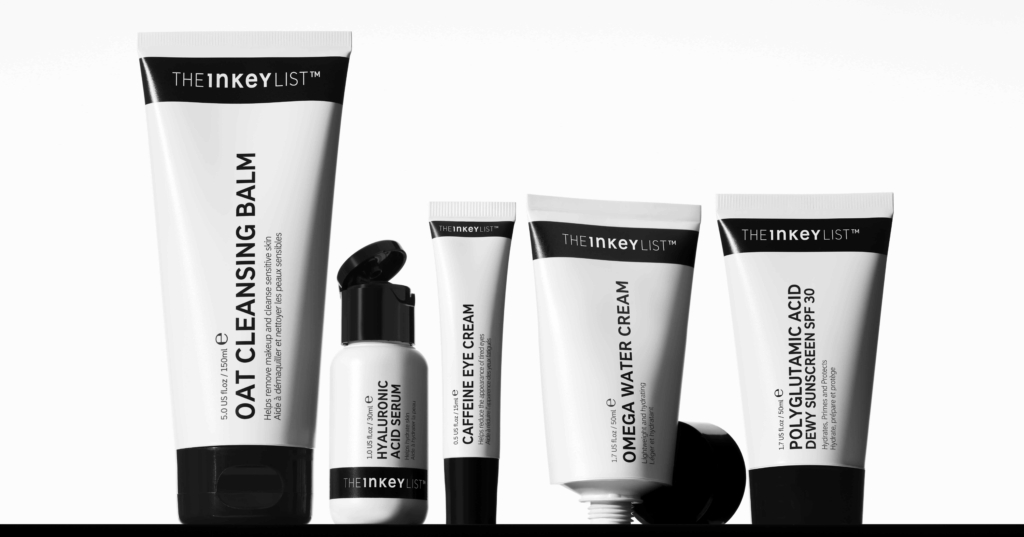
Nait-Amer highlights The Inkey List as a possible skincare brand to follow in Medik8’s footsteps to an exit. The brand generated nearly $97 million in 2024 sales, down from almost $99 million the year before. Its gross profit was up to about $55 million in 2024 from almost $53 million in 2023. The Inkey List is carried in Cult Beauty, Boots, Sephora and Ulta Beauty, where it launched in all doors in the United States in July. According to an industry sources estimate in Women’s Wear Daily, the brand is projected to reach $200 million in retail sales in 2026. Nait-Amer says, “It’s one that definitely is in the pipeline.”
However, Nait-Amer notes The Inkey List has a few challenges in wooing potential acquirers. She says its margin structure isn’t as strong as Medik8’s and it’s grappled with pursuing growth as it increases profitability. Straddling mass and masstige, it also plays in a similar lane as brands like Bubble, the American gen Z skincare brand that’s hired investment bank Centerview to explore options, and Byoma which was acquired by Bansk Group in September. The good news for The Inkey List is that The Ordinary, a brand it’s frequently compared to, has been a bright spot for Estée Lauder amid a rocky period for the company. Colette Laxton and Mark Curry, both of whom previously worked at Boots, founded The Inkey List in 2018.
111Skin is a luxury clinical skincare brand to watch. In January, it received a significant minority investment from SKKY Partners, the consumer-focused private equity firm founded by Jay Sammons and Kim Kardashian, to expand direct-to-consumer distribution and globally in Asia and North America. 111SKIN’s sales rose 9% to approximately $27.7 million in 2024, and its losses deepened to around $4 million in 2024 from $2.1 million the previous year.
London-based plastic and reconstructive surgeon Yannis Alexandrides founded 111Skin in 2012. In 2021, the brand landed a multimillion-pound investment from Vaultier7. Nait-Amer doesn’t believe 111Skin will nab a big exit in the immediate future, but pegs it as promising for one because the field of luxury clinical skincare is in demand from buyers, and it isn’t flush with possibilities.
Skin + Me and Beauty Pie come up often in Nait-Amer’s conversations with investors. She caveats that their models—the former being a dermatologist-prescribed skincare brand and the latter a DTC membership club—make their paths to strategic sales less straightforward than for skincare brands with traditional models. If either were to transact, Nait-Amer predicts private equity is probable. Skin + Me has raised over $14 million, and Beauty Pie has raised approximately $170 million. Serial beauty entrepreneur Marcia Kilgore founded Beauty Pie in 2016. James Mishreki, also the founder and CEO of another company called Life Supplies, founded Skin + Me in 2018 with Philip Wilkinson, an investor who formerly founded affordable fragrance brand Diem Scents.
Beauty Pie’s revenue grew 8% year-over-year to $92.8 million for the fiscal year ended March 31 last year, while gross profit increased 10% to $42.9 million, though the company posted a net loss of $29.7 million as it invested in growth initiatives including personnel, marketing and technology. Skin + Me’s sales reached $47 million in 2024, according to the publication FEBE, as the personalized teledermatology brand expanded into major U.K. retailers such as John Lewis and Boots following its $12.7 million series B funding round led by Octopus Ventures in 2023. Based on a financial filing for the year ended Aug. 31, 2024, it held net assets of $8.3 million and total liabilities of $55.5 million.
Fragrance
The fragrance category has been hot—for M&A and consumer interest—and Nait-Amer doesn’t anticipate it going cold anytime soon, though she acknowledges it’s difficult to pick winners in the category as the crowds in it mushroom. She details a brand’s story, ingredient quality, formula performance, scent complexity, customer experience and distribution are crucial differentiators. She lists British brands Ffern and Roja London as excelling on those fronts.
Founded in 2018 by siblings Owen Mears and Emily Cameron, TikTok-favorite Ffern releases four natural fragrances per year and amasses limited-capacity waitlists of 20,000-plus people. A backer of the brand, London venture capital firm Highland Europe typically invests in companies with over $12.7 million in annual revenues. For the year ended Oct. 31, 2024, Ffern held net assets of $19.8 million and reported profits of $7.1 million, with cash balances reaching $14.5 million, up dramatically from $591,000 the previous year.
Roja London sells fragrances priced upwards of $3,215 for a 100-ml. bottle. Roja Dove, British perfumer who worked for 20 years at Guerlain, founded the brand in 2011. Roja Parfums achieved sales of approximately $21.4 million in fiscal 2024, up 20% from $17.8 million in the prior year. Operating profit increased 12% to roughly $6.6 million from $5.9 million. “Niche being a hot category, it is bound to attract some level of interest as an independent brand,” says Nait-Amer.
In the packed fragrance category—Kaplan refers to it as eating the world—he suggests companies tunneling into it in distinct ways have an edge. He cites laundry care brand Tallow+Ash, a brand Five Seasons Ventures has invested in, and cleaning brand Purdy & Figg as examples that could become deal targets down the line. Kaplan says, “As layering and personalization have grown as trends, it’s started to open up real opportunities for personal care and beauty products across category to start integrating fragrance in a really meaningful way and customers are really responding to that.”
According to the Sunday Times’ 2024 list of the U.K.’s fastest-growing private companies, Purdy & Figg achieved about $62.5 million in annual sales in 2024 versus about $565,000 in 2021. It’s available at zero-waste stores and on Amazon. Purdy & Figg was founded in 2020 by Charlotte Figg, a horticulturalist, and Purdy Rubin, a nurse.
Founded by Ciara McGurk and Matt Ree, Tallow + Ash scaled rapidly from launch in 2023 to over $7.5 million in annual run rate revenue by early 2024, according to James Watt, the former CEO of BrewDog and an investor in the company. The brand’s balance sheet shifted from net liabilities of approximately $161,726 as of January 31, 2024 to net assets of approximately $747,290 by January 31, 2025, reflecting a transition to profitability. Tallow + Ash is sold at Tesco.
Haircare
Kaplan and Nait-Amer mention Ayurvedic brands Chāmpo and Fable & Mane as haircare brands to keep an eye on. Nait-Amer estimates Chāmpo’s sales clock in at less than $26 million. It ranked eighth in The Sunday Times’ list of fastest-growing companies in the U.K. in 2023, with a compound annual growth rate of 217% over the previous three years. At the time, it sold more than 1 million products since its 2019 launch. Kuldeep Knox, a former finance professional who’s struggled with thinning hair, founded the brand in 2019.
Chāmpo raised $1.2 million in 2021 from an investment fund supported by the European Investment Bank and angel investors. The brand has entered high-end British retailers, including Harrods, Selfridges and H Beauty.
Nait-Amer pegs Fable & Mane’s sales at about $30 million. The brand was founded in 2020 by siblings Akash Mehta, formerly global digital manager at Dior Beauty, and Nikita Mehta, who was previously in luxury fragrance development. It’s available at Sephora, Cult Beauty and Selfridges.
“The Western customer is really, really responding to Ayurvedic principles, traditions and formulations in a super meaningful way, and it’s not just, say, in the U.K. because there is a large South Asian community here,” he says. “I think it’s expanding far beyond the core demographic group in a way that K-Beauty and to a lesser extent J-Beauty have.”

Makeup
Makeup doesn’t have as many prospects as fragrance, haircare and skincare, and British brands have to contend with there being a surfeit of American makeup brands searching for new homes, from possible corporate divestures such as Too Faced and Fenty Beauty to private equity- and VC-backed brands such as Makeup by Mario and Merit.
Nait-Amer shouts out Refy as being one of the best growth stories in makeup from the U.K. For the year ending Aug. 31, 2024, the brand reported approximately $52 million in revenue and $17 million in pre‑tax profit.
Founded in 2020 by influencer Jess Hunt and entrepreneur Jenna Meek, Refy is available at Sephora and Selfridges and recently expanded into the Middle East. Nait-Amer says, “It’s a brand there that investors keep mentioning and asking about because they have scaled pretty quickly, including in the U.S.”
Hunt and Meek both invested around $78,000 to launch Refy. Meek told The Business of Fashion last year that Refy will generate $130 million in sales by 2026 with profit margins of around 37%. She believes the business can hit a $2.7 billion valuation by 2031.
In April, WWD broke the news that Trinny London hired an investment bank to assess options. Television personality Trinny Woodall founded the brand in 2017. It’s secured venture funding from Unilever Ventures and Downing, and sources inform WWD that its sales are around $80 million. Trinny London products are sold at Liberty and John Lewis, and the brand is on Amazon.
Another famous British personality, Victoria Beckham, could see her fashion and beauty brand fetch $700 million, according to Reuters. Across the categories, the company generated $152 million in revenue for the year ended Dec. 31, 2024, a 26% jump from the prior year, and $3 million in earnings before interest, taxes, depreciation and amortization (EBITDA), a 22% gain from the prior year.
In January, WWD calculated that sales from Satin Kajal Liner, which six-year-old Victoria Beckham Beauty has divulged sells every 30 seconds, are north of $30 million annually. The brand also has had a fruitful partnership with Augustinus Bader on complexion and skincare products. Victoria Beckham Beauty is carried by several luxury retailers, including Neiman Marcus, Bergdorf Goodman, Selfridges, Harrods, Nordstrom, Bluemercury and Violet Grey.
Personal Care
Kaplan compares personal care brand AKT London to American brand Salt & Stone. Both are centered on deodorant, but have expanded beyond it. Salt & Stone has tapped investment bank Raymond James to explore options. Kaplan expects AKT London to follow in Salt & Stone’s footsteps. AKT London is carried by Credo in the U.S., and John Bell & Croyden in the U.K. The brand raised $7 million in a series A funding round led by Felix Capital, when it was projected to reach $10 million in revenue. Former West End performers Ed Currie and Andy Coxon founded AKT London in 2020.
AKT London is best known for its deodorant balm housed in an aluminum tube. “I think that form factor in general and new and innovative ones is something that the large CPG and beauty corporates are spending a lot of time on right now within potential acquisition targets,” says Kaplan. “And so, accordingly, it’s something that I’m always on the lookout for as well.”
Kaplan highlights oral care brand Suri as another potential acquisition target in the future. Likened to Quip in the U.S., Gyve Safavi and Mark Rushmore, alums of Procter & Gamble, founded Suri in 2021. Its electric toothbrushes are available at Boots, Best Buy and Target. They feature replaceable brush heads made from plant‑based cornstarch and castor oil components and aluminum handles.
Relative to Quip, Kaplan says Suri has “a meaningfully better product and then what they have built around the brand in terms of the brand halo of sustainability and expanding into shoulder products like say toothpaste which is recyclable.” He adds, “They really practice what they preach and have built a real brand around it, which I think some of the early movers in the subscription electric toothbrush category in the U.S. never really did.”
Suri has raised around $7.8 million in funding from investors, including JamJar Investments, V3 Ventures and DMG Ventures. According to an estimate provided to the Financial Times, Suri has sold more than 1 million toothbrushes and generated revenue of about $30 million last year.
Click here to learn more about Dealmaker Summit happening June 8 & 9 in New York.
The players
5 mentionedToo Faced

Fenty Beauty
The Ordinary
Estée Lauder
BYOMA