Exosomes: What They Are, Why They're Becoming Big, And How They're Raising Concerns
But drawing a client’s blood, which is then spun in a centrifuge to extract plasma that gets injected or applied topically, is less than ideal for many patients and practitioners. Exosomes, nanoparticles that carry messages from one cell to another and are secreted by every cell in the body, have entered the advanced aesthetics picture as an alternative sans the squeamish step. Promising similar or even superior results to PRP, many experts assert they’re poised to dominate the industry in the coming years.
Validating predictions of exosomes’ acceleration, consumer interest in them is growing. According to data intelligence firm Spate, Google search volume in the United States for exosomes has climbed 17.3% over the last year to 31,800 on average monthly.
But exosomes aren’t completely free of complications. Usually derived from human placenta extract for aesthetic services, they’ve yet to be approved by the U.S. Food and Drug Administration for use as an infusion, and questions remain about their sourcing and overall safety.
Aion Aesthetics charges $795 for a single microneedling treatment with exosome therapy from clinical skincare brand AnteAGE. Akis Ntonos, a nurse practitioner who performs the treatments, says, “Exosomes have regenerative abilities that are greater to other methods currently available in the market. They target injured or aging cells in order to repair them. This means that they can have greater benefits in applications such as hair restoration, skin rejuvenation or tissue repair.”
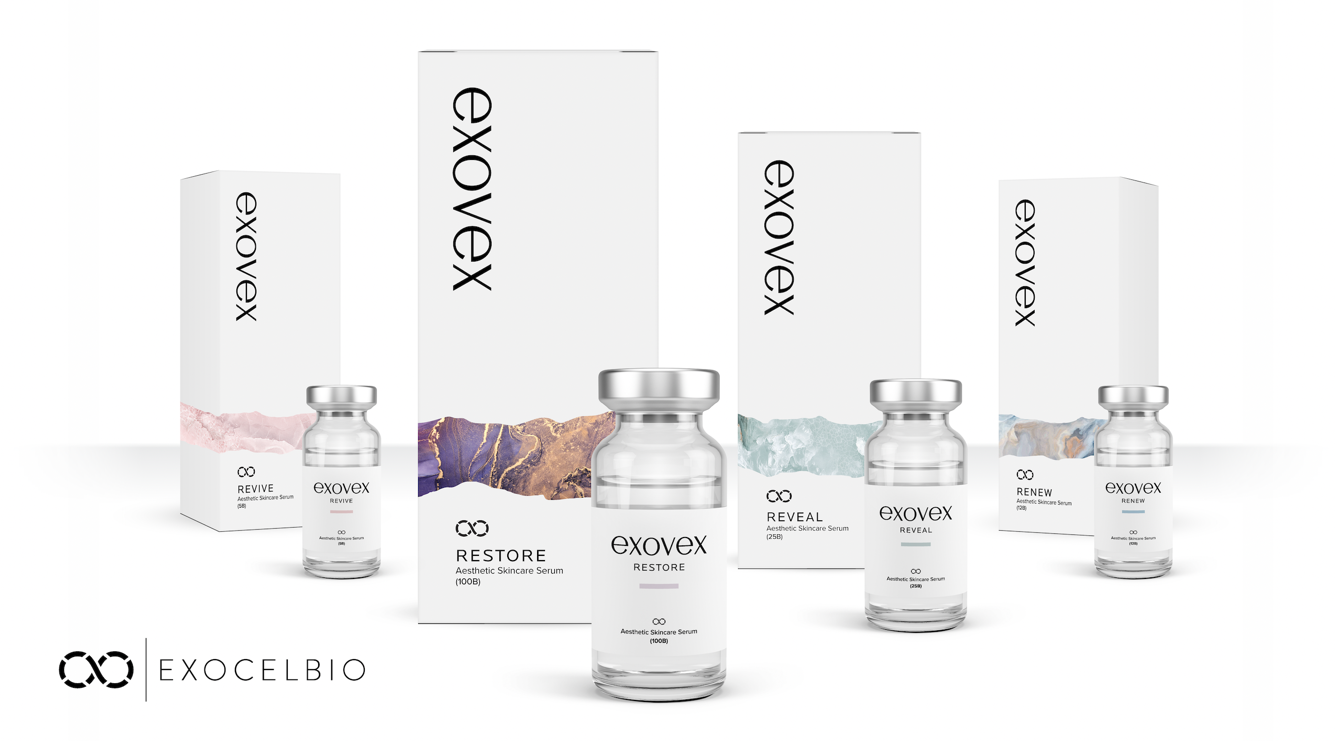
Dermatologist Marina Peredo has been applying products from Exovex, a professional line of topical skincare options with exosomes from biotechnology company Exocel Bio, to her clients’ skin post-procedure to hasten healing, and improve skin tone and elasticity. Exocel Bio details the exosomes in Exovex’s products are produced by mesenchymal stem cells or stem cells found in bone marrow critical for skeletal tissues from donated human placenta screened for diseases and pathogens, and the products have peptide growth factors along with mRNA, genetic materials that code for collagen, keratin and elastin.
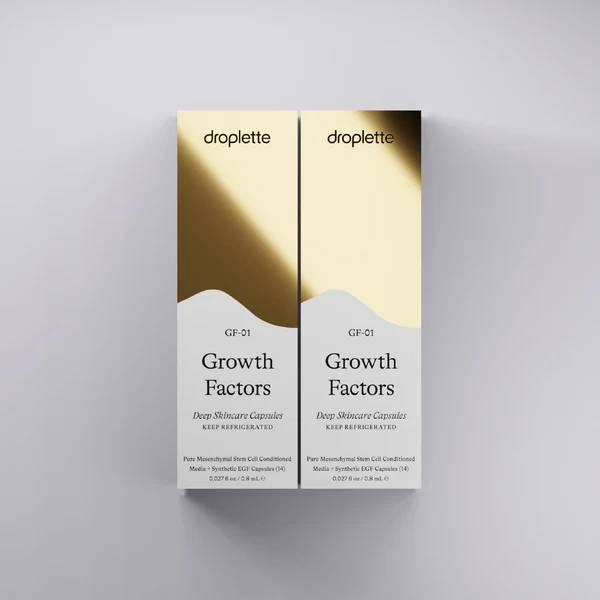
In non-professional settings, exosomes are starting to make an appearance, too. In December, Droplette introduced Growth Factor capsules that the skincare device specialist says are shipped and stored cold, and feature peptides and exosomes. At $380 for 28 capsules, Growth Factor is Droplette’s most expensive capsule offering. By contrast, its 30-count boxes of its Glycolic Illuminator or Collagen Hydrofiller are $79 each, and 30 capsules of its Tranexamic Eraser retail for $110.
A huge impediment for human placenta-derived exosomes in the broad beauty industry is existing technologies require them to be kept cold to remain stable, says Roger Schechter, a physician and chief medical officer at Exocel Bio. For stability, he divulges they’re stored at 4 degrees celsius for up to a week or minus 80 degrees celsius for longer term storage. Despite the hurdle, companies are managing to put exosomes in conventional skincare, particularly in South Korea, an exosome pioneer. South Korean company Outin Futures’ brand Neogen has released the product High R Exosome Cream.
While facial plastic and reconstructive surgeon Eunice Park, founder of Airem Modern Beauty Rituals, a med-spa where a microneedling service with an exosome treatment is priced at $1295, forecasts exosomes will soon break into the American beauty landscape in a big way, she believes more clinical research needs to be conducted before filling tubes of topical skincare with exosomes en masse in order to determine their absorption through an intact skin barrier.
“My preferred method of using exosomes is when you open the skin,” says Park. “You have to open the skin through microneedling in order to really absorb it.”
By applying an exosome serum following an aesthetic treatment like microneedling, the particles can penetrate the dermis. Peredo says, “Exosomes reduce redness, burning and discomfort, [and] significantly shorten the downtime of the procedure and enhance the desired results. We commonly apply exosomes immediately after most of our lasers and micro-needling procedures for patients who are seeking to decrease the discomfort and the recovery time post-procedure as well as to get the most desired outcome.”
Skincare products with exosomes on their ingredient decks are incorporating plant-derived exosomes or a combination of human- and plant-derived exosomes. Plant-derived exosomes may be easier to work with. Park says, “Plant-derived exosomes in the form of rose stem cell-derived exosomes are becoming very popular in more mainstream skincare products because they have less variability in potency compared to human cell-derived exosomes.”
Plant exosomes don’t have to be stored cold, but may not be as potent as human-derived exosomes, although the potency disparity isn’t clear. Park says, “I have researched this and the answer is that the level of growth factors, peptides and amino acids in plant exosomes may be lower than human stem cell derived exosomes.”

Plant-derived exosomes avoid the tendency of an ingredient derived from human placenta giving people pause. Beyond that issue, growth factors, an essential reason why human placenta-derived exosome therapy has become so buzzy and generates results akin or superior to PRP, are associated with cancer concerns due to the promotion of cell proliferation. As a consequence, Park cautions that close attention has to be paid to the sourcing of exosomes.
“Exosomes are not stem cells, but they are derived from human stem cell lines,” she explains. “So, you have to be careful because they carry growth factors. They do carry DNA, RNA. They carry products and proteins that are derived from a human stem cell line. You really have to be careful about the purification process, the monitoring, the potency. How do you know what you’re putting on your face?”
Companies in South Korea and Japan hold patents on the procurement and purification processes of the ingredient. Last summer, Park visited the Global Exosome Center, an approximately $20 million manufacturing and research facility opened in 2019 by the company ExoCoBio, to learn about the ins and outs of exosome sourcing.
“We had a great discussion about the safety protocols and things related to the procurement of exosomes,” she says. “Then, it goes to potency and purity. You have to trust that a certain company is doing all of their due diligence and making sure there’s a standardized protocol for that, which I felt satisfied with once I spoke to them.”
In South Korea, Park detected a significant swing away from PRP to exosome treatments, a swing she sees being replicated in the United States. Schechter reports that about 500 practices nationwide have Exovex’s products, and he expects that number to jump 25% to 40% in 2023.
Ntonos envisions that exosome therapy could replace PRP in the U.S., but notes PRP is at an advantage since it’s been the market for a while. He says, “It will take some time before PRP is replaced by exosomes for aesthetic purposes, especially since the use of PRP is so diverse and can be used for a variety of treatments.”
Exosomes’ greatest potential is believed to lie outside of aesthetics in what Park calls “clinical therapeutics,” treatments for inflammatory conditions like psoriasis and contact dermatitis. “Because of its promise, right now there are studies being conducted related to its anti-inflammatory processes as an infusion,” she says. “They’re looking at it for conditions like chronic kidney disease. There are really wide-ranging therapeutic benefits.”
However, in order for exosome infusions to be administered, they must be approved by the FDA for that use. Exosomes are only approved for topical application today, where their therapeutic impact is tempered. Within the world of aesthetics, that means exosomes are for now primarily sticking to post-treatment skin applications. Without FDA approval for internal usage, companies are finding creative strategies to package topical exosome products for inclusion in treatments performed at medical offices and med-spas, and increasingly for consumers at-home.
Dp Dermaceuticals sells a microneedling device and Exo-Skin Therapy, a $299 topical product it describes as “one of the first exosome therapies available for at-home daily use.” The brand heralds the skincare product as a “revolution” of “the new non-negotiable supporting regenerative procedures.”
The players
5 mentionedUnder Your Skin

Topicals
Ritual
Too Faced
AS Beauty