The Great Drugstore Contraction’s Surprising Upside For Emerging Beauty Brands
The decimation of drugstores isn’t finished. Over the next three years, the big three drugstore retailers—Walgreens, CVS and Rite Aid—plan to reduce their collective store count by more than 3,000 due to pressure on profits in part from geographic overlap, productivity declines and online competition from rivals as diverse as Amazon and Uber Eats.
Walgreens, the largest drugstore company in the U.S., has seen its market value slashed from around $100 billion in 2015 to under $8 billion. It’s reportedly in talks to be acquired by private equity firm Sycamore Partners.
Weighed down by $8.6 billion in debt, Rite Aid declared Chapter 11 bankruptcy in 2023 and came out of it last year as a private company after slashing $2 billion in debt and transitioning ownership to creditors. In 2024, CVS Health, owner of health insurer Aetna as well as pharmacy locations, explored spinning off its struggling insurance division.
The depletion of drugstores has sparked fears of pharmacy deserts that erect barriers to health care, particularly in minority communities, and diminish beauty product sales. Although drugstores are responsible for a low double-digit percentage of beauty sales globally, putting its beauty industry market share under specialty retail and e-commerce, beauty brands depend on them to enter neighborhoods across the country, and their disappearance could be viewed as a serious setback for broad exposure.
But beauty industry experts aren’t convinced it’s a huge blow. The drugstore channel is already substantially diminished for beauty, having fallen from grace with the explosion of specialty stores and enhanced beauty sections at Walmart and Target, not to mention Amazon’s foray into the field. In light of its struggles, several experts argue contraction could give indie brands a chance to thrive in the channel, noting that a reduced number of stores with better productivity might be improved platforms for growth, and amid fierce drugstore competition, emerging brands provide a competitive advantage by distinguishing assortments. In addition, if drugstore megachains go private, management can take risks on brands as they make long-term decisions.
“I don’t see consolidation as an issue for our indie brand,” says Deborah Dixon, owner of skincare brand Precious Mineralz. “Less competition between the stores through consolidation makes it easier for innovative products to get attention and brand growth.”
Drugstore chains have been launch pads for upstart brands. CVS is now attempting to catch younger shoppers with an end-cap presentation labeled “Trending Brand You Don’t Want to Miss,” and Mixik, a nascent brand describing itself as K-Beauty, is in it. The nascent brand describes itself as K-Beauty, and CVS was one of the first retailers in the U.S. to jump on K-Beauty brands in 2017.
Along with picking up Mixik, K-Beauty brand Joah is exclusive to CVS. Established by Bespoke Beauty Brands, the incubator began by NYX founder Toni Ko, in collaboration with Korean American drag queen Kim Chi, KimChi Chic Beauty has landed at CVS, and the haircare brand Eva NYC has announced it will break into the chain.
Walgreens helped Olive & June gain traction. The nail products brand made its drugstore debut at it following its arrival at Target. The drugstore retailer is credited with implementing merchandising techniques that changed the beauty game such as selling nail color adjacent to nail care to build baskets.

Beauty represents a scant portion of drugstore sales. Prescriptions account for as much as 75% of them for many operators. An enormous challenge for drugstores is that 10% to 15% of their store square footage generates three-quarters of sales, and even with tightening insurance reimbursement rates, most profits flow from pharmacy.
A former drugstore merchant explains that 80% to 85% of drugstore square footage is a drag on revenue generation and productivity. The over-the-counter products ubiquitous in mass-market retail, including on replenishment powerhouse Amazon, are sales drivers, but not contributors to assortment uniqueness.
“Even with the option of pharmacist recommendation, drug chains haven’t been able to revitalize the front end,” says the merchant. “In a real sense, barring any revolutionary product category introduction from left field, beauty stands out as a possible savior with beautiful product designs, exciting consumer benefits and the possibility of creating a really enticing department, all with excellent margins—averaging 30%—and a drugstore history that could still be resurrected. Even a deal with Ulta like in Target, but in the smaller confines of the drugstore could well be a blockbuster for the channel.”
Elizabeth Karvonen, team lead for distributor The Emerson Group, says, “Ultimately, there are currently too many drugstore locations, leading to a number of unprofitable stores for many retailers. In the long run, I believe having fewer stores will create a more sustainable and profitable model for everyone.”
In a similar vein, Wendy Liebmann, CEO of shopper insights and retail strategy firm WSL Strategic Retail, says, “The question is, do you need 8,000 doors, especially when retailers can have a digital presence?”
Chithra Kannan, founder and CEO of Skin Centrick, a skincare brand sold at CVS, admits the drugstore consolidation causes challenges, but contends the advantages outweigh the challenges. “On one hand, fewer doors might imply a more competitive environment where only the most compelling brands are selected for shelf space. However, this can also be seen as an opportunity for brands to truly shine and establish a strong presence in a more focused retail setting,” she says. “Fewer stores can mean enhanced brand representation.”
A positive outcome Kannan foresees is that a concentrated network of stores will pave the way for strategic marketing efforts, tailored in-store experiences and collaborations. Indie brands, she postulates, can distinguish drugstores from the pack. Kannan says, “This need for differentiation can open doors for indie brands to negotiate better terms and gain more visibility.”
Not everyone sees the beauty in a shrinking channel. Barry Shields, an industry veteran that’s worked at behemoths like Coty and built indie brands like Red Carpet Manicure and Nailtopia, isn’t sanguine about drugstore chains’ prospects unless they pursue successful tactics to draw younger shoppers and burnish their image.
“The front end is not a beauty destination. People don’t spend much time in drugstores, they grab their aspirin or cold remedy and are in and out,” he says. “Drug chains need to decide if they want to be competitive in beauty. They have the space to make an impact. Someone needs to decide to break out of the pack.”
In the meantime, Shields envisions sales could climb at the digital platforms of the preeminent drug chains as physical doors shutter. “Or people will go to the next closest drugstore down the road,” he says. “There isn’t that much brand loyalty in drug chain choice.”
A brand founder who asked not to be named says drug chains are “notoriously” hard to do business with, citing lofty entry costs too onerous for most fledgling brands to handle without financial backing. The beauty inventory turns at drugstores are lower than those of non-drugstores, and the cost of adding items strains an already delicate profit-loss balance. To offset costs, drugstore retailers charge vendors higher fees. For example, they charge coop fees not as prevalent elsewhere of around 10% on purchase orders.
Unlike specialty and big-store stores, people typically visit drugstore chains for convenience and pharmaceuticals, not to discover beauty brands, and they’re forced to propel beauty purchases with loyalty programs and discounts like buy-one-get-one free at costs to brands. On top of the discounts, most drugstore chains favor manufacturer fixtures versus the universal sets popular at big-box chains, another substantial cost for brands. To get into drugstore beauty assortments, brands need to offer drugstores reasons to exit what’s in their precious footage, which can mean buybacks or markdowns.
“The cost of entry, the deduction processing and all the order processing can eat you up alive,” says a brand founder, remarking that indie brands that have prospered in drugstores tend to have developed a sizable direct-to-consumer business prior to launching at them.
The founder elaborates that big-box chains and specialty stores like Walmart, Target and Ulta Beauty are more collaborative and sell 10X the pieces per stockkeeping unit of drug chains on high-demand items. Big-box chains have the benefit of apparel and groceries as traffic lures, he says, where “drug chains are left relying on national brands that can support the slow inventory turns rather than take a chance on indies.”
Liebmann and Karvonen acknowledge the drugstore sector’s difficulties have led to serious business pains for beauty brands as the sector works through closures. Karvonen says, “The challenge in the short term is that brands are managing returns from these less profitable stores, while retailers seem to be adjusting cost structures to help maintain their profitability during this period of closures.”
Liebmann says, “Even though they are lesser performing stores, they do have foot traffic and the opportunity for someone to pick up a lipstick with their prescription, but these are the lowest performing stores. It has been a real estate strategy rather than building loyalty and engagement…Brands can be sitting in stores where it is actually hurting you.”
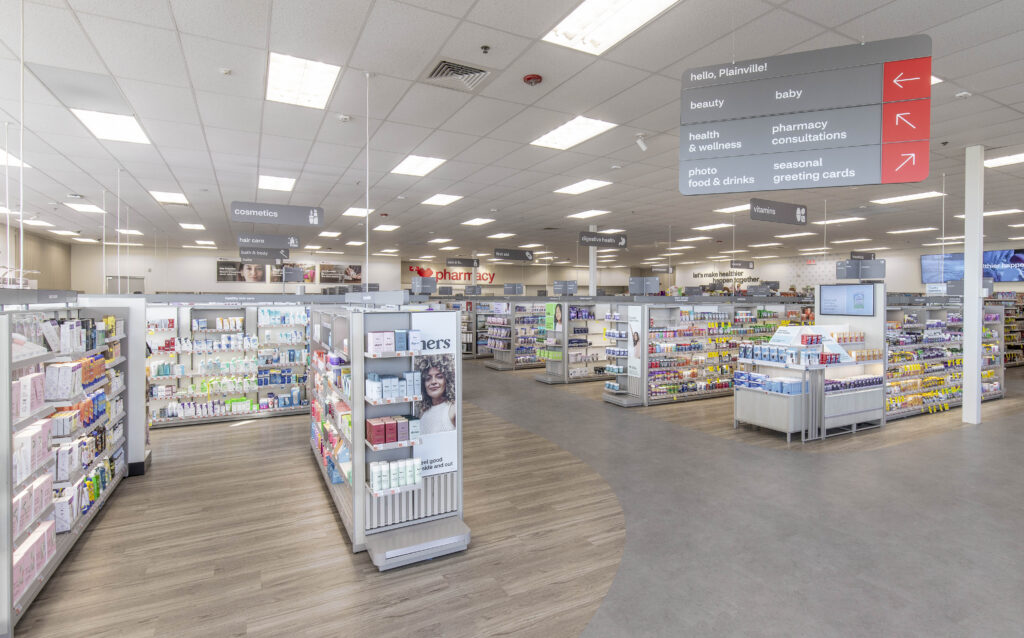
With fewer stores, beauty industry experts hope that drugstore retailers concentrate on revitalizing beauty displays and selections that have deteriorated. To battle specialty stores, they contend drugstores must elevate the shopping experience.
“Brands and retailers succeed when they put the customer first and focus on enhancing the shopping experience,” says Jeremy Lowenstein, CMO at makeup brand Milani. “As we are all trying to navigate this new retail ecosystem and improve the in-store experience, emphasizing core categories is key to driving foot traffic and repeat purchases.”
Bruce E. Teitelbaum, CEO and founder of RPG, a beauty brand display specialist, agrees, saying, “Beauty brands should strongly advocate for elevated consumer environments that encourage shoppers to discover, experience and purchase. Current store designs are unimpressive and not engaging. Just as consumers would rather walk into a well-designed grocery store, the expectation should be the same of retailers in the drug channel.”
Teitelbaum suggests large drugstore chains take cues from Zitomer. RPG handled the independent New York City drugstore’s renovation. “The product mix remained essentially the same, which was always excellent, but the renovation served to significantly increase sales,” says Teitelbaum. “It’s interesting how an elevated store environment boosts consumer traffic and purchases.”
Attention to detail could be the prescription to boost ailing drugstore beauty sales. A shopper strolling the aisles at a Rite Aid describes the common challenge in the industry. The shopper says, “I go into one store with a compelling environment and wonder why I can’t have that in my local store.”
Decreased doors could facilitate greater consistency among product and brand presentations. Currently, CVS has a few doors with a prototype it hails as the store of the future featuring what it describes as an “upscale beauty collection” and “expanded health section.” Teitelbaum praises the prototype for custom gondolas allowing CVS to frequently freshen its look.
Fresh environments and compelling assortments potentially offset price issues for drugstores that can’t meet Amazon and Walmart’s low-price supremacy. Concludes one brand, “Drugstores need to bring back the magic that once made them beauty destinations.”
The players
5 mentionedOlive & June

Under Your Skin
Better Being
Counter
AS Beauty