Doctors Are Skincare's Biggest Stars (Again)
Their brands, including Dr. Whitney Bowe Beauty, Jori, Dr. Devgan Scientific Beauty, PillowtalkDerm by Dr. Shereene Idriss and SLMD Skincare, are the latest in a long history of doctor-founded skincare brands such as Murad, Perricone MD, Rodan + Fields, Obagi Medical, Environ, Epionce, Goldfaden MD, Dr. Brandt Skincare and Dr. Dennis Gross Skincare that existed well before social media-famous physicians put their names on cleansers and serums.
Between the last generation and the new generation of skincare-inclined doctors, clean beauty, hero ingredient-centered and celebrity-fueled brands assumed the reins of skincare with brands like Drunk Elephant, Tatcha, The Ordinary and Youth to the People. The endurance and resurgence of doctor brands demonstrates that, while the significance of qualifications to consumers may ebb and flow, they remain differentiators that don’t easily erode. Their abilities to erect moats around brands are seen throughout the beauty industry, where professional makeup artists and hairstylists have perennially taken the path to beauty brand ownership.
Recent history substantiates their skincare relevance, too. New doctor skincare brands are descendants of Augustinus Bader, which was founded by financier Charles Rosier and Bader, an applied stem cell biology professor and doctor, and Dr. Barbara Sturm, which was founded by an aesthetics doctor, two brands that have proven there’s contemporary consumer demand for and dollars in products associated with medical bona fides. Last year, Augustinus Bader closed a $25 million funding round at a $1 billion valuation.
Speaking of the brand famous for The Rich Cream, Cassandra Grey, founder and chair of Violet Grey, a beauty retail and e-tail destination integral to its success, says, “That’s what every brand wants to be right now. They want that huge valuation and eventually, if that’s the game plan, a buyout.”
Beauty industry insiders peg Augustinus Bader and Dr. Barbara Sturm as top contenders for buyouts in the doctor brand brew. Grey singles out 111Skin, the brand launched by plastic surgeon Yannis Alexandrides and his wife Eva in 2008, and Eighth Day, a brand started by dermatologist Antony Nakhla in 2018 that’s a Violet Grey favorite, as further contenders. She says they’re “getting it right.”
Ransley Carpio, head of venture investment at Amazon retail management firm Fortress Brand, believes the figure Bader commands could set the tone for doctor brand deals, but says beauty deals are swinging toward comparably affordable brands on the whole. Selling products priced in the hundreds, Augustinus Bader is squarely in the prestige beauty segment as is largely the case with doctor skincare brands. However, newer brands are responding to inflation-provoked price sensitivity in the current market with a keen eye toward the value they supply for their prices.
“I’m not sure if we’ll see high multiples north of the hundreds of millions of dollars in this category if it’s truly in the prestige market. Most buyers are not looking for prestige as they are the middle-of-the-road price point,” says Carpio, continuing, “Marquee exits in recent years seem to give maximum credit to brands who demonstrate similar characteristics: ability to reach a broad number of devoted consumers, mature margin profiles and achievable future growth. Sturm and Bader come to mind as a rare few prestige/premium brands who possess similar brand equity.”
Along with Sturm and Bader, he highlights nearly 23-year-old Dr. Dennis Gross Skincare and QMS Medicosmetics, which was launched in 1986 by former facial surgeon Erich Schulte, as worthy of mentions in conversations about potential doctor brand deals. Zurich-based QMS Medicosmetics broke into the United States in the past year. It’s in Saks Fifth Avenue and luxury hotel spa distribution. Another prestige retailer is on deck for this year.
Dr. Dennis Gross Skincare’s popular peel pads have garnered it a spot in the pantheon of doctor brands with exit expectations. Aggie Burnett, a beauty marketing and public relations strategist at agency AB Creative, says it’s had steady growth “with long-standing partnerships with Sephora, Nordstrom, Bloomingdale’s, Space NK and more. The brand has become a household name for dermatologist-led brands.”
Doctors aiming for deals have evidence that skincare brands yield them. In 2020, The Hut Group acquired Perricone MD for $60 million. A year later, NovaBay Pharmaceuticals bought dermatologist Audrey Kunin-founded DermaDoctor for $15 million. In 2015, Unilever purchased Murad for an undisclosed sum. In 2013, Obagi Medical sold to Valeant for $344 million.
A year prior, Allergan picked up dermatologist Richard Fitzpatrick-founded SkinMedica for $350 million. Dr. Barbara Sturm, Dr. Dennis Gross Skincare, 111Skin and RescueMD, a scar specialist founded in 2020 by plastic surgeon Michael Suzman, have received investment from Stripes, Main Post Partners, Vaultier7 and L Catterton, respectively.
It may be years until new doctor brands score the superyacht-size paydays that Dr. Barbara Sturm and Augustinus Bader are predicted to nab, but that doesn’t mean investors and strategic buyers aren’t monitoring their rise. Jessica Chia, a beauty editor and investment banking associate in the consumer M&A practice at investment bank Lincoln International, says, “There is automatic credibility with a doctor-founded brand that you don’t get with other brands in the saturated skincare market.”
Lisa Adams, founder and CEO of beauty retail strategy agency The Beauty Matchmakers, argues the reason for the resurgence of doctor-led skincare brands is “consumers need credibility.” Chia agrees that consumers are leaning into authority more than ever. She says, “The trust factor dermatologist and doctor brands can generate is huge.”
Carpio thinks the most significant factor in the ascendance of new doctor brands is influential advocates taking the mic on social media. “There’s a network effect of influence these doctors bring,” he says. “When they partner with other influential people organically or inorganically, there’s a megaphone of sorts.”
Consumers appreciate tapping into doctors’ knowledge via social media and their products, making skincare businesses helmed by doctors a win-win. Carpio says, “Whatever it is that they’re putting out there has gone through the rigor consumers expect from their dermatologist and the consulting they would give to be able to land on a product.”
In the early days of influencers, skincare trailed makeup, and there was handwringing over the difficulties of conveying skincare transformations on social media. That’s changed, especially with TikTok. Chia says, “Video-based social media provides an almost perfect platform for dermatologists to educate and gain vast new followings that weren’t available four years ago. Dermatologists can talk about these issues in video format and flash up imagery to illustrate.”
Lara Devgan, plastic surgeon and founder of Dr. Devgan Scientific Beauty, credits social media for her brand’s $50 Platinum Lip Plump becoming a sensation. It was one of the first products to go viral with the hashtag #tiktokmademebuyit. To date, 1 million units of the product have been sold. Devgan says, “We got a lot of traction from tastemakers on social, and those moments are fueled by retail, which I think of as opening access to the world and awareness.”
Grey underscores that the information age has made beauty a more sophisticated industry, producing educated and discerning customers. Like those consumers, Grey is a TikTok enthusiast. She relies on the social media network for learning what interests people. TikTok is responsible for pushing plenty of suspect skincare trends, but it’s also responsible for spreading several that are less questionable, notably skin cycling, a scheduling of skincare throughout the week featuring “rest days” that came to the fore courtesy of Bowe.
Grey says, “There’s a lot of nonfactual information there, but you can see that customers and people are acting like investigative reporters now, particularly [with] skincare.”
On TikTok and elsewhere, the hunger for authority may be the result of consumers burned by straying from it. Yarden Horwitz, co-founder of beauty trendspotting artificial intelligence platform Spate, explains that consumers experimented with a wide variety of skincare ingredients and products during the pandemic, leaving them with a lot of irritation and sensitivity that’s prodding their hunt for sound skincare remedies.
Starting in 2021, she says, “Consumers got smarter and started searching for doctor-recommended products and ingredients…They’re looking to dermatologists for support, so it shows how consumer behavior has evolved.” Daniel Granatell, director at ingredient supplier of Grant Industries, says consumers trust brands founded by doctors will deliver safe and effective products with quality ingredients.
The new wave of doctor brands incorporates tried-and-true ingredients that have been the basis of skincare for years—retinol, vitamin C and hyaluronic acid, for example—but how they’re utilized is advanced to boost effectiveness. Chia says, “The possibilities open to cosmetic chemists are so much wider. They can play with particle size, dial-up bioavailability or find a way to put a finicky ingredient in a combination that wasn’t possible before.”
While they’re buzzy and have newfangled ingredients, new doctor brands aren’t guaranteed success. They’re joining a crowded skincare market and trying to lure consumers who may be tired of the skincare hordes. According to Spate, dermatologist-related skincare searches alongside the skincare category are down 29.5% year-over-year.
Nevertheless, certain brands are performing well, which Horwitz says is a likely indicator that consumers are turning to dermatologist brands with good reputations rather than depending on blanket doctor recommendations. Spate data has year-over-year search volume for EltaMD up 20.1%, ZO Skin Health up 20.4% and DRMTLGY up 38.8%. Horwitz says, “Interestingly, growth for both EltaMD and DRMTLGY is driven by their sunscreen options, indicating an opportunity for brands to launch a sunscreen or get a dermatologist to vouch for one they already have.”
Even with social media in a doctor’s court, developing, launching and marketing a brand that will cut through the noise takes time, energy, perseverance, connections and money. Emerging doctor-led brands, including Jori, Dr. Devgan Scientific Beauty and PillowtalkDerm by Dr. Shereene Idriss, are mostly privately held. They tend to kick off with a tightly curated edit of products to keep costs down and convey a clear perspective.
Younger doctor brands have usually bootstrapped their businesses or raised relatively small funding rounds. Idriss says, “I had the luxury of being able to save to start my own dermatology practice, so I set aside some of those funds for the skincare brand even though I still have student loans to repay.”
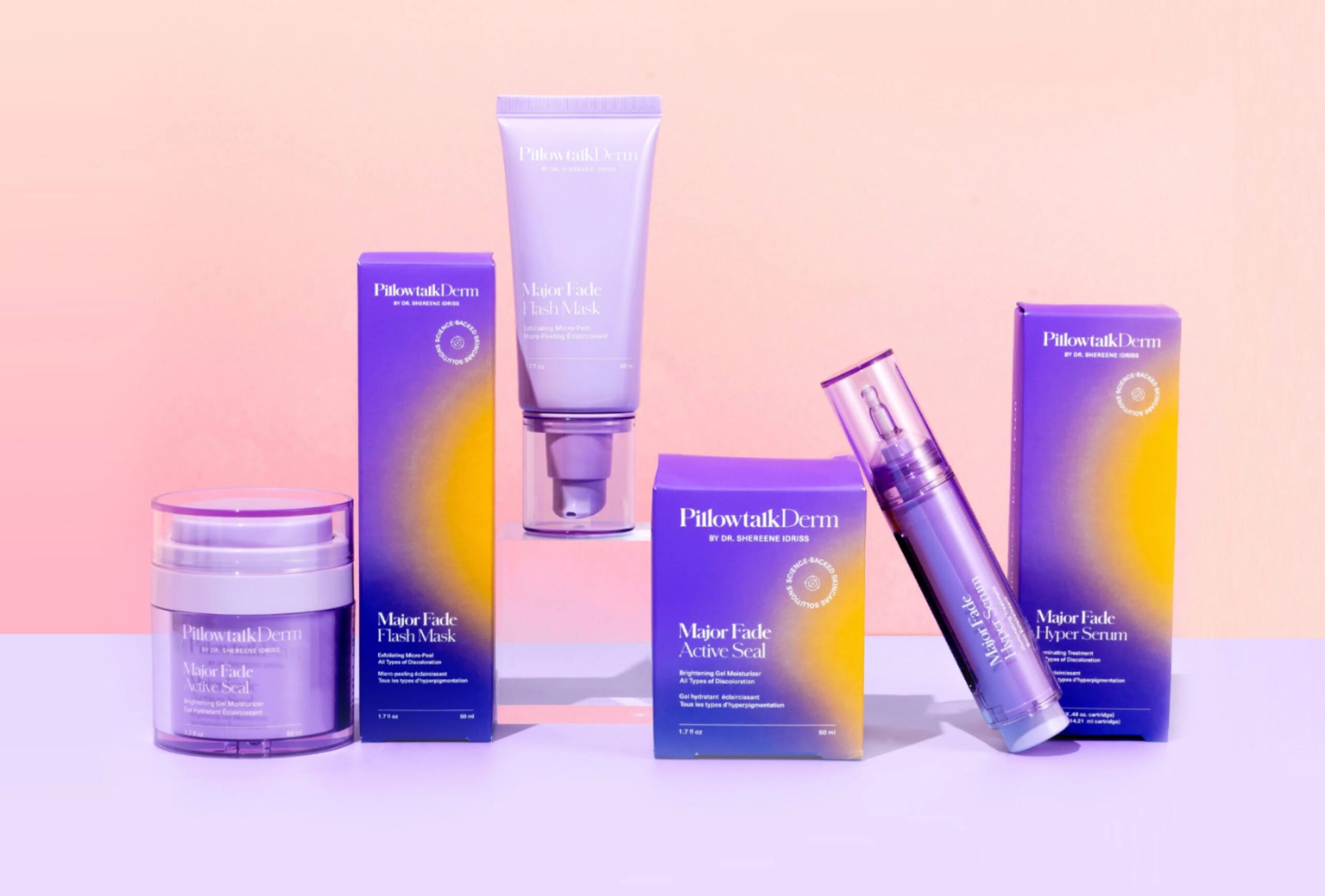
Launched in October 2022, her brand has three products targeting hyperpigmentation: Major Fade Flash Mask, Major Fade Hyper Serum and Major Fade Active Seal. It sold out pre-launch. At its official launch, its entire inventory was wiped clean in two months, promptly placing the company on track to becoming profitable. Idriss says, “Every dollar we make, we put back into the business.”
Chia typically finds that doctors are the major stakeholders in their brands, setting them up for a nice haul later if a lucrative exit is executed. “It’s a personal choice whether to go at it alone or bring in some funding and perhaps some expertise that can help you grow,” she says. “It also keeps them in the driver’s seat in terms of the future of their brand.”
Although Idriss’s brand is opting to stay in direct-to-consumer distribution as long as possible, retailers are busy pursuing doctor-led brands because of their founders’ coveted expertise and social media clout. “These brands are now more of a focus in retail because there’s a want for credibility in the prestigious space,” says Adams. “Doctors have big social media followings, and the conversations in the threads can help drive customers to whatever retailer that partnership is with.”
Dermatologist Sandra Lee, a.k.a. Dr. Pimple Popper, became a viral YouTube sensation in 2014 with jaw-dropping zit-popping videos. In 2017, she launched self-funded brand SLMD Skincare. In its first year, it generated $2.5 million in sales and now surpasses $10 million in sales annually. In 2019, SLMD Skincare teamed up with Target to adhere to its philosophy of “democratizing dermatology.” Today, it’s in over 1,600 stores nationwide.
Retail partnerships have been paramount for Devgan’s brand. It’s in Sephora, Net-a-Porter and Saks Fifth Avenue, and will soon expand to Moda Operandi and Galleries Lafayette. The brand is in talks with Mecca, Bluemercury and Nordstrom. Devgan says, “I love the idea of being a DTC brand—it’s what’s in our hearts—but we were unable to grow as quickly as desired through that route. Retail let us be more widely known.”
Plenty of budding doctor brands are exploring retail distribution. Among them are Dr. Koo Private Practice by plastic surgeon Michele Koo and ophthalmologist Diane Hilal-Campo’s Twenty/twenty beauty.
Gary Goldfaden, the dermatologist behind Goldfaden MD, shares that his company is embarking on fundraising for a series A round. He hopes to sell a majority stake in the next three to five years. The brand raised $500,000 from friends and family in its initial years in business. Goldfaden says, “I still want to be a part of the journey as an owner and board member.”
Devgan has no plans to sell her brand. She’s declined offers from investment firms because she wants to own 100 percent of the business. “You don’t just get a blank check when you take that money. You become an employee of a big investment firm and take on the values of that company’s practice—good, bad and questionable,” says Devgan, emphasizing that she doesn’t mind “taking a pay cut to keep the brand running…I want to hold it.”
Lee isn’t ready to consider investment or exit strategies yet, but they’re on SLMD Skincare’s roadmap. She says, “There is growth that the founding team can still achieve. Our ultimate goal is to get the business to a position in which we feel like there is a company or group that are better owners and can take it to the next level, accelerate our ability to achieve our brand mission, and get our products and expertise out to the world.”
Chia notes investors look for the same metrics at doctor brands that they look for at any skincare business: strong unit economics, repeat customers and the dexterity to sell across brick-and-mortar and DTC distribution without hemorrhaging money on advertising to propel purchases.
“The doctor brands that have built a strong omnichannel presence—selling via their site, their practice and within major beauty retail destinations—are the ones that will garner the highest multiples in the future and also the ones with the stickiest customer base,” says Chia. “Whether it’s via simply offering an effective product or through social media celebrity, gaining the kind of traction that can truly outlive your involvement is what buyers will pay for.”
Grey concurs that most of the business dynamics that apply to skincare brands generally apply to doctor brands. In the end, she stresses, “What matters are results, authenticity and transparency, but founders can’t lose track of the most important relationship: the one they have with their customers.”
The players
5 mentionedMomentous

Rodan + Fields
AS Beauty
Tatcha
Augustinus Bader