Curious If Someone’s Had Work Done? Aesthetic Injectors On TikTok Will Suss It Out
As of May this year, consumers insights firm Spate estimates hashtags on TikTok related to the term “aesthetic injector” drew 67.6 million total views, up 88.9% from a year ago. Views tied to hashtags on TikTok related to the term “Botox” grew 167.9% and views tied to hashtags on TikTok related to the term “face fillers” grew 54.4% from last year.
Traackr figures the number of active aesthetic professional content creators on TikTok increased 20% and posts from them increased 85% in the first quarter this year from the same period last year. The influencer marketing software company reports views of aesthetics posts on TikTok and engagement on them climbed 46% and 54%, respectively.
A Traackr analysis of TikTok content with aesthetic injector-related keywords showed they earned nearly double the engagement of creator content across all skincare posts (3.5% versus 1.94%). “Content from aesthetic injectors may be more effective at capturing viewers’ attention,” says Holly Jackson, global director of professional services at Traackr.
She explains, “Consumers are becoming aware of unrealistic beauty standards and want to know if the people they follow online and admire [or] aspire to be are getting procedures done. The uptick in content around these topics could also be creators and celebrities reacting to that demand.”
Kevin Creusy, CEO of Upfluence, characterizes the aesthetics content creator universe on TikTok as “niche.” Out of the 1 million-plus TikTok content creators monitored by the social commerce and creator marketing company, around 220 describe themselves as in an aesthetics profession, including nurse practitioner, physician assistant and registered nurse, in their TikTok bios.
Among the handles identified by Upfluence for top TikTok accounts focused on aesthetics are @injectorlina, @lipsandlattes and @dawnmonteith.rn. In the six months ending May, Upfluence approximates the average engagement of aesthetics content creators on TikTok gained 663%.
While aesthetics content creators constitute a niche, Creusy says it’s “clearly an influential niche. Content is doing extremely well, and the accounts mentioning these topics are booming.” He reasons, “More and more topics that were seen as too technical, scary or even taboo are finding an audience, thanks to the creativity of creators on TikTok. They are finding ways to talk about what they love and are growing their audience while doing it. This is an area that deserves to be discussed, and people are taking an interest.”
The explosion of the medical aesthetics industry and a shift in attitudes toward injectables may contribute to the interest in injector-related social media content. According to the American Med Spa Association in 2022, medical aesthetics was a $15 billion industry employing 70,000 people, and 18- to 34-year-olds, an important demographic for TikTok, made up 26% of patients. A recent survey from market research firm Mintel found that 51% of respondents agreed it’s OK to have non-invasive surgery for appearance reasons compared to 46% in 2019.
“It’s about feeling more confident, not about people not loving themselves or these treatments being an unnatural thing,” says Ginelle Brown, an aesthetic nurse practitioner who began posting on TikTok in 2020, where she has 48,600 followers and over 586,000 likes, when she was pregnant with her second child and pandemic measures limited her exposure to patients. She adds, “My goal is to show the human side of aesthetics and why people do these treatments.”
She elaborates, “I’m not trying to influence people to get injections because, outside of something like headaches and muscle tension, we don’t have a medical need for neuromodulators or fillers…but I’m going to educate you on how it works or the way they’re used to achieve certain outcomes.”
People are turning to TikTok to get their questions answered about aesthetics treatments. On the social media network, registered nurse and injector Olivia Salmen has posted a 30-part series with mock consultations addressing questions that people have, and the series has produced some of her most-liked content.
Salmen says, “By answering questions on a big platform, I help my patients learn more about treatments, and I get new patients in my chair.”
Salmen’s treatment schedule is booked out months in advance. Similar to Brown, she took to TikTok in 2020, and she attributes at least 75% of her bookings for injector training, speaking gigs and membership on advisory boards for Redensity and Daxxify to her TikTok presence. Salmen has 8.5 million likes and over 187,000 followers on TikTok.
Brown gets new patients from TikTok, too. “The majority of my new patients find me on social media and TikTok more than any of the other platform,” she says. “While some might see me on Instagram, Pinterest or a random Facebook group, TikTok consistently brings 75% or more of my new patients. Having exposure on social media was massive for my practice.”
Clare Hennigan, principal beauty and personal care analyst at research firm Mintel, points out Salmen and Brown aren’t alone in their client recruitment strategy. “Aesthetic injectors stand to expand their presence online by leveraging TikTok’s engaging and user-centric features,” she says. “The personalized nature of TikTok’s For You page tailors content to individual interests, ensuring that consumers intrigued by aesthetic procedures are more likely to encounter such content.”
Jackson says, “Ultimately, Injectors are leaning into social media because it makes sense simply as a highly effective way to reach interested consumers with authentic, informative content that has a wide reach. They’ve discovered that social media marketing/content creation can be much more efficient and effective than print advertising, traditional digital advertising. They can grow their level of popularity, following, reputation in the space in order to drive more appointments in their clinic.”
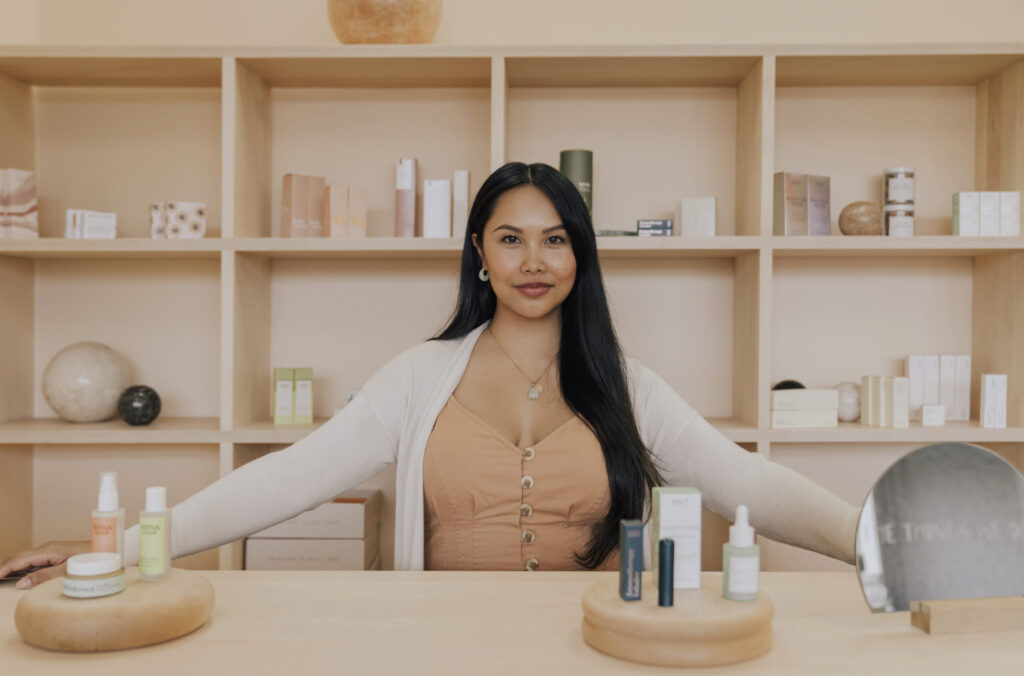
On TikTok, where she started posting content in 2020 as well and has 89,300 followers and 2.3 million likes, Vanessa Lee, nurse injector and founder of The Things We Do, a medical aesthetics concept with five locations in Los Angeles and Honolulu, has discovered users are intrigued by her candor about the treatments she’s undergone. Ditto for Brown, who also sees engagement spikes for posts about treatments for Black and brown women and diversity in aesthetics.
Many people are flocking to TikTok out of curiosity about what’s been stuffed in—and cut out of—famous faces. Posts on the platform conjecture about what Brad Pitt, Anne Hathaway, Ariana Grande and countless others have done. Tabloid-like ruminations on the aesthetics habits of Hollywood may be entertaining, but Lee argues they negatively impact the aesthetics industry and are largely wrong.
“I’ve never seen anyone be spot-on in videos that talk about celebrities’ so-called treatments,” says Lee. “In fact, they’re very far away from what has been done.”
Speaking of aesthetics treatment providers, Lee continues, “We love interacting with patients, and we want to make a very impactful change within people’s lives. I think that we have to figure out, as providers, how do we want to utilize social media and TikTok especially? How is that going to serve our legacy as providers and our patients?”
Keeping the work they’ve had hush-hush, celebrities rarely correct the social media record. Chrissy Teigen may be the notable counter example. Last year, she refuted a plastic surgeon who commented on Instagram about the model, entrepreneur and television personality having bad fillers.
Lee believes inaccurate information on social media about the aesthetics treatments celebrities receive skews expectations of what can and can’t be achieved with the treatments. And she emphasizes nuances are missing from aesthetics content, pointing out TikTokers generally don’t examine who the right candidates are for treatments.
Salmen experimented with celebrity-tied content as a vehicle for education on what can go wrong with injectables, but ultimately stopped posting it. She says, “It’s low-hanging fruit, and people can be brutal in the comment section.” Salmen stresses, “I’m a medical provider who shares scientifically backed information online as a way to prevent misinformation and fearmongering within the space.”
Companies are increasingly sponsoring injectors on TikTok. Still, Spate data shows sponsored posts represent a significant minority of aesthetics content posts. One percent of posts with hashtags associated with “face fillers” and 9.3% of posts with hashtags associated with “Botox” were attributed to paid partnerships, had brand partner hashtags or were eligible for commission. No posts with hashtags associated with “aesthetic injector” were attributed to paid partnerships, had brand partner hashtags or were eligible for commission.
Wading into the paid content partnership waters can be tricky for aesthetics treatments subject to regulation by the United States Food and Drug Administration. Brown participated in two paid partnerships before determining they weren’t for her. Prior to that decision, a sponsor instructed her not to delve into off-label uses of its filler, a restriction she holds undermined her ability to educate on it. On top of that, she was dismayed that her followers began requesting filler from the sponsor when it wasn’t suitable for them.
Lee has accepted around three sponsorships and rejected substantially more. “There are a ton of possible partnerships and money being thrown at us all the time, and we’re talking about offers of $5,000 to $10,000 a partnership because my engagement is so high with my community,” she says. “But whatever is best for me, a lot of times can be very conflicting for my actual patient clientele. As a medical professional first, I want viewers and patients to know that my first concern is whatever is best for them.”
Salmen accepts 10% to 15% of the paid partnership deals skincare and aesthetics companies such as those specializing in fillers or medical devices propose to her. She stays away from partnerships with companies not in the aesthetics or skincare industries. “I don’t want my page to become a bunch of brand deals that highlight other topics because it feels spammy and makes a page very confusing,” she says. “Most of my followers are here because of aesthetic medicine content. That’s my entire career, so that’s what I want to speak to.”
Lee understands the lure of speculative celebrity social media posts and potentially lucrative partnerships. She suggests experienced injectors steering clear of them are losing out to less experienced injectors who have no problem with them.
“I’m hoping that more advanced practitioners join TikTok and put the right information [on the platform],” says Lee. “For us to be able to utilize this really wonderful, free platform is something that truly affects our industry. I think it’s going to help the market share grow, but I also think that the more seasoned professionals need to be more involved.”
The players
5 mentionedToo Faced

Topicals
Counter
AS Beauty
Under Your Skin