Your Beauty Products Have Gotten More Expensive
Whether it’s a lip gloss that’s $3 more expensive or a shampoo that’s an extra $2, beauty product prices are climbing faster than prices overall. The price surge isn’t surprising considering the beauty industry’s dependence on China for production, ingredients and packaging. Tariffs on Chinese imports are around 30% and President Donald Trump has threatened to raise them to 100%.
Still, the beauty product price increases could endanger the industry’s resilience as squeezed consumers confront widespread inflationary pressures and other troubling economic signs such as slower job growth, slackening consumer spending and swelling unemployment. The increases are hitting digital and physical shelves as consumers, a good portion of whom loaded up on beauty products in recent years, are thinking about reining in their beauty spending.
“Makeup relies heavily on custom primary and secondary packaging, much of which is sourced from China. The math stops working unless prices rise or costs come down elsewhere,” says Benjamin Lord, founder of brand consultancy Antidote. “Many prestige brands are in a survival mode right now, trying to protect their positioning and assortment while absorbing these costs in the short term, but, without operational changes, it’s not sustainable.”
price increases
Breaking down beauty into segments, prestige beauty brands are passing on steeper price increases than mass beauty brands. The prestige segment closing in on half of the American beauty industry is characterized by higher prices and distribution at premium retailers the likes of Sephora, Bluemercury and Nordstrom. According to predictive commerce intelligence firm Daash, the average price of a prestige beauty product climbed 12% to $35.78 in June from a year ago.
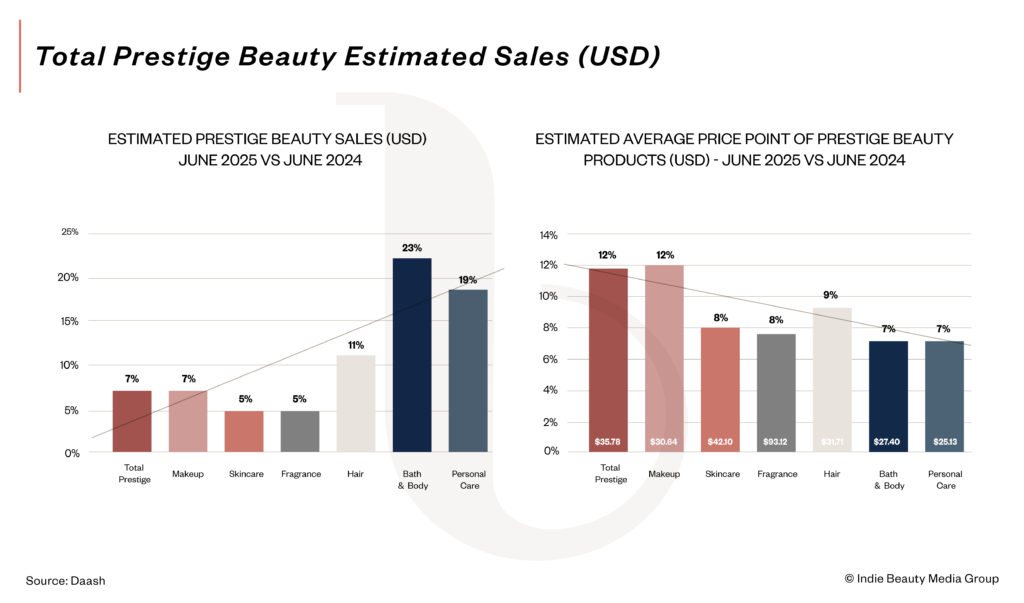
In the prestige haircare, makeup, skincare and fragrance categories specifically, product prices rose 9%, 12%, 8% and 8% to $31.71, $30.64, $42.10 and $93.12, respectively. For the period June 2024 to June 2025, Daash estimates prestige beauty sales advanced 7%. In June, the Consumer Price Index, a measure of the average prices paid by consumers in the United States, gained 2.7%, according to the U.S. Bureau of Labor Statistics. In the second quarter, U.S. gross domestic product rose 3%, according to the Bureau of Economic Analysis.
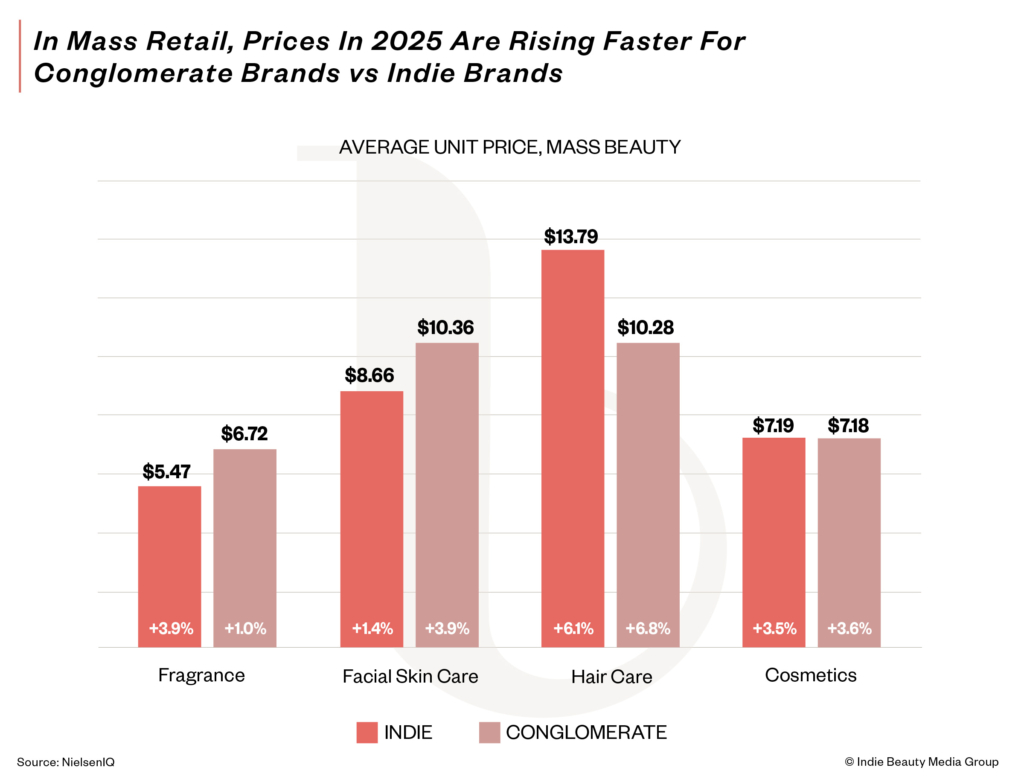
On the mass beauty side, the price hikes are decidedly more muted. However, as large conglomerates continue to lift prices (Procter & Gamble has announced plans to increase prices on a quarter of its products in the U.S. starting next month), the expense of beauty products for everyday shoppers could compound. Already, consumer intelligence firm NIQ has clocked mass beauty price increases from conglomerates accelerating faster than those from indie brands.
Mass haircare unit prices from conglomerates increased 6.8% to $10.28 and 6.1% to $13.79 from indie brands in the 52 weeks ending June 14 this year, per NIQ. Conglomerate mass makeup unit prices were up 3.6% to $7.18, and indie mass makeup unit prices were up 3.5% to $7.19. Conglomerate mass facial skincare unit prices rose 3.9% to $10.36, and indie mass facial skincare unit prices rose 1.4% to $8.66. Conglomerate mass fragrance unit prices were up 1% to $6.72, and indie mass fragrance unit prices were up 3.9% to $5.47.
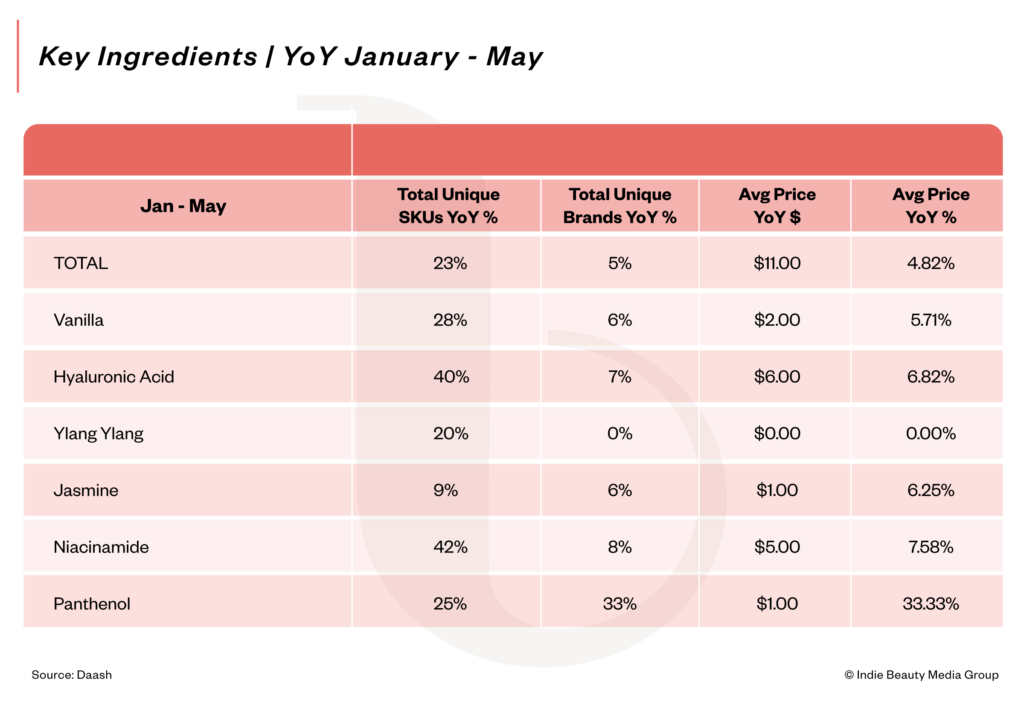
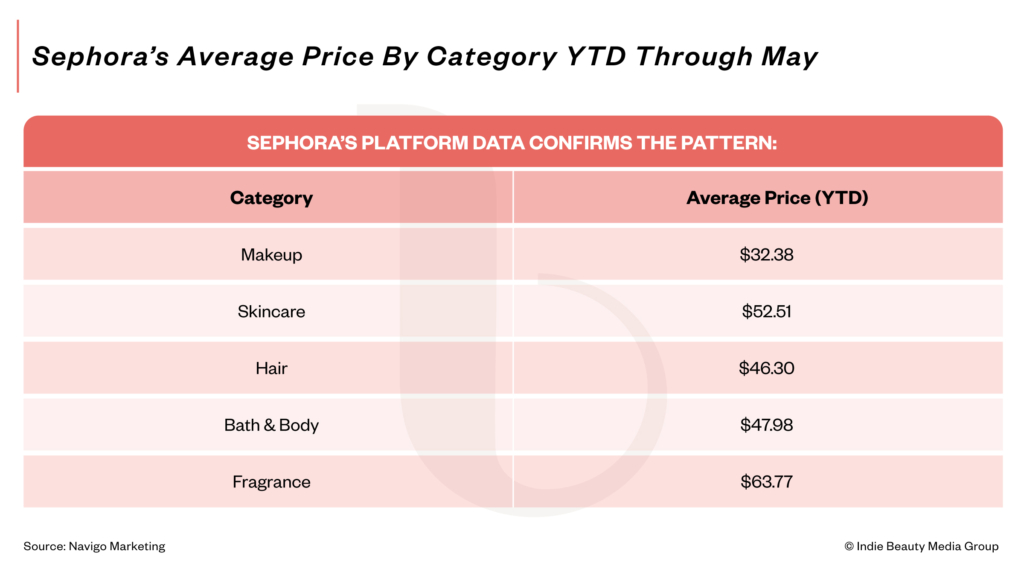
The beauty-buying public has been let in on price inflation by brands revealing price increases to head off disappointing surprises, including E.l.f. Beauty, Rahua, Glow Recipe, Danessa Myricks Beauty, Saie, The Inkey List and Velour. Navigo Marketing founder and CEO Jacob St John reports almost all of his agency’s around 20 beauty brand clients have increased prices, on average about 10%. According to data from Navigo, the average price of the top 20 beauty and personal care products on Amazon was $24.08 in the second quarter versus $21.62 in the first quarter.
Coupled with tariffs, beauty brands are contending with ad rate hikes as they try to break through in a noisy beauty landscape. Navigo Marketing estimates cost-per-click Amazon ad rates have climbed 9% year-to-date. Lord notes customer acquisition costs have jumped 18% to 29% across most categories, with Meta CPMs or the cost for showing ads to 1,000 people up 15% year-over-year.
Lord also notes that fierce competition for breakthrough products is driving up costs. “Rising COGS isn’t just about tariffs,” he says. “It’s also about elevated R&D and innovation expectations. Consumers expect more sophisticated, clinically-backed formulations with visible results, clean and vegan claims, and sustainability certifications, all of which drive up development and ingredient costs.”
In the environment of pervasively higher costs, Rachel Green, founder of beauty and luxury consultancy Rachel Green Consulting, speculates tariffs can give brands cover for raising prices even if non-tariff factors are at play. She says, “Tariffs make it a convenient conversation to have right now. In the past, they might have done it without saying anything.”
Consumer behavior
After plunging in April coinciding with Trump’s “Liberation Day” tariff tidal wave, American consumer confidence as measured by think tank The Conference Board rebounded in the weeks since as he backpedaled. Despite the rebound, Americans largely aren’t fans of Trump’s tariffs and have anticipated they will cause price increases. In a survey of nearly 3,400 consumers conducted by global retail platform First Insight, 75% of American consumers said in May that tariffs will raise prices.
Even though consumers expect them, that doesn’t mean they will stick with their regular shopping habits as they roll out. The First Insight survey shows 36% of consumers plan to cut back on beauty and personal care purchases because of price increases, but are first looking to cut back on home goods (54%), apparel (53%) and electronics (50%). Consumers plan to buy less overall and switch to cheaper brands as prices ascend.
A May survey of 1,000 consumers by Zappi, which was cited by the publication Glossy in June, found that 61% said they would stop buying cosmetics with a 5% price increase and 78% said they would stop buying cosmetics with a 10% price increase. In a real-world illustration of price sensitivity, St John raised the Amazon price of a client’s beauty product to $30 from $27, only to have sales slashed in half. He promptly returned the price to $27.
The results from Amazon’s Prime Day running from July 8 to 11 provided another example of price sensitivity. St John explains, “Historically, our brands that promoted a 20% discount saw an 8X increase in sales. If they went to a 25% discount, that increased their average daily sales to 10X, but, if they went to a 30% discount, it didn’t have any impact. This year, we got closer to a 12X return on a 30% discount.”
Dissecting the revelations from a survey of consumers, McKinsey & Co., wrote, “The pressure is mounting across all price tiers to justify pricing.” The management consultancy pointed out that 83% of consumers in a survey it conducted feel haircare is affordable, but only 67% feel fragrances are, and around a quarter report they’ve traded down to a less expensive beauty product in the last year.
According to CivicScience, the opinion polling firm that fields 1 million poll responses daily, “brand” has been more important than “price” to shoppers since 2021, but, by the end of last year, they became virtually equal in importance. In addition, the firm discovered fewer Americans are following beauty trends and daily makeup wearing has dipped.
With the proliferation of beauty dupes and prevailing belief that their quality rivals that of the products they’re duping, it makes sense to Green that beauty consumers would trade down if product prices increase. Business intelligence company Morning Consult’s survey data finds 27% of U.S. adults have intentionally purchased a dupe of a premium product.
“There is a product at a price point for everyone,” she says. “So, if you don’t want to spend any more on Better Than Sex mascara for $32, you can find one at the drugstore that is almost the same.”
Price-value equation
That doesn’t mean that consumers are completely abandoning expensive products. Brands that stand out for status or efficacy are in demand. St John highlights that Nutrafol’s hair growth supplements priced at $88 on Amazon are a sales leader in the beauty and personal category. St John emphasizes efficacy is the reason why shoppers are willing to pay for the supplements. He says, “Customers are still willing to pay a premium if they see the value.”
For brands contemplating pushing up prices, Green recommends they push the needle to substantiate them by offering, for example, eye-catching before-and-after images, new claims or enhanced ingredients. She says, “If there’s some sort of perceived value you are able to give, that’s certainly better than just increasing the price.”
A common tactic for brands to convey value is to increase their prices along with increased sizing. However, in analysis of the tactic, St John points out that consumers react to the absolute price of a product more than the price per ounce. He says, “You are not going to bring in net new customers with those larger sizes.”
Lord has detected brands shifting from broad awareness strategies to channels with sharper return on ad spend (ROAS) and restructuring their teams by tapping support from fractional consultants and artificial intelligence-powered tools. For beauty brands increasing prices, he advises they draw clear lines between their products’ prices and worth.
“What’s your USP? Clinical efficacy? Ingredient quality? Packaging experience? Origin story?” he says. “That message has to carry from awareness to conversion, from paid social to PDP. It’s not enough to hope the consumer gets it, you have to make it obvious.”
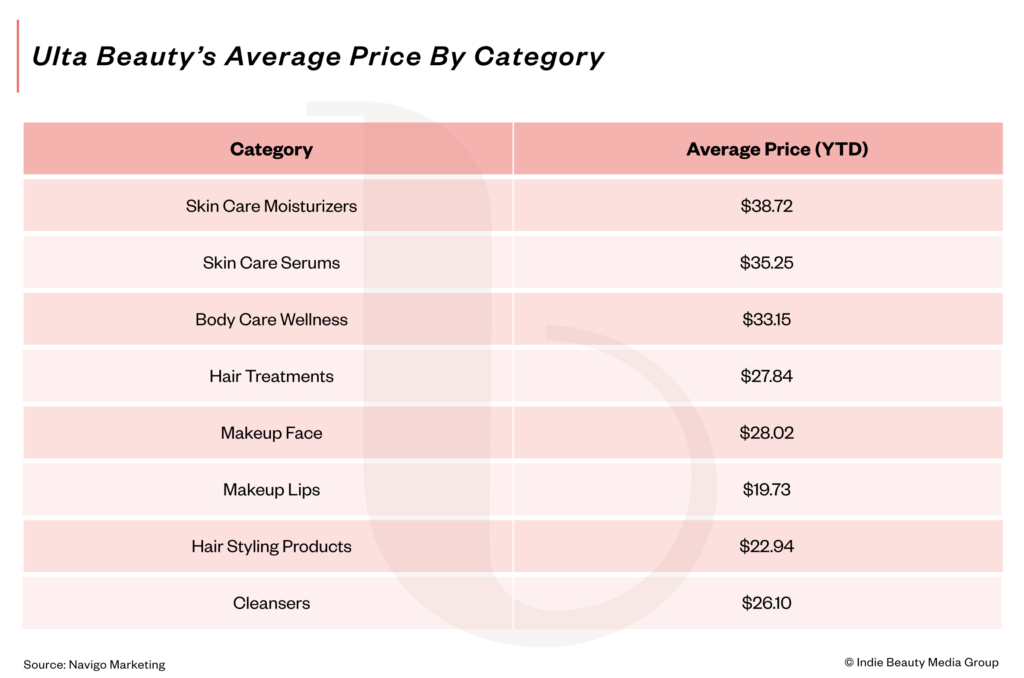
If brands are going to make price changes, Justine Chan, managing director at professional services firm Meru, suggests they make them before the peak fourth-quarter shopping season to allow for ample time for consumers, supply chain partners and retailers to adjust. She urges brands to be transparent about price hikes. Morning Consult’s survey data seconds that. It shows shoppers conclude that brands that communicate tariff-induced price changes are smart, practical and trustworthy.
Many brands remain cautious about raising prices, fearing resistance from jittery consumers with seemingly boundless options. Vanessa Kuykendall, chief engagement officer at Market Defense, figures about a quarter of the firm’s roughly 40 beauty brand clients have increased prices, and most of those have increased them only a dollar here or there.
“We have not seen brands make big moves. They have a wait-and-see attitude,” she says. “They have their ears to the ground of what the consumer is saying, and they react to that. Consumer sentiment is going to be the driving factor.”
The players
5 mentionedAS Beauty

Danessa Myricks Beauty
Formulate
iS Clinical
LVMH Moët Hennessy Louis Vuitton