What Six Virtual Try-On Service Providers Offer Emerging Beauty Brands
In 2014, L’Oréal ventured into virtual makeup try-on with the launch of its app Makeup Genius, which was followed in 2016 by Sephora’s Virtual Artist and Cover Girl’s now-defunct BeautyU. A series of AR and AI acquisitions came next. Ulta Beauty bought AR startups GlamST and QM Scientific in 2018. L’Oreal bought Canadian AR provider ModiFace the same year. L Catterton-backed Il Makiage has purchased two AI innovators: NeoWize in 2019 and Voyage81 this year.
When the pandemic hit and caused retail closures, management consultancy McKinsey & Co. figures the adoption of digital technologies occurred at a rate estimated for seven years in just two years. AR and AI technologies quickly shifted from a nice-to-have to a need-to-have for brands and retailers of all sizes looking to stay competitive—and touchless—in a digital-first world. Service providers have responded by supplying basic AR website features for little to no monthly fees.
To learn more about their offerings, Beauty Independent connected with six AR and AI companies serving emerging beauty and wellness brands. Below, find out about what makes each company unique and the advantages of virtual try-on features.
PERFECT CORP.
Founded in Taiwan in 2014, Perfect Corp. has become one of the largest providers of omnichannel virtual solutions in the beauty industry. From makeup and hair color try-on to skin analysis, diagnostics and shade matching, its technology powers a whopping 10 billion try-ons every year across nearly 400 global brands, including Estée Lauder, Cover Girl, Kylie Cosmetics, MAC Cosmetics, Fenty Beauty, Tarte and E.l.f Cosmetics. Perfect’s YouCam suite of try-on apps have generated over 950 million global downloads.
Launched in 2019, YouCam for Web is Perfect’s self-service subscription-based solution for small- and mid-size businesses interested in integrated AR and AI technologies into their direct-to-consumer strategies. “We have solutions for every type of business, whether that is an indie brand that wants to build its customer base or a large brand looking for custom solutions,” says Perfect CEO Alice Chang. “Our goal is to democratize beauty technology so that everyone has the solutions to make better business decisions and drive powerful customer connections, no matter the size of the brand.”
Brands implement YouCam for Web have experienced up to a 2.5X increase in conversion and a 40% increase in average baskets, according to information on Perfect’s website. Nudestix began working with Perfect in March of this year. The brand implemented its virtual try-on technology across its DTC and social media channels as well as in educational materials and at retail.
“They provide an extremely accurate shade-matching technology to allow customers to make the best purchasing decisions,” says Taylor Frankel, chief brand officer at Nudestix. “We are still working closely with Perfect to make this experience even more accurate than it is currently.” While Frankel declined to discuss Nudestix’s conversion rates, she discloses that over 400,000 visitors have engaged with the virtual try-on technology to date, and blush, eyeshadow, and lip color are the three highest-performing categories.
To fuel expansion, Perfect closed an Goldman Sachs-led $50 million series C funding round in January and recently introduced YouCam AR Tutorial solution. “The technology provides consumers with a guided step-by-step tutorial for learning makeup techniques and also empowers brands with a revolutionary tool to educate their artists on the newest trends,” says Chang, a believer in virtual technologies assisting brands in their sustainability efforts. “These technologies will allow beauty brands of all sizes to significantly reduce the product’s plastic waste created during in the traditional product testing experience. This is a key growth area as brands move toward more sustainable business practices.”
Perfect’s services start at $399 per month for virtual try-on tools involving lipstick and blush. Its premium plan, which extends into eyeshadow, eyeliner, mascara, fake eyelashes and foundation, costs $799 per month.
FACECAKE
Founded over a decade ago, CMO Robb Whittlef says FaceCake created the first beauty AR technology on the market. “We’ve stayed under the radar because we believe that there’s a big play here. I look at this business almost like a pharmaceutical or med-tech company,” he expounds. “We’ve invested over the course of a decade waiting for the moment when the AR/AI explosion would happen. To build VTO [virtual try-on] in an ad or shopping that’s programmatic in scale is difficult and takes time to execute right. We figured out all those processes over the life cycle of the company to be that provider that can serve industries with best-in-class services for companies of any size.”
FaceCake asserts it offers solutions to make the digital shopping experience as realistic and personalized as possible, from front-end AR try-on to back-end AI-driven product recommendations. Its reach spans beyond beauty to categories such as apparel, jewelry, handbags, watches, shoes and home. “We took the view of the whole consumer, understanding that choices they make in beauty are connected to choices they’ll make on what they wear on their body,” says Whittlef. Anastasia Beverly Hills’ brow app was a crucial collaboration for FaceCake when it launched in early 2021. Designed to be similar to a brow appointment in the palms of consumers’ hands, the app analyzes users’ faces to find the best brow shapes for them.
“We did the world’s first AR try-on for eyebrows with ABH. That technology is revolutionary. It virtually reshapes your eyebrows according to Anastasia’s patented Golden Ratio principle. To be able to do that across all skin tones, undertones, ethnicities, ages and demographics in a real time basis totally changes the game,” says Whittlef. He reports that downloads for the app have been “well beyond expectation.”
To date, FaceCake has racked up over 100 beauty brand partners, including Too Faced, Physician’s Formula, Wet ‘n’ Wild, Lancôme, Shiseido and Battington Lashes. Further partnerships with budding beauty brands are in the works. This month, FaceCake is slated to launch a years-in-the-making AR comparison tool enabling users to interact with up to four frames simultaneously in real time.
In an effort to democratize its services and draw smaller clients, FaceCake employs an affiliate model rather than charging an upfront cost. The company receives a nominal percentage of purchases each time its virtual try-on technology converts a customer. The company wouldn’t reveal the exact percentage, but says it’s within the ballpark of many beauty industry affiliate programs.
MIME
CEO Chris Merkle founded AI personalization company MIME to solve what he saw as a big problem consumers face when beauty shopping: pinning down the right complexion product for their skin tones. “We want to be No. 1 in the market for shade matching,” he says. “So, we built out all this tech around lighting normalization, where the light is coming from, what type of light it is, the highlights and shadows on your face, all to figure out the best regions to get readings from.”
After users answer a few short questions and take a selfie, MIME’s patented algorithms go to work locating their ideal foundation shades, a process Merkle divulges typically results in over 50% of consumers clicking through to find out more about products. “We build the confidence of the shopper because we’re showing them something extremely relevant and personalized to them very quickly,” he says. “We’ve seen as high as 20% conversion rates with our technology, meaning one out of five people have gone through to purchase. That’s mind-blowing for us.”
Between 60 to 70 beauty brands tap MIME’s shade-matching technology, including several color brands listed with Cult Beauty. MIME partnered with the British beauty e-tail powerhouse retailer to launch its MatchMe service in early 2021. The service analyzes nearly 1,730 foundation shades from 83 product lines and 35 brands to determine matches.
“What was great about Cult Beauty was bringing all those brands to the table. In the beginning, we were making small-scale recommendations, one out of six shades, for example, but they challenged us to broaden our service across over a thousand shades. That was a huge challenge and something we’re very proud of delivering on,” says Merkle. who reports that MIME has assisted 1 million shoppers to date and completed over 1.4 million shade matches through its brand and retail partnerships.
While MIME’s technology doesn’t currently work on non-complexion color cosmetics products like blush and lipstick, it recently launched a curation tool on Charlotte Tilbury’s direct-to-consumer platform that builds a personalized complexion routine from a user’s shade match. Think primer, concealer, powder and bronzer. MIME also rolled out a shop-the-look-type tool with Monika Blunder Beauty that recommends various shades of Blunder Cover Foundation for different areas of the face. Two additional retail partnerships and a possible skin analysis tool are on deck for MIME in 2022. Its services start at $125 per month.
CAMERA IQ
Launched in 2016, Camera IQ is a female-founded AR technology startup hyper-focused on the creation, integration and promotion of AR experiences across social media platforms. Rooted in the consumer packaged goods, media and entertainment industries, where the company serves major clients like Nestle, Viacom, HBO Max and Bumble, Cameria IQ stretched into beauty 2019. At the moment, it has 15 indie and corporate beauty clients on its roster such as MAC, Smashbox, Avon, LoveSeen, Dominique Cosmetics, Undone Beauty and BeSpoke Beauty.
Since its debut in summer 2021, Camera IQ’s Composer feature allows beauty brands, influencers and beauty professionals to wield AR effects directly. It’s akin to no-code AR for people who have no programming experience. “We are so excited that our tool is giving rise to a new role or function at beauty brands: the digital makeup artist,” says Allison Ferenci, co-founder and CEO of Camera IQ. “For our major beauty brands, it’s given them the opportunity to scale their AR strategy across their regional teams, making AR an integral medium throughout the brand’s global strategy. For our indie partners, we’ve successfully turned marketers into beauty creators and designers who are now empowered to launch their own experiences.”
For the launch of its Coral Blossom Palette in October, Dominique Cosmetics created two AR effects for Instagram in collaboration with Camera IQ. One allowed users to virtually try on two signature looks from the palette. The other took inspiration from the palette’s tag line, “There’s beauty in growth,” to create an experience where users were digitally surrounded by butterflies and greenery. The collaboration underscores Camera IQ’s full-funnel strategy helping brands create experiences that instigate conversion, acquisition and engagement as high as 4X greater than a photo or video.
“In addition to traditional VTO, brands want experiences that will evoke emotion in their users and make them feel good in their makeup and confident in their brand. Ultimately, they’re looking for a moment of connection and to drive engagement and educate their users on what makes their products and brand unique. That means that instead of over-the-top and heavily branded AR effects, they’re creating simple and beautiful effects that make the user the star of the show,” says Ferenci. On average, she shares 50% to 80% of people scrolling past a Camera IQ experience choose to opt in and engage. Social media has been the company’s primary area of focus thus far, but additional distribution channels are in the pipeline for 2022.
HOLITION
While global luxury brands were hesitant to adopt digital strategies in the late 2000s, the founders of award-winning British digital retail agency Holition felt they should go in a different direction. “At the beginning, it was thought that digital would commoditize luxury, and that was bad,” says John Peeters, head of global business development at Holition. “But Holition saw the world embrace this new and arising digital-savvy consumer, so we wanted to bridge the gap with old school luxury.” In the over a decade since its launch, Holition has produced large-scale retail installations, data visualizations and interactive runway shows for clients such as Tiffany & Co., Louis Vuitton, BMW and Hermes.
Holition plays in beauty, and some of the world’s biggest beauty companies—Puig and Coty among them—are its clients. In 2015, the agency designed Rimmel’s Get The Look App allowing users to snap a photo of any makeup look from any face—live, on screen or in print—and “get the look” in seconds to try on virtually. After creating what Peeters refers to as the world’s first interactive “magic mirror” for Uniqlo in 2012, Holition deployed the “magic mirror” for Cover Girl and Charlotte Tilbury at retail in 2018 and 2016, respectively, facilitating virtual try-on inside stores.
Holition brought Burberry Beauty’s first AR activation to market in 2020. The web-based Burberry Beauty Virtual Studio combined AR and AI with facial-tracking technology to aid customers with discovering and trying on products. It also featured AR-guided tutorials. Peeters predicts immersive tutorials will soon be top-of-mind for all AR providers. “I’m convinced that tutorials will be that perfected in a few years’ time where you look into your phone or your iPad and it tells you where to apply which color on which part of your face,” he says. “It’s like putting a makeup artist into a digital device.”
Wanting to capture small- and mid-size brands, Holition launched Beauty By Holition in 2020 to extend its VTO and skin analysis services to AR/AI-interested companies with tight resources. “Our Beauty By addition is the evolution of something that’s been iterated over for many years, so when we launched 18 months ago the product was very polished in how it gets deployed. It gets deployed into browser at very high speed,” says Russell Freeman, CTO of Holition. “We’ve put a lot of effort in the visual quality of our rendering because we’ve come from the luxury side of things. We have nearly a decade’s worth of experience in color and how it renders on the screen.”
He elaborates that dozens of Holition’s international clients use its Beauty By technology, including CTZN Cosmetics, Banana Beauty, Karen Murrell and Rollover Reaction. Pricing for makeup VTO ranges from 300 pounds or about $400 per month to 5,000 pounds or about $6,695 per month. Holition’s Virtual Skincare Lab, which includes AI skin analysis, is 1,500 pounds or about $2,000 per month.
VIRTOOAL
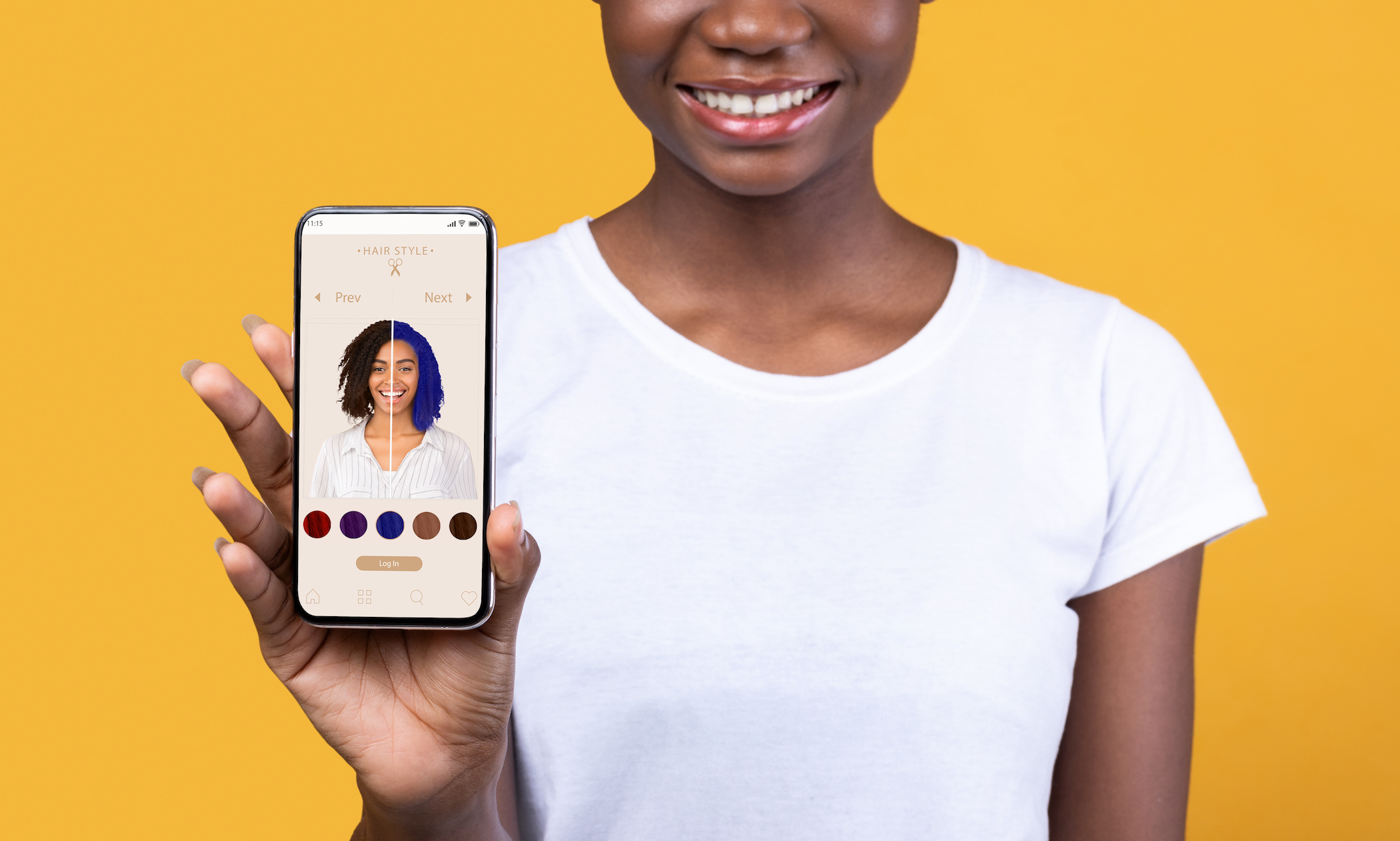
The first iteration of Virtooal was a popular hairstyle try-on website in Europe called easyhairstyle.com, which launched in 2008. “We earned our first million dollars from that. It grew organically without any marketing,” says Ondrej Bagin, co-founder and CEO. When big European drugstore chains like Rossmann started inquiring about the possibility of virtual try-on for cosmetics, Bagin was confident Virtooal could satisfy their demands.
After a rebrand, Prague-based Virtooal officially launched in 2015 with VTO services it dubs Magic Mirror. The company works across across beauty and fashion, and has about 70 beauty clients around the globe, including Avon, Dermacol, Panvel and Ezebra. Past clients include Rossmann, L’Oréal and Iman Cosmetics. Virtooal had a seminal partnership with Iman Cosmetics that helped diversify its model library.
One of Virtooal’s main goals has been to deploy AR try-on as a quick and easy plug-and-play solution for smaller brands and retailers to integrate into their e-commerce websites. “We deliver a solution where the client can create and customize the try-on themselves or with us through consultation. It’s very affordable as the system is built to be used very easily,” says Bagin. “AR is going to be more and more democratized over time, so we’re trying to be prepared for that. We have 300 paying customers now worldwide, but I believe in just a few years it will increase to 3,000 or 5,000.”
A distinct point of differentiation, Virtooal offers tiered pricing. The cheapest option is called “freemium.” Specifically targeted to smaller brands with comparatively limited assortments and mounting traffic, the “freemium” plan covers up to 100 unique monthly users to a brand’s Magic Mirror with 50 products available for try on. No technical support or usage statistics are provided. Bagin says Virtooal currently has 5,000 customers on the “freemium” plan. Packages can cost $359 per month or more for a custom offering. In 2022, Virtooal is slated for an upgrade to make its VTO more realistic, and it plans to expand distribution to social channels.
Heather Fink, CEO and founder of The Sexiest Beauty, a client of Virtooal, was on the hunt for web-based VTO prior to the pandemic. “As a smaller brand with limited distribution and a focus on bringing in new customers, I knew that it would be helpful to give shoppers the opportunity to ‘try on’ our lip colors before buying,” says Fink. “I was searching for the next best option after a physical tester and, then, COVID hit. Customers were shopping from home more than ever. It became even more critical.”
The Sexiest Beauty is in Virtooal’s “lite” tier, which is $39 per month for up to 100 active products available for VTO. For the brand, the feature garners 1,000 unique monthly users. Virtooal’s Magic Mirror tool debuted on The Sexiest Beauty’s website in June 2020 after an integration process Fink describes as “easy and affordable.” The brand’s 40 color SKUs are available for VTO. Fink says The Sexiest Beauty customers find the try-on experience fun and informative.
The players
5 mentionedMomentous

MAC Cosmetics
Function of Beauty
Il Makiage
Charlotte Tilbury