The Surprisingly Confident State Of Indie Beauty 2025
And yet indie beauty entrepreneurs are hardly down for the count. Instead, they’re perhaps surprisingly confident that the appetite for products from beauty upstarts isn’t satiated, and their positions in the market are even strengthening amid a transformational period in beauty defined by a shifting of the guard in retail, robust demand from gen Z and gen alpha, and the enduring allure of new things.
In a survey conducted by Beauty Independent last month of indie beauty brands, over 86% of around 150 respondents forecast their sales will increase this year. Many described themselves as optimistic that their brands are primed for acceleration after fine-tuning distribution—professional channel strategies and pivots to or away from brick-and-mortar retail were commonly reported—and magnifying their differentiation.
One optimistic respondent says, “Indie beauty continues to grow more competitive, but that only sharpens our focus. As an independent brand, we can’t compete with the sheer scale of big-budget marketing—and we don’t want to. Instead, we’re digging deeper into our brand’s story and values, staying true to ourselves. In a crowded market, that authenticity becomes our quiet advantage.”
Another says, “Long term, I still believe in indie beauty, but it’s definitely a tougher playing field. A great product isn’t enough anymore. You need focus, staying power and a story that actually earns attention. It’s forcing founders to be sharper, and while that’s hard, it’s also where the best ideas rise.”
Data supports brands’ confidence in the potential of indie beauty. According to market research firm NIQ, indie beauty brands are persistently snatching market share from legacy players. In the 52 weeks ended June 14, independently owned and operated brands with under $300 million in annual revenues accounted for 31% of the $120 billion American beauty industry, up from 28% of the $109 billion industry in the preceding 52 weeks, and indie beauty brands’ sales jumped 21.6% versus 5.4% for conglomerates.
Amazon and TikTok Shop, distribution channels without the wide moats of Ulta Beauty and Sephora, are siphoning dollars from beauty specialty and big-box stores. They were the top retail share gainers in beauty in the first half of this year, according to consumer insights firm YipitData. NIQ estimates Amazon is capturing nearly 50% of indie beauty sales compared to 18.3% for beauty specialty and 10.2% for mass.
It’s not necessarily indie beauty per se that’s fueling consumers to choose indie brands. According to a survey of 3,127 consumers conducted by Toluna for investment firm Coefficient Capital and media outlet The New Consumer, 44% of gen Zers and millennials don’t prefer small indie brands and 52% of gen Xers and older don’t prefer them. Among consumers who prefer smaller, indie brands, trust, price and unique innovations are the primary reasons.
Cassie Cowman, co-founder and partner at beauty consultancy View from 32, says, “Indie brands resonate because, in the Sephoras of the world, they’re pushing those brands, they’re pushing the exclusive brands, but the big brands still have a level of trust with the consumer that the indies need to build. That’s the biggest opportunity from day one, start building that trust so that you can have loyalty and longevity.”
Retailers like Sephora breed newness and indie energy to compete in a Darwinian retail environment. That’s clear from the emphasis the beauty specialty chain is putting on exclusive brand launches such as Chris McMillan’s namesake haircare brand, M.Ph from makeup artist Mary Phillips, and the forthcoming fragrance brand Lore from industry veterans Melanie Bender, Joe Cloyes, Greg Gonzalez and Mazdack Rassi.
YipitData finds that exclusive brands at Sephora like Kayali, One/Size and Patrick Ta deepen consumers’ wallet with the retailer. On the other hand, customers for a brand like Biodance, which entered the Amazon fray prior to landing at Sephora, largely purchase replenishment products on Amazon rather than Sephora.
In fragrance, a blazing category that’s seen its growth cool lately, new products have been the preeminent growth drivers. According to YipitData, in the first half of this year, fragrance category sales increased 14% and 9% of that increase was from new stockkeeping units. Two years ago, one-third of shoppers were buying three or more fragrances in a 12-month stretch. Today, YipitData figures that’s gone up to two-thirds of shoppers.
“This is an exciting time, especially for brands who are launching new SKUs in the category,” says Chelsey Birgisdottir, an analyst at YipitData during a webinar on beauty in the first half of this year. “Customers are interested, they’re willing to test things out…They’re willing to broaden their wardrobe.”
DISTRIBUTION
If 2024 was the year of Sephora in beauty retail, 2025 has been the year of Amazon, at least so far. It became the No. 1 beauty retailer this year—and its beauty encroachment isn’t expected to ebb. According to financial services firm TD Cowen, Amazon’s market share is anticipated to rise 6% over the next five years to account for 15% of the beauty retail market by 2030.
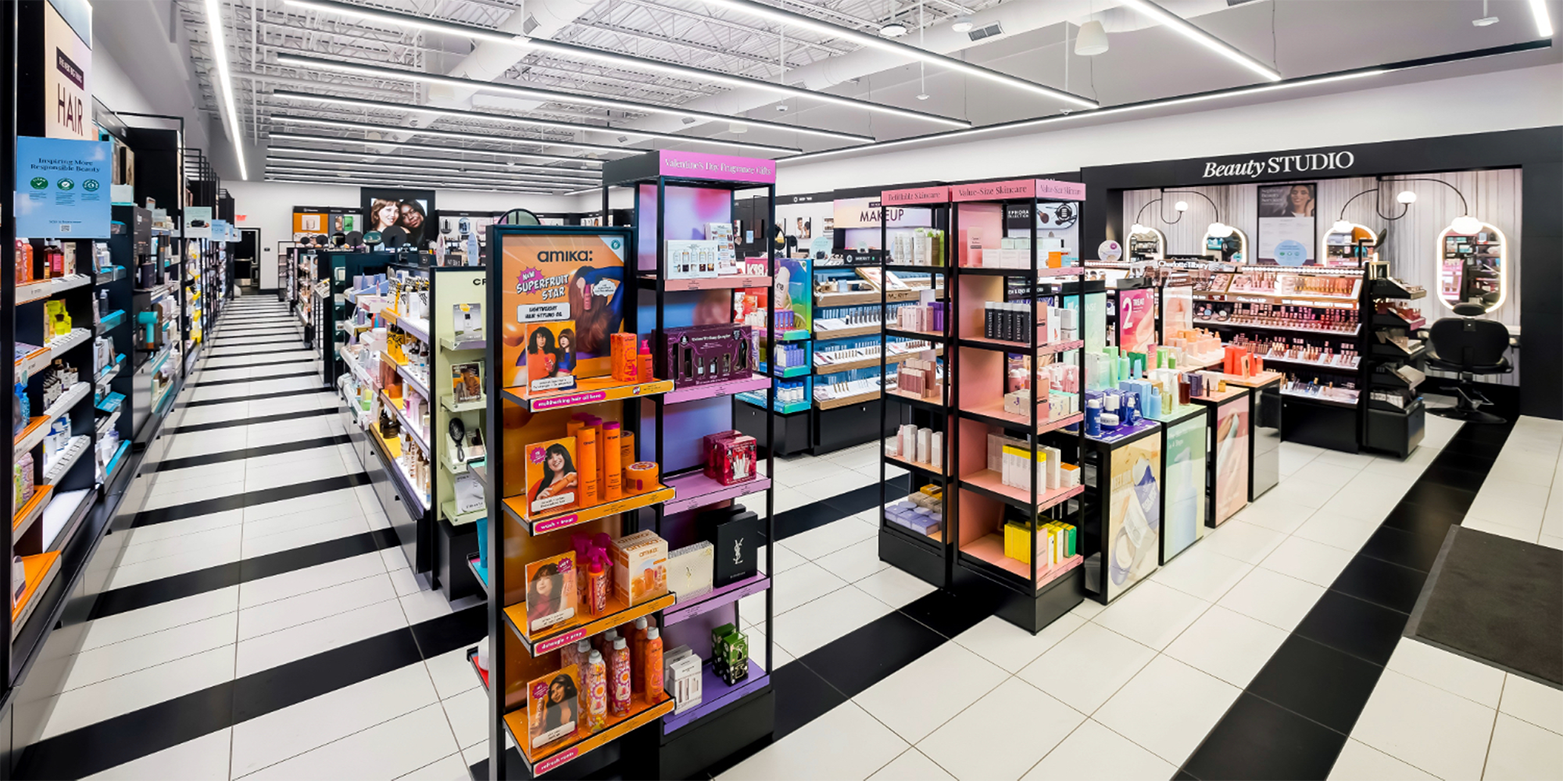
Amazon’s beauty rivals have been making aggressive counter moves. Sephora announced earlier this year that it’s redesigning its entire North American store fleet of over 700 locations to improve the shopping experience, marking the largest capital investment in its history. Walmart is busy building out its premium beauty business, now encompassing 2,500 products from 80-plus brands. Ulta acquired British beauty specialty retailer Space NK to achieve instant international scale while it readies to launch a third-party marketplace this fall to extend its offering stateside.
For emerging beauty brands, retail chains are dog-eat-dog environments where profitability has become elusive, and brands have to pour millions into marketing to cut through the clutter. Retail sales agency Bright Beauty Connect’s brand partners have reported that in-store fees have increased 20% to 30% over the last year at large retailers like Sephora, Ulta and Bluemercury.
“Large beauty retail is broken,” says Susannah Dellinger, founder and CEO of Bright Beauty Connect. “Beauty retail has not been set up to support brands of any size to help them become profitable. They are being squeezed in every angle in a way that I have not seen before and I’ve been in this since 2002.”
Despite surging costs, brick-and-mortar retail continues to be indispensable in beauty, especially as brands navigate what Dellinger refers to as a “trust recession” with shoppers regularly questioning the authenticity of what they find online. According to management consultancy McKinsey & Co.’s “State of Beauty 2025” report written in collaboration with the publication The Business of Fashion, brick-and-mortar accounted for 74% of global beauty purchases in 2024. However, its share is forecast to decrease over the next five years to 70%, with e-commerce accounting for nearly a third of global beauty purchases.
For brands stocked at big retailers, Dellinger recommends they tighten assortments and zero in on top sellers and bundles. “Do as much as you can in terms of community driving,” she advises. “If you are not showing up, you are sitting on the shelf and just counting down the days until they tell you that there’s an RTV [return to vendor] coming. That is the death sentence for these brands.”
Consumers’ interactions with stores are rapidly changing. Digitally savvy and heavily trend-led, younger consumers are relying on TikTok and ChatGPT to search for products and recommendations when they visit beauty stores. “The best retailers are going to figure out how to bring that kind of AI-assisted expertise to life,” says Dellinger. “On the brand side, how can they really engage on their visual merchandising?”
As beauty brands race to optimize for ChatGPT, artificial intelligence-centric third-party agencies are popping up to serve them. One of them is Antidote, a marketing agency started by former L’Oréal and Shiseido VP Benjamin Lord that’s introduced generative engine optimization (GEO) services to boost brands’ visibility in AI searches. Lord asserts that GEO allows for a stronger connection with customers than standard Meta advertising.
“When you appear in an AI-generated response, you’re not just getting a click, you’re being recommended as the solution to a specific problem by what consumers perceive as an objective, intelligent source. The recall and conversion rates are dramatically higher,” he says. “The brands investing in GEO now will have insurmountable advantages when this becomes mainstream. It might not have Meta’s current scale, but it represents the future of high-intent, high-conversion discovery.”
Coupled with AI’s proliferation, DTC has gotten significantly harder for beauty brands to navigate over the past year. Lord approximates customer acquisition costs have climbed between 18% to 29% across most categories, while Meta ad rates have increased 15% year-over-year. Return on advertising spend declined to 1.67 compared to higher industry averages. Customers are overwhelmed by the deluge of advertising, causing a 15.31% decline in click-through rates.
The spread of third-party marketplaces is adding another wrinkle, further forcing time- and cash-strapped brands to decipher the platforms worth tackling. “Being everywhere without a clear value proposition is a recipe for stagnation,” says Justin Boettcher, CEO and e-commerce strategist at Synsthsa Consulting and former senior manager of business development for Amazon Premium Beauty. “One could also say all these marketplaces will give new opportunities to niche/new brands, but a crowded beauty market plus crowded marketplace offering seems like the consumer will fatigue and newness will slow, showing more cracks in the space.”
TikTok Shop, arguably one of the most important third-party marketplaces with $2 billion in beauty sales generated in just two years, is a must for many brands, but not without difficulties. “It’s a margin disaster. You need to hit $15 to $20 price points, which means massive discounting from typical prestige positioning,” says Lord. “TikTok charges sellers a 1.8% fee even on cancelled or returned orders, and beauty products often can’t be returned due to hygiene concerns, creating a double margin hit. When you factor in return rates and automatic refunds for items under $10, your net sales can be half your gross sales.”
Having the right channel footprint is critical to achieve DTC scale. Lord mentions brands that derive 60% to 70% of their revenues from their websites typically achieve greater profitability than those that are overly reliant on wholesale channels. He says, “The key is treating Amazon as a discovery and convenience channel while keeping TikTok Shop out of your premium strategy entirely.”
Digging into metrics even further, he advises brands to adopt a surgical approach when it comes to their DTC businesses. That includes “maintaining >70% gross margins, achieving blended ROAS >2.5, and securing three- to four-month repeat purchase rates while building differentiated brand stories that can cut through an increasingly crowded market,” details Lord. “It’s about real added value, not just points. While Sephora and Ulta rely on traditional points-based systems, DTC brands can offer jumbo sizes or exclusivity at regular prices, benefits that wholesale partners can’t match.”
Dellinger argues that indie shops and grocers are the most significant channels of opportunity for emerging beauty brands today. She notes Whole Foods has been actively onboarding beauty brands with prestige price points. “They see their shopper on average 45 times a year. Beauty sees their shopper on average four times a year,” she says. “The chance of conversion is so high with volume in grocery. Erewhon definitely led the way, but I think that now that Whole Foods and Sprouts are getting in the mix, it’s going to be really interesting.”
SUPPLY CHAIN
Punishing tariffs have been the main supply chain story of the year, especially for small businesses taking an outsized wallop from them. The Cut Buddy, a grooming brand selling hair shavers and clippers, was slammed with a 152% tariff on its goods manufactured in China following President Donald Trump’s “Liberation Day” tariff rollout. Instead of passing the cost to consumers, which could’ve ruined velocity and revenue, the brand made cuts elsewhere, including lowering donations to disabled veterans, slashing ad expenses and firing three marketing consultants. While tariffs on The Cut Buddy’s goods have declined to the 30% range, impacts remain.
Founder Joshua Esnard says, “What we’re going to look at is a waterfall situation where I already took the kick in the nuts from the tariffs on my P&L, but I’m still going to feel the pain of this because, for instance, I have to send my balance sheet to funders or investors, and they’re going to have a big question about why my profit margin has gone down so much.”
Slayyy Hair lost around $350,000 when a May shipment from China was tariffed at 145%. Though the tariff has dropped to 37.5%, the synthetic braiding hair brand decided to raise prices on Aug. 1 as a result of the levy. Founder Diann Valentine says, “We have seen a dip in our sales, but we are hopeful that the difference in [the quality of] Slayyy can withstand the slight cost increase.”
E.l.f. Beauty, Rahua, Glow Recipe, Danessa Myricks Beauty, Saie, The Inkey List and Velour join Slayyy in pushing up prices. Beauty product prices are climbing faster than prices overall, with prestige beauty brands passing on steeper price increases than mass beauty brands. According to predictive commerce intelligence firm Daash, the average price of a prestige beauty product climbed 12% to $35.78 in June from a year ago.
The beauty industry’s dependence on China for production, ingredients and packaging has been a key factor propelling price increases. Brands are looking elsewhere. Esnard and Valentine have explored manufacturing in other countries, throwing out Malaysia, Mexico, Bangladesh and Vietnam as options, but they have concerns about quality. Esnard says, “The problem is no one else makes batteries and motors and circuits better than China right now.”
One of the goals of the tariffs is to bring manufacturing back to the United States, where only 7% of beauty products sold in the country are manufactured, according to market research firm NIQ. Mary Berry, founder of Austin-based contract manufacturer Cosmos Labs, and Darryl Do, senior perfumer for New York-based manufacturer Delbia Do, have both experienced an increase in clients following the imposition of tariffs. Berry says, “Brands are looking at their options of saying, OK, well, we love our Canadian manufacturer, but we want to sign up with another manufacturer just in case something happens tariffs wise.”
Domestic production isn’t immune to the cost implications of tariffs. Beauty ingredients are sourced from around the world. Cosmos Labs stockpiled ingredients often used in haircare, but they’ve become pricier due to tariffs. Some brands are reformulating to swap ingredients from high-tariffed countries to ingredients from low-tariffed countries.
Berry says, “For something that’s already expensive, if there’s even a 10% increase, that’s significant.” Do says, “If I can get the same material from, say, Mexico or South America that I can from Europe, then I’m looking at that as well. Trying to figure out all the avenues I can pursue in order to get these raw materials and also get them at a decent price.”
More than ever, AJ Addae, founder of beauty research and development company Sula Labs, has noticed brands prioritize high-margin products. She says there’s “less newness in terms of developing products and a lot more of being really smart about how we can get together really good claims for the products that they already do have.”
With the Modernization of Cosmetics Regulation Act (MoCRA), legislation that was passed in 2022 to expand the U.S. Food and Drug Administration’s authority over cosmetics regulation, in effect, product launches were becoming costlier tariffs or no tariffs. Addae says, “It may have been cheaper a couple of years ago because you could go around certain compliance testing, but now you do have to spend that extra money on those regulatory measures, so that’s an added cost compounded with the tariffs.”
Esnard advises founders double down on forecasting and renegotiate deals with their supply chain partners. When The Cut Buddy’s products were slapped with a 152% tariff, he asked for a better price and payment terms from its manufacturer. Esnard says, “If you’ve had a good rapport with your manufacturer and your clients, it’s always good to tell them what’s going on ahead of time.” He adds, “To those that are thinking about shutting their doors or closing down, I understand, but just try to keep fighting. There’s always some sort of solution. It just comes at a cost.”
Berry doesn’t foresee supply chain issues subsiding anytime soon, and indie beauty brands will be ensnarled in those issues. “I certainly think that there’s going to be more closures of brands this year or more sales and not amazing sales,” she says. “I don’t necessarily think that it’s a trend as much as I think it’s a new normal. I think for, as long as I’m in this supply chain business, from here on out, it’s hard.”
Addae agrees that inconveniences like tariffs and supply chain delays will stick around—and brands should account for them on the front end. She says, “You have to build the product in a way that it is amenable to several different economic realities.”
MARKETING
In Beauty Independent’s survey of indie beauty brands last year, funding and digital ad costs were tied as the most challenging aspects of business. This year, digital ad costs stood alone as the most challenging aspect of business. The publication Digiday has reported some content creators are doubling their rates, and the rate hikes are occurring as brands face exorbitant pressure to churn out content. Renee Ogaki, founder of the agency Ogaki Digital, says, “Brands are so overwhelmed by the volume of content that they need to succeed.”
For emerging brands, the burden of creating content for multiple channels falls on the founder or a contractor. For brands that have scaled, the CMO role is transmuting at the pace of social media. Sharon Fox, operating partner at private equity firm Stride Consumer Partners, calls the contemporary role a “full-stack CMO” and describes it as a marketing leader who oversees full-funnel marketing with an omnichannel scope.
Fox says, “Brands that are winning recognize the fluidity between sales and marketing and the need for a brand’s communication strategy to be woven effectively across consumer touchpoints…This type of organization design removes silos and increases the efficiency and effectiveness of the impact of integrated marketing. It is where the magic happens.” She elaborates, “Brands should prioritize a leader in their organization that owns and is accountable for a thoughtful test-and-learn marketing strategy and the key metrics that underpin success.”
The integration complicates the marketing function and can overwhelm people working on it. Ogaki points to the recent development of Instagram posts indexing in Google searches, fortifying the link between social and search, complicating matters.
“Everyone is using search and social media together, which I don’t think is how anyone thought about marketing a year or two years ago,” she says. “You need to think about your social media keyword strategy and social media captions in your SEO strategy. Captions can’t be an afterthought in your content, it’s how people are going to discover your brand, not only on the social channels, but also on Google and ChatGPT.”
Aggie Burnett, founder of beauty brand strategy firm AB Creative, has observed brands niching down on organic messaging registering impressive growth. For example, when Milusos, a personal care brand that specializes in anti-fungal products for athletes, tailored its messaging for Jiu-jitsu practitioners rather than athletes more broadly, it doubled its DTC conversion rate, and its year-over-year conversion rate has skyrocketed 10X. Burnett says, “It really shows us the power of the niching.”
Burnett suggests brands begin spending on digital ads after they nail organic messaging. “For indie brands, that’s not necessarily something they have a budget for,” she says. “I can’t even tell you how many of our founders have gotten burned just spending thousands and thousands of dollars on ads because that’s what they heard they were supposed to do, testing out different audiences, different messaging.”
Burnett’s brand clients have seen improvements with their return on Meta’s Advantage+ AI ad targeting optimization tool. An update to it has done away with interest targeting, the traditional way brands decided who their ads would be served to. Burnett sees the move as a boon to emerging brands that have honed their messaging.
“The algorithm has been updated to be a lot more sophisticated to read and comprehend content and keywords and who something should be served to…It is causing trouble for brands that are not adapting and who don’t understand that your messaging has to be hyper dialed in,” she says. “Every word counts versus testing a bunch of content on Meta and see what sticks.”
How do brands know whether they’ve crafted their messaging well enough to invest in ads? Burnett uses a few basic benchmarks, including a DTC site that’s notching conversion rates of at least 1% to 2%, email open rates above 30% and click-through rates of at least 2%. Social media metrics are trickier to pin down, but she gives an engagement rate of .5% as a minimum.
Ogaki has detected an uptick in spend on influencer marketing this year—global spending on influencer advertising is forecast to advance at an annual growth rate of 9.37% to go from roughly $33 billion in 2025 to $56 billion by 2029, data from information resource Statista shows—and every brand client wants in on affiliate marketing through platforms like TikTok Shop and ShopMy.
“A huge part of that strategy is in the target development,” says Ogaki. “A lot of people struggle with that because they think they can just launch a TikTok Shop program, and they’re going to have this giant success that they see other brands doing, but there’s a huge strategy behind that to lead to that success, and it’s extremely competitive.”
Ogaki counsels brands to pore over the metrics the platforms provide to find the best affiliates. She highlights that TikTok Shop allows brands to view the gross merchandise value (GMV) content creators have spawned in the past, and Ogaki advises brands to investigate the types of products they’ve sold most often. She says, “They might be driving great sales for a $5 Amazon product, which might not be relevant to your brand.”
The average order value on TikTok Shop is $32, according to Earnest Analytics Orion transaction data cited by Coefficient and The New Consumer. Because TikTok Shop rewards volume, Ogaki encourages brands to gift at least 100 products a month. Mailers don’t have to be elaborate. A single product for a creator to check out is sufficient.
“Maybe there’s a product that you have a lot of inventory and that you’re trying to sell through,” says Ogaki. “That’s a good place to start.”
The players
5 mentionedBetter Being

E.l.f. Beauty
Too Faced
Space NK
Danessa Myricks Beauty