Post–Space NK, Beautyspace Plans To Open Its Own Stores In NYC This Year
The prestige wholesale curator, an outgrowth of Space NK’s former arm in the United States, plans to open two branded brick-and-mortar stores in New York City this year. Following the debut of a new direct-to-consumer website in December, the store openings will see Beautyspace return to freestanding retail after a six-year absence. This time, it’s under the stewardship of The PCA Companies, the beauty distributor that bought it from British beauty retailer Space NK in 2024 for an undisclosed sum. PCA purchased inclusive beauty retailer Thirteen Lune the same year through its private equity division, SNR Capital.
Previously, Beautyspace operated about 18 Space NK boutiques in the U.S. that were shuttered in 2020, when it transitioned exclusively to wholesale partnerships. It launched BeautyspaceNK prestige shop-in-shops in 250 Walmart doors in 2022, a number that’s since increased to 280, before spreading the concept to Nordstrom Rack a year later. Prior to 2020, it established shop-in-shop partnerships with Bloomingdale’s, Nordstrom and Macy’s.
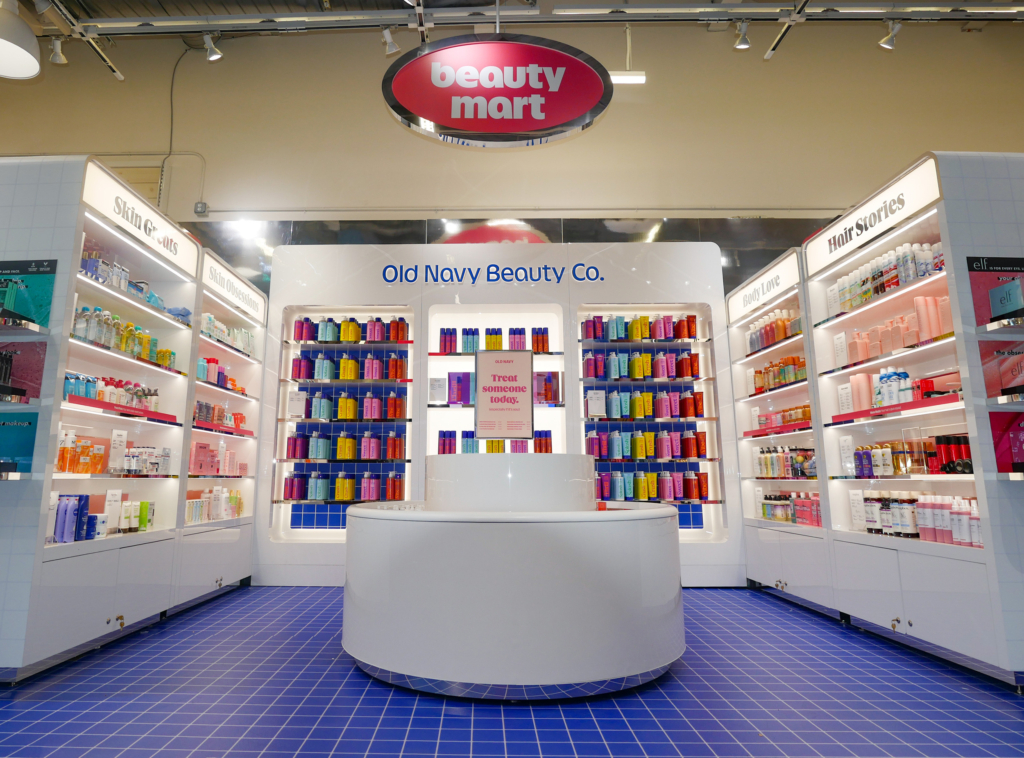
Under PCA, Beautyspace dropped the “NK” from its name and rolled out to 50 Dillard’s locations last year. It also won a bid to spearhead Gap’s third-party beauty assortment for Old Navy, where it’s in 151 locations now.
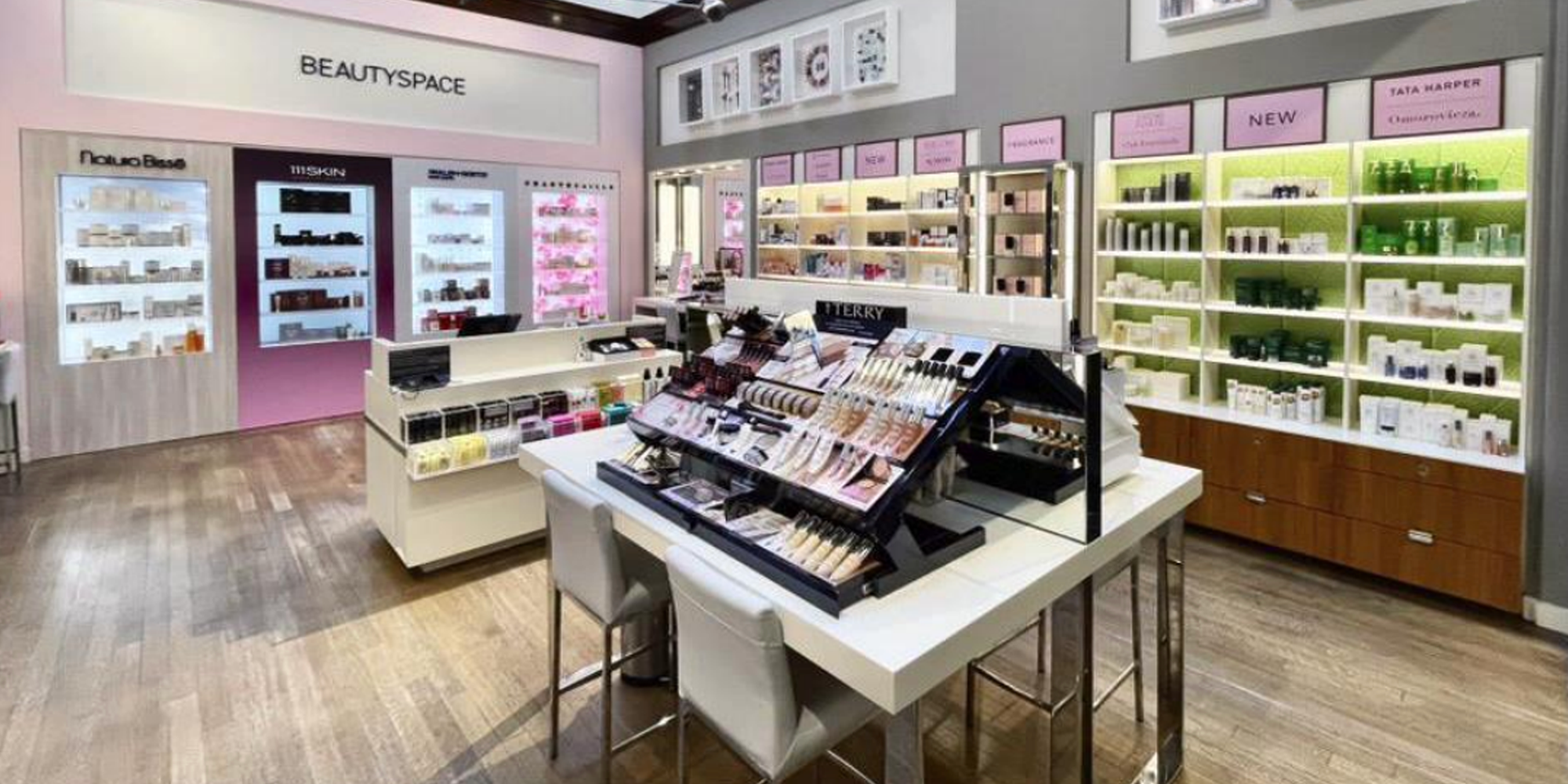
Today, Beautyspace stocks about 150 beauty brands, including Aesop, SkinMedica, Virtue, Living Proof, Olaplex, Natura Bisse, Kevyn Aucoin, Bare Minerals and Hourglass, across 750-plus points of distribution at Bloomingdale’s, Nordstrom, Macy’s, Dillard’s, Walmart and Nordstrom Rack. At Nordstrom and Bloomingdale’s, it registered double-digit increases in the fourth quarter, and it expects to expand to an additional regional department store retailer this spring.
Beauty Independent spoke with Noah Rosenblatt, president of Beautyspace, about the challenges facing the business, dynamics driving mass-market beauty, products gaining momentum across prestige, mass-market and off-price channels, and early results from its partnership with Old Navy.
Beautyspace has expanded across distinct retail channels. How has its brand matrix evolved along with that expansion?
Across prestige, mass and off-price, our business is evenly split. Obviously, that breaks down into productivity by location. I have 27 Bloomingdale stores that do an equivalent dollar base to 250 Walmart doors. So, there’s productivity based on AUR [average unit retail].
We want to be a great service provider to our retail partners regardless of the matrix that works for them. One of the reasons why retailers like us is because we only work at full price. So, when you go into a Walmart, we’re not ending at .97 or .98. When you go into a Nordstrom Rack, we’re not ending at a .97 or a .98. We’re curating by price point for your consumer in those channels.
Brand acquisition strategy has been really important for us over the last 12 months. We’ve brought on nearly 50 to 60 new brands in our portfolio in that period, and that’s across your most luxurious Eighth Days of the world all the way to brands like Touchland. We now have about 800 points of distribution on Touchland alone. Our service presentation is what retailers and brands are coming to us for.
Beautyspace recently launched a DTC website, MyBeautyspace.com. Why now?
It’s the first time since we parted ways from Space NK that we feel we have our own way to tell messaging about our curation. We’re excited to be back playing on the digital storefront model.
Going through a rebrand can be a really daunting task. You’ve got this existing customer base that knows you as one thing. You go through a rebrand and everybody’s watching to see what happens. The launch of our dot-com is a testament to the team’s work to be able to get us through that process and allows us to speak to the consumer directly where we weren’t previously capable of doing that.
We’re of a generation. We remember MySpace and the personalization that came from our own MySpace pages. You’re seeing Sephora do My Sephora now, where influencers are getting their own storefronts. We plan on launching a similar strategy.
Service and education have always been at the core of our business. Every order gets free shipping. If you spend more than $75, it’s free second-day shipping. We know that there’s a great customer acquisition strategy there. Layer on top of that a personalization component, and you’re getting a consumer destination that’s allowing them to make choices that are easy, simple and well-informed.
What are the challenges you face as you look to raise Beautyspace’s awareness and expand its footprint?
Keeping the focus on our existing partners has to remain our core competence before going towards shiny new opportunities. The other is around the cost of doing business in the market, specifically on building brand awareness at the speed that a lot of other brands move. We also have the added layer of being a wholesale partner.
We’ve got to be clear with the brand’s messages, too. Beautyspace should be a curator of the world’s best beauty products, but we should also be really focused on telling the brand story versus trying to tell ours too much.
How’s Beautyspace performing in the mass-market and off-price channels, and what’s different about operating there?
If you look at our retailers within North America, customer awareness and brand accessibility have become super speed. I can pick up my phone, learn about a new brand almost immediately, and then I need to have accessibility to that brand or that product in mass. We’re pretty bullish on that channel for the upcoming year. We had a very good 2025 in both of them.
To be in mass channels, we have to become experts in operation because what we’re observing is that the customer is shopping much closer to holidays, life events and moments than the consumer who has more accessibility to shopping at any point year-round. We have to be really strategic in ensuring that we have the right products on the shelf at the right time far more than we need to be in the luxury channels because the rate of sale is far spikier in mass market.
Mass-market beauty seems to have turned a corner. Is that largely economic or more nuanced?
Whether it’s in product innovation or trends, momentum has previously started in prestige and made its way to mass markets. I think that’s what we’re experiencing again. Brands have gotten to a certain size now, and they need to find ways of communicating or getting product into hands of the rest of the consumer across the country. That success that we saw in prestige four years ago is following that trend.
If I go a layer down, look at haircare. Haircare had this massive wave that took place in prestige over a period of time, dating back to the height of Olaplex. Then, you look at some of the other brands like Dryer, see where they are today and how they line up with trends in hair that are just now catching up in the mass market. Previously, mass was very focused on your P&G brands, and now people are getting into specialty in mass markets.
Separately, a lot of people have moved out of major cities. From a Beautyspace perspective, areas like Tennessee and Salt Lake City are becoming top doors. That makes me scratch my head because previously I wouldn’t have suspected that Murphysboro, Tenn., was going to be a top five door.
It goes back to accessibility. These retailers are bringing brands to a consumer who’s well-educated, well-informed and understands what they want. There’s not a lot of Sephoras, Ultas or the other major players in those areas.
What’s working across Beautyspace’s retail channels?
Price accessibility is working across the board. Going back to Touchland, that sits in Bloomingdale’s, Nordstrom, Macy’s and Old Navy and will be going into this new retailer, too. Combined, that’ll be about 1,200 points of distribution for the brand. That sweet spot of the $10 price point on a product that’s highly designed, efficacious in its use case, scent profile, wellness-based and accessible to every consumer, that’s working everywhere.
Solution-based products are doing very well across touchpoints. We’re seeing this with pimple patches and sheet masks, too.
I look at brands that have historically had QVC presences and are now in stores with us at multiple touchpoints, and we’re seeing a lot of interest. There’s a brand called Calista that was founded by a hairdresser [Maria McCool]. She built her entire business based on QVC. We have it in Bloomingdale’s, Nordstrom, Nordstrom Rack, Walmart. There’s a specific product called the Gogo Mini Round Brush, which is a styling tool for $30, and it sells well in every single channel. It’s at pace where we’re sometimes chasing the demand.
When you bring a brand in, how often is it placed across channels?
We work with every brand on that strategy collectively. Distributors tend to say, great, we have your brand, we can put it everywhere. As a wholesale partner, one of our differentiators is that every brand needs to sign off on the channel of distribution.
There’s probably 20 brands in our portfolio that work across luxury and mass. K-Beauty is a great example of that. Mixsoon is in luxury department stores and in Walmart, and every one of the channels is doing well.
Kind Patches is working across all channels as well, hundreds and hundreds of units a week. You put on a patch, it’s giving a transdermal delivery of vitamins or NAD in really small doses. So, it might be trends that are guiding the consumer to find the product in those touchpoints.
You curated the new Old Navy beauty assortment, excluding the private-label products. Are you looking to form similar partnerships moving forward?
Our focus is on building partnerships where brands, retailers and the consumer experience are connected. We want our brand to show in tandem with the retailers we work with, ensuring alignment across storytelling, distribution, and customer engagement.
Early results in Old Navy stores are already telling us that beauty is helping the total store and adding a layer to the overall apparel business. That consumer’s young, fun and likes makeup. They’re playful in their fashion choices. So, it makes sense for them to be able to bring in beauty to complete the look for the consumer.