The Next Stage Of The Textured Haircare Market Is All About Addressing Customer Diversity
It marked three of the four biggest beauty companies in the world recognizing the category enough to have a brand within it in their portfolios. L’Oréal acquired Carol’s Daughter in 2014 and Unilever purchased SheaMoisture three years later.
For many of the latest brands jumping into textured haircare, the landmark transaction is a capstone to version 1.0 of contemporary textured haircare that mainstreamed the category. They’re pressing the category to version 2.0 and beyond with technology, customization, customer segmentation and questioning what’s become conventional textured haircare wisdom. The brands that get the recipe right will follow in Mielle, Carol’s Daughter’s and SheaMoisture’s footsteps to become beauty conglomerates’ next acquisition targets.
Ceci Kurzman, founder of artificial intelligence-powered personalization platform OurX, believes the textured haircare category has become stagnant. She says, “Where you see all this business model innovation that has now become standard and table stakes—e-commerce, personalization, next-gen ingredients, nontoxic ingredients, sustainability, data-driven innovation across product and marketing—you’re not seeing all of that happening in textured hair.”
Launched last month, OurX is out to shake the stagnancy off of textured haircare. It leverages proprietary algorithms to provide textured haircare consumers with tailored regimens and couples the regimens with one-on-one hair coaching. Kurzman says, “The more heritage formulations and brands are great and have a lot of phenomenal applications, but this customer is diverse and should have at least as much preference of a product as the general market does.”
Myavana is another budding company utilizing AI and science intelligence (SI) for curly haired consumers. Its hair analysis tool enables them to take pictures of their hair to examine its porosity, elasticity, density and overall health. It also offers a mail-in Hair Strand Analysis Kit that’s been referred to as 23&Me for hair.
“Through my research, I’ve realized that your hair is as unique as your fingerprint and what works for you is different from me and even from your sister or your mom,” says Myavana founder Candace Mitchell Harris. “All of our textures and types are different.”
Mitchell Harris has been working on Myavana for 11 years. Her work picked up speed three years ago with the advancement of AI. Myavana’s technology is being piloted at salons and retailers. SheaMoisture and Nordstrom tested it at the recent Essence Festival. Myavnna is slated to bow at an undisclosed major retailer soon.
Along with the brands Holy Curls and Afrocenchix, Myavnna is spearheading a movement away from the hair-type classification system initially popularized by hairstylist Andre Walker in the 1990s to characterize curl patterns. Afrocenchix has decried the system as not being scientific and recommends concentrating on hair texture, density and condition.
Holy Curls has introduced a chart that examines similar characteristics such as porosity and width. Founder Badria Ahmed says, “Although identifying one’s curl pattern is helpful, the current chart is a one-size-fits-all system that leaves a lot of customers confused and frustrated.”
Textured hair has historically been an under-researched area and, in turn, is underserved. Companies are attempting to address that partially with data compilation and analysis. OurX plans on publishing a data index on textured hair by the end of the year based on information it gathers from customer assessments. Over time, the information will be harnessed to predict what textured haircare customers may want in the future. Myavana will release a consumer trends report with findings from its lab studies.
OurX hired Meghan Maupin, founder of Atolla, a skincare customization brand acquired by Function of Beauty in 2021, as CEO to spearhead its data project. She says, “Sharing these insights will be able to create some major change in the industry through looking at textured hair in a much more nuanced way across multiple factors and how people’s needs change as they move, as they travel a lot and as they age, similar to other parts of health and wellness.”
Last month, textured hair digital platform Carra Labs published the “Texture Gap Report 2023″ with a profile of textured haircare consumers with Type 4 hair, the tightest curl pattern from Walker’s hair-type system, grounded in data. The report states, “Consumers on the Type 4 spectrum still remain overlooked when it comes to their hair concerns and finding products that actually work for their hair texture.”
Robyn Watkins, founder of product development consultancy Holistic Beauty Group, concurs with the report and sees the coily hair segment as prime for growth and innovation. “Type 4 hair textures are physically, structurally and physiologically different than looser hair curl patterns,” she says. “The tighter the texture the more versatile it is, but also the curlier, the more solutions that are needed as it relates to moisture, porosity, repair, elasticity, scalp issues, it’s all there.”
According to market research firm Mintel, coiled hair is the largest portion of the market for texture-specific Black haircare products, with more than half of Black adults having some form of coil. Curly textures are the second largest portion of the market. Watkins highlights OurX as a brand catering to coily consumers. Others are 4C Only and The Ashley Marie Collection.
Mintel spotlights Tracee Ellis Ross’s Pattern Beauty as an example, too. The brand has four conditioners geared toward textures varying from curly to tight. Mintel advises, “Offering a range of texture-specific options can widen a brand’s relevance.” However, it has a caveat that a “wider product range should be accompanied by clear guidance to educate rather than overwhelm shoppers.”

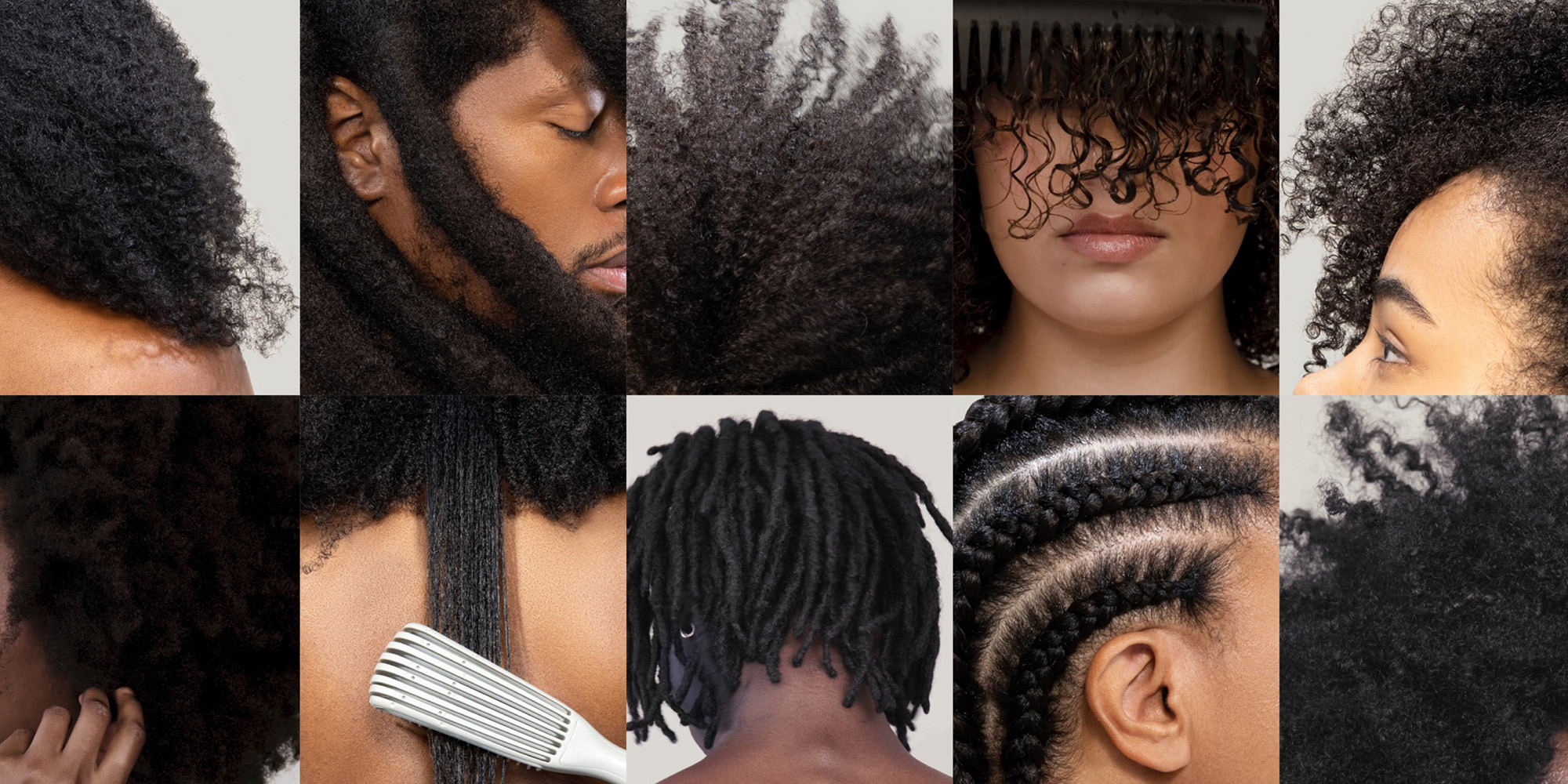
Beauty industry experts mention subcategories like locs, braids, wigs and extensions as growth opportunities. Mintel details that locs are the second most popular style worn by Black men and braids are the second most popular style worn by young Black women. Brands like Peculiar Roots, The Frontal Queen, Rebundle, Waeve and Parfait are touching on these subcategories already, but Romina Brown, CEO and president of category management firm Strategic Solutions International, asserts there remains plenty of openings for emerging players.
“This consumer has embraced the benefits associated with having natural hair, but there are still many challenges associated with managing and wearing it and their solution tends to be braids, extensions or wigs in some format,” she says. “There’s a white space where somebody can get in there and innovate.”
Melody Bockelman, owner of product development consultancy Private Label Insider, echoes Brown. She says, “A couple years ago, the natural hair market was still relatively fresh and clean, but it has matured, and so in order to make an impact, you need to niche down and look for the one-off trends like gray hair or locs or Ozempic hair loss.” She tacks on, “Nobody needs another twist-out cream, we’re good on that.”
Taliah Waajid, who started her eponymous textured haircare brand in 1996, chimes in, “Customers continue to have more and more options, whether they want to wear braids, wigs, locs, straight or au naturel. The future has something for all.”
Dimpy Jindal, associate partner at global management consultancy McKinsey & Co., says texture haircare consumers’ basket sizes trend to be larger than those of haircare consumers generally, an incentive for retailers to pay attention to the textured haircare category. In assortments with conglomerate-owned brands, emerging textured haircare brands Adwoa Beauty, Bread Beauty, Ceremonia, Rizos Curls, Donna’s Recipe, Camille Rose, The Doux, Txtur and Curls are vying for shoppers at retailers the likes of Sephora, Target and Ulta Beauty, to name a few.
Per Brown, the textured haircare category generates $1.2 billion in sales at retail chains. When beauty supply stores are measured in tandem with retail chains, that amount increases to $2.8 billion. She notes that beauty supply stores have become savvier in terms of inventory management and views them as a major blind spot for brands. She elaborates, “The requirements are less strict and regulated than retail chain stores. These stores can carry a deeper assortment and don’t have set planogram dates. Hence, along with online direct-to-consumer sales, it becomes a more efficient proposition for market entry.”
Textured haircare consumers’ haircare product spending is higher than consumers generally, but it does fluctuate. Mintel outlines that the Black haircare market took a hit immediately once the pandemic arrived in the United States due to a reduction in out-of-home activities and consumers experimenting with fewer products. Mintel notes, “For some, a scaled back approach to style and product proved time- and cost-efficient and allowed them to gain satisfactory results with lower spend.”
Brown reinforces that a no-fuss haircare approach could be gaining steam because of macroeconomic circumstances. She says, “Coming out of COVID, we’ve had much more economic pressure, and with the rising inflationary pressures, consumers are a little more realistic in some of their choices and less idealistic.”
Textured haircare sales are being a bit squeezed in the mass beauty sector while they’re surging in the prestige beauty sector. Market research firm Circana estimates that sales of U.S. prestige haircare products for wavy and curly hair have advanced 17% from last year and totaled $123 million in the period.
According to data from market research firm Nielsen, sales of curly hair styling product unit sales have increased 1.5% and sales of curly hair treatments have declined 6.6% in the last 52 weeks. Dollar sales for curly hair styling products increased by 9.9%. Nielsen deduces an average unit price bump of 8.3% could be a likely contributor to the dollar sales increase.
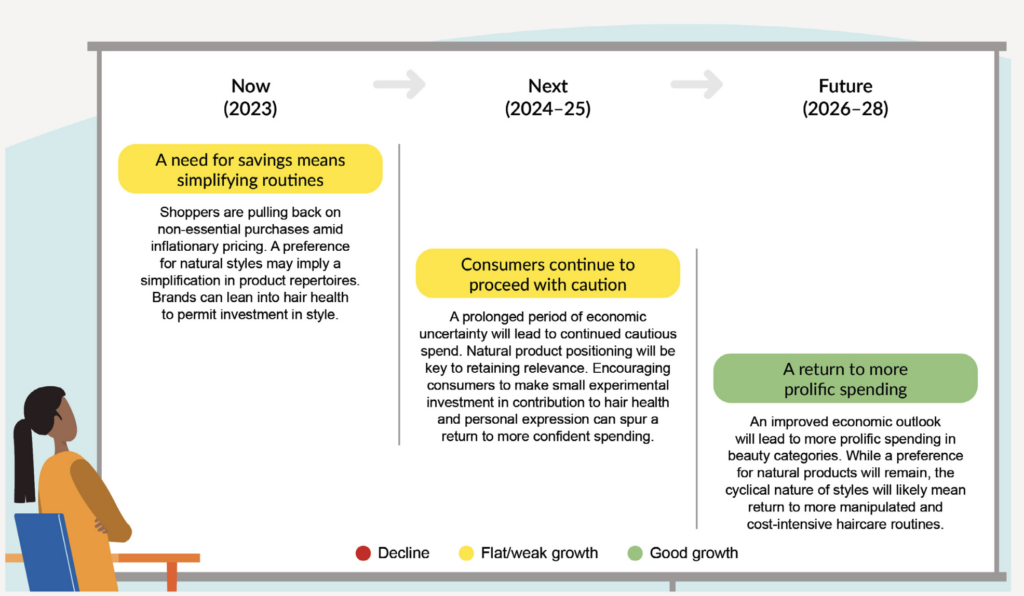
Mintel projects that the textured haircare market will be roughly flat through 2027. McKinsey has a comparably bullish prognostication. It forecasts textured haircare sales will progress annually at a rate of 10% to 11%. The consultancy pegs the market at $2.5 billion to $3 billion in sales in 2022 and approximates it has accelerated at an annual rate of 6% to 7% for the last six years.
Jindal cites premiumization as a factor in the growth of the textured haircare segment, but maintains there’s a limit to it. She says, “There is a ceiling to that price increase because of the channel mix,” with most of textured haircare purchases occurring in mass, grocery and drugstore venues.
To encourage textured haircare spending in the near term, Mintel counsels brands to “lean into necessity, value and accessible fun.” Natural positioning persists as a strong selling proposition for consumers, and brands should consider familiar ingredients and free-from claims on packaging and in promotional materials. Corey Huggins, founder of global beauty think tank Ready to Beauty, stresses that appealing packaging, efficacious products and strategic marketing efforts, including social media campaigns, trade shows and events, are vital for textured haircare brands looking to stand out in a packed space.
Watkins underscores that strategic buyers are seeking textured haircare brands that know their consumers inside and out. “We see curly hair brands having a very intimate discussion with their consumers and being able to co-create with them in very authentic ways,” she says. Pointing to Rizos Curls as an example, she adds, “They’re completely unstoppable because they are so authentic and grounded in curls and community and culture. They’re tunnel-visioned into their people and their tribe.”
Conglomerates typically can’t replicate the closeness between indie textured haircare brands and their communities no matter how much money they throw at marketing. Brown says, “By and large that type of success is elusive, and so they really lean into these brands and acquisitions.”
Brown conjectures that conglomerates will be snapping up indie textured haircare brands at a greater velocity to fill glaring white spaces in their portfolios. Lindsay Carlson, managing director for consumer and retail at William Blair, an investment bank that was the exclusive advisor to Mielle Organics on its investment from Berkshire Partners and co-advisor on the brand’s sale to P&G, agrees that there are deals to be done in textured haircare.
“There continues to be lots of newcomers, and I think that’s really exciting because they’re all coming about it with a slightly different angle,” she says. “It’s a massive market, so there’s a lot of opportunity to continue to take share and room for multiple players.”
The players
5 mentionedAS Beauty

Unilever
Harry's
Function of Beauty
The Doux