Beauty Shoppers Showed Up On Black Friday/Cyber Monday Despite Economic Jitters
Indie beauty brands saw double-digit to triple-digit lifts in sales and basket sizes as they leaned into generous site-wide discounts, giftable holiday kits, free shipping, buy-one-give-one offers and gifts-with-purchase promotions to appeal to value-hungry consumers who approached the shopping holiday with increased caution. The performance matches merchants on Shopify, which generated a record $14.6 billion in sales over Black Friday/Cyber Monday, up 27% from last year.
The performance is sending mixed signals about the state of the economy. With consumer sentiment in the United States plunging, reflecting widespread concerns about inflation and jobs, it suggests deals are effective levers in motivating purchases and could portend larger roles for them if trepidation over the economy persists. On the other hand, it demonstrates that American consumers aren’t panicked enough about economic affairs to withdraw from annual holiday shopping rites, especially if they deem there’s a product and deal worth splurging on—and beauty has given them plenty of reasons to do so.
“It’s no longer about buying more, it’s about buying smarter. Customers are choosing quality over quantity and making sure every dollar goes toward products that deliver,” says Will Henderson, founder of Skincare Generics, a dupe brand that sells skincare products it compares to those from iconic luxury skincare brands like SkinCeuticals, Augustinus Bader and Barbara Sturm.
Jacqueline Flam Stokes, managing director of beauty and health at consumer intelligence firm NIQ, observes that beauty consumers shopped with greater discernment on Black Friday versus previous years. “Beauty shoppers are still engaged, just more controlled. Less adrenaline, more intent,” she writes in a LinkedIn post. “Black Friday beauty traffic was steady this year, and while shoppers showed up, they didn’t arrive in a frenzy from what I observed. I expected rushes to holiday deals.”
Beauty headed into Black Friday from a place of relative strength. The category’s sales in prestige and mass were up 4% and 5%, respectively, to $24.1 billion and $54.5 billion, according to market insights firm Circana. A spokesperson from Sephora says the retailer’s recent Fall Savings Event, which took place from Oct. 31 to Nov. 10, registered its strongest performance yet across North America. However, data insights firm Consumer Edge presents conflicting numbers for the event, showing Sephora’s sales were flat or dipped by a low single-digit amount from last year. Ulta’s 21 Days of Beauty promotion, which ran from Aug. 29 through Sept. 18, was up a low single-digit percentage from last year, according to Consumer Edge.
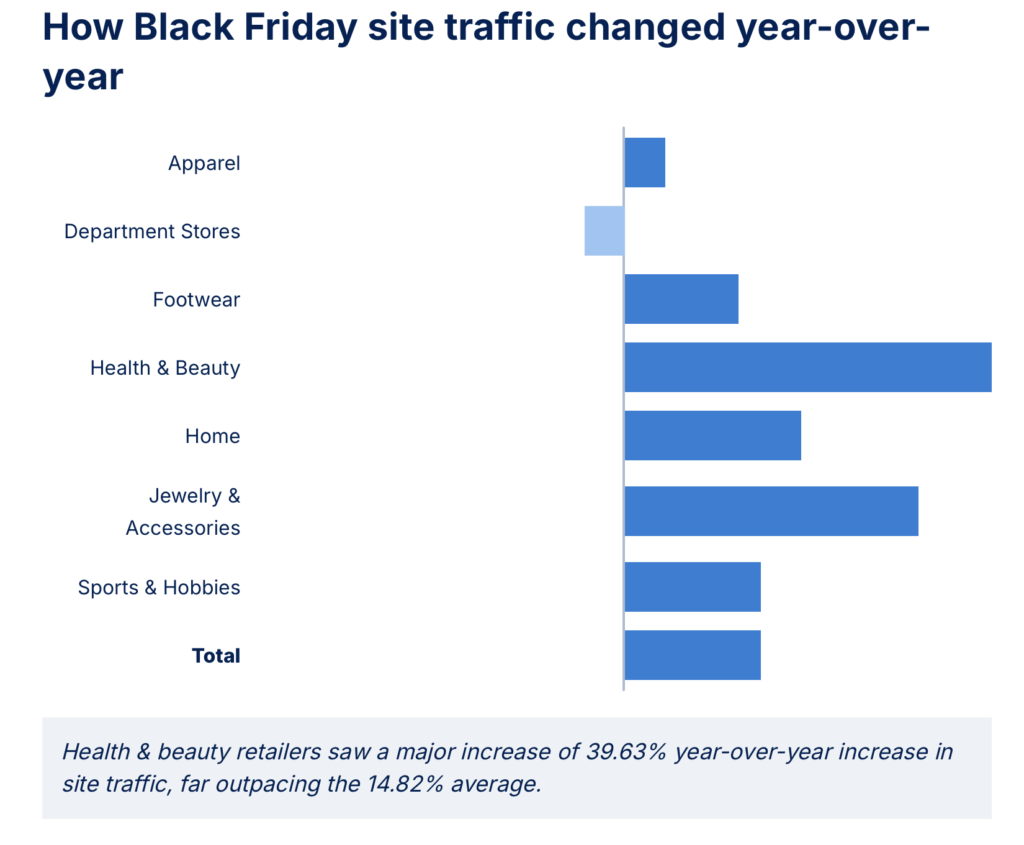
Retail technology company Bluecore estimates traffic to health and beauty brands’ websites surged over 39% on Black Friday, far outpacing that of apparel, department stores, footwear, home, sports, and jewelry and accessories. Order volume jumped 6.12%, but average order value (AOV) decreased 3.13%. In 2024, traffic to health and beauty brands’ websites declined 2.2% and order volume dipped 10.1%.
Looking broadly across the Black Friday landscape, Salesforce reports that U.S. consumers spent $18 billion online on the shopping holiday, up 3% from last year, with accessories and luxury apparel among the top categories. Despite the bump, Americans didn’t buy more holiday gifts. Units per transaction fell 2% on a year-over-year basis, and order volumes decreased 1% as average selling prices rose 7%. Salesforce had projected that beauty would be among the most heavily discounted categories this year, with average markdowns of roughly 40% for makeup and about 33% for skincare, according to figures cited by Business of Fashion.
Adobe found that Americans spent $11.8 billion online on Black Friday, up 9.1% from 2024, with artificial intelligence-driven retail traffic soaring 805% from last year. Cyber Monday sales totaled $14.25 billion, up 7.1% from last year, with buy now, pay later fueling over $1 billion alone, an increase of 4.2% year-over-year.
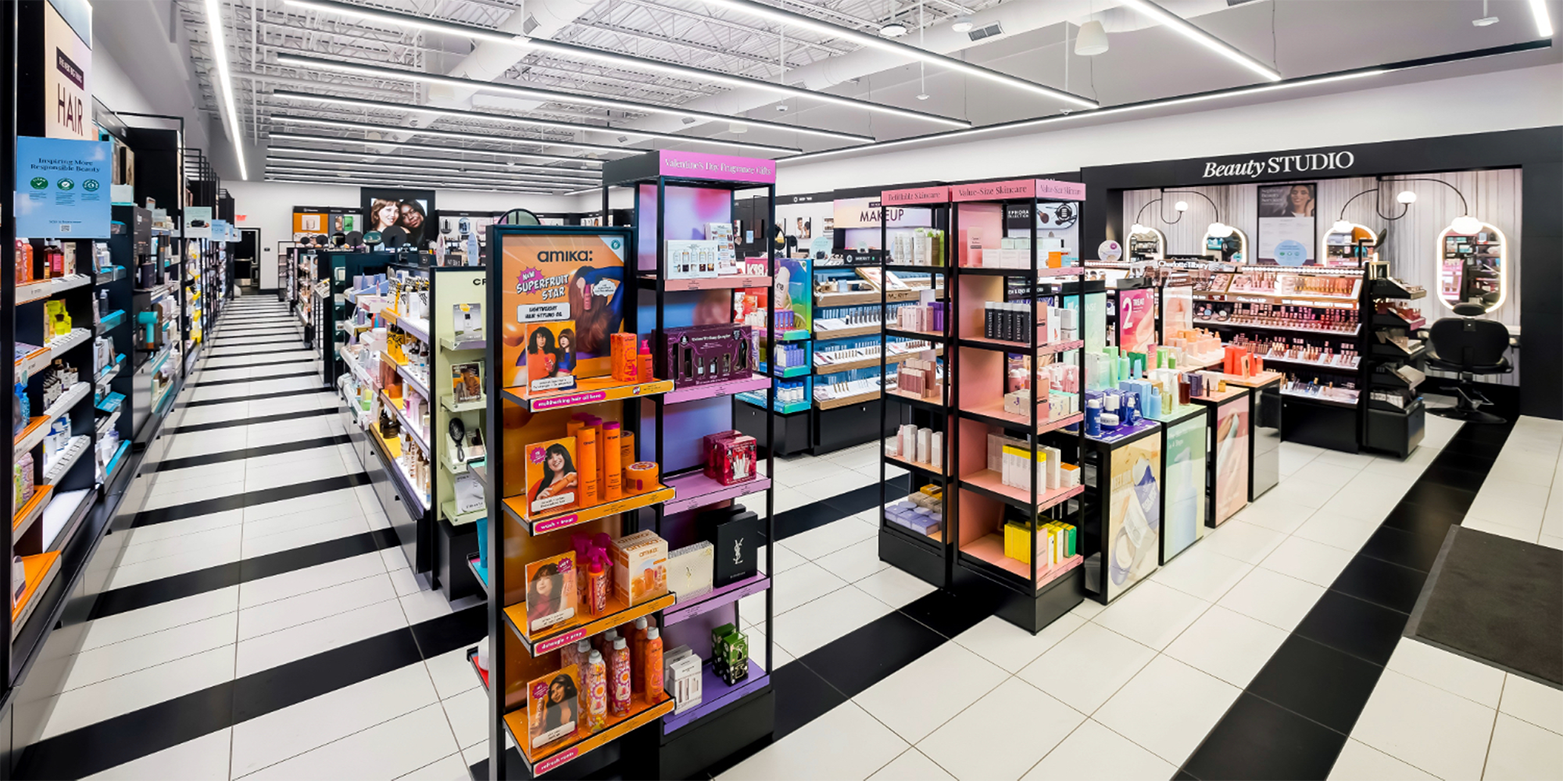
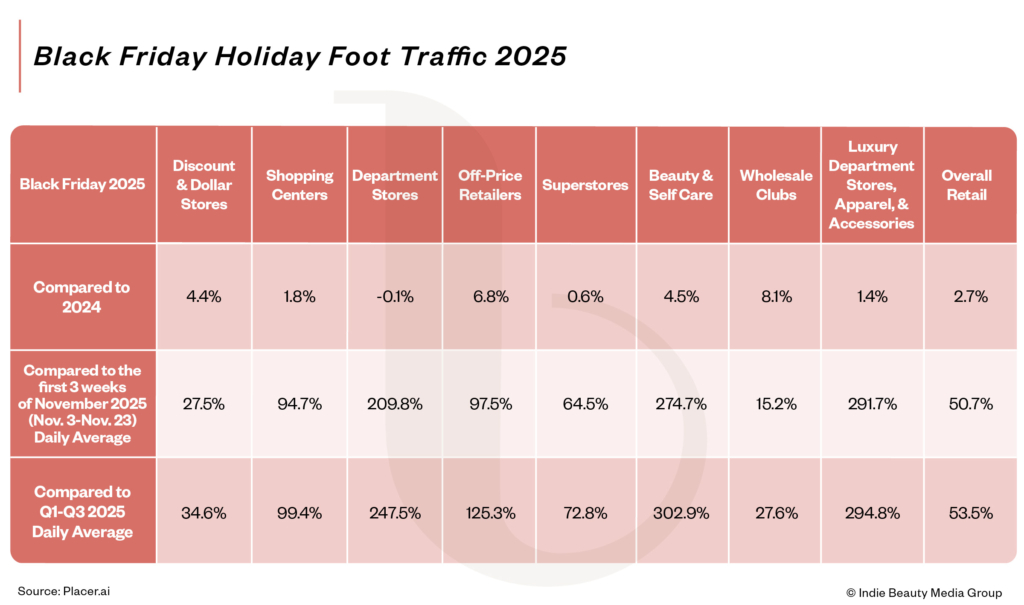
Shoppers turned up in stores to browse and buy over the shopping holiday, but brick-and-mortar stores experienced softer performance than e-commerce. According to Mastercard SpendingPulse, e-commerce sales grew 10.4% on Black Friday, and store sales advanced 1.7%. Foot traffic to beauty and self-care stores Ulta, Sephora and Sally Beauty Supply was up by a collective 4.5% on Black Friday, according to location intelligence firm Placer.ai. Specifically, Ulta’s foot traffic fell by a modest .5% over last year.
The National Retail Federation reported that 202.9 million people in the U.S. shopped over the crucial holiday shopping period, beating the all-time high of 200.4 million shoppers in 2023 and 16 million more than last year. The NRF estimated 129.5 million people shopped in stores, up 3% from 2024. The amount of online shoppers grew in the high single digits, with 134.9 million browsing the internet, up 9% from last year. On average, consumers spent $337.86 for gifts, holiday decor and other seasonal purchases versus $315.56 the year before.
INDIE BEAUTY PERFORMANCE
Many beauty brands started their promotions well before Black Friday week commenced. Body care brand Voesh provided customers three chances to score savings throughout November, beginning with gift sets and tiered gifts-with-purchase offers during the first week of the month followed by a 30% off site-wide sale for Singles’ Day on Nov. 11, during which the brand almost doubled its sales from the year prior. From Nov. 25 to Dec. 1, it offered an additional 30% off site-wide plus 50% off select items on its site.
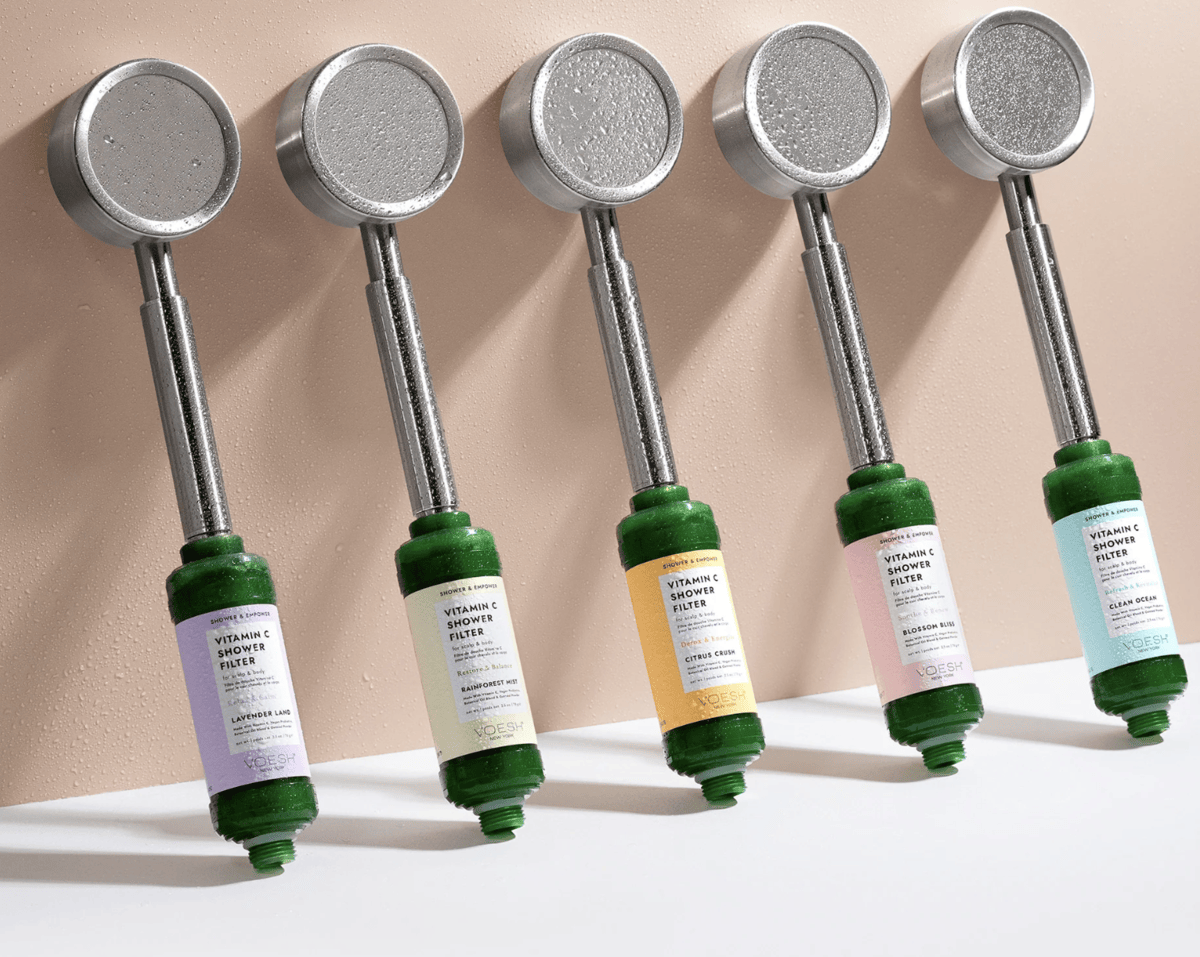
Voesh’s sales rose about 28% from the Black Friday period last year, with its AOV increasing 15.5% and units per transaction rising 13%. The brand’s $29 Vitamin C Shower Filters and hand and foot care gift sets were bestsellers. Vera Oh, co-founder and CEO of Voesh, says shoppers “looked for practical luxuries, choosing products that feel good to use, but also deliver results. Social content, especially short-form video on TikTok, played a major role in driving awareness and influencing purchases.”
The Good Patch ran a 30% off site-wide discount from Nov. 12 through Dec. 3. The wellness brand’s Black Friday sales beat last year by 20%, with its B12 Awake, Rescue, Nite Nite and Be Calm patches the strongest performers. AOV increased slightly. The Good Patch’s patches normally retail from $12 to $16 for packs of four.
“We actually saw less basket diversification compared to last year,” says Christie Cipriano, brand marketing manager at The Good Patch. “Instead of mixing in new patches to experiment with, shoppers seemed more focused on stocking up on the ones they already know and love. There was also a big shift toward small, affordable self-care where people are seeking out solutions…without the commitment or price tag of a bigger wellness investment.”
Haircare and body care brand Prive offered four holiday bundles valued at $82 containing a shampoo and conditioner plus a free body cleanser for 30% off each starting Oct. 15. The promotion initially ran for five days before it relaunched ahead of Black Friday. It will run through December while inventory lasts. Sales for the brand increased 20% over the holiday shopping period, with the $29.50 Shining Weightless Amplifier, $31 Texturing Spray and $28 Moisture Rich Shampoo and $30 Conditioner resonating the most with customers. The brand’s AOV dipped by about 15% due to customers stocking up earlier in the season.
Other brands took a different approach, offering sharper deal windows to motivate customers to act fast rather than wait for better deals later. Skincare brand AveSeena kicked off its 30% site-wide Black Friday/Cyber Week sale, its only sale of the year, on Nov. 24, and it will go through Dec. 5. So far, revenue has increased a little over 50% compared with last year, with AOV rising about 20%, and units per transaction increasing roughly 15%. New customer acquisition is up around 35%. The brand’s $157 Ageless Perfection Cream and $460 ANKA Face and Body System, a 6-in-1 device that combines LED with radio frequency, micro current and ultrasound, were its bestsellers.
“Shoppers seemed tired of vague marketing and are now asking very specific questions about mechanisms, ingredient safety and long term impact on the skin barrier and overall wellness,” says Ebru Karpuzoglu, founder and CSO of AveSeena.
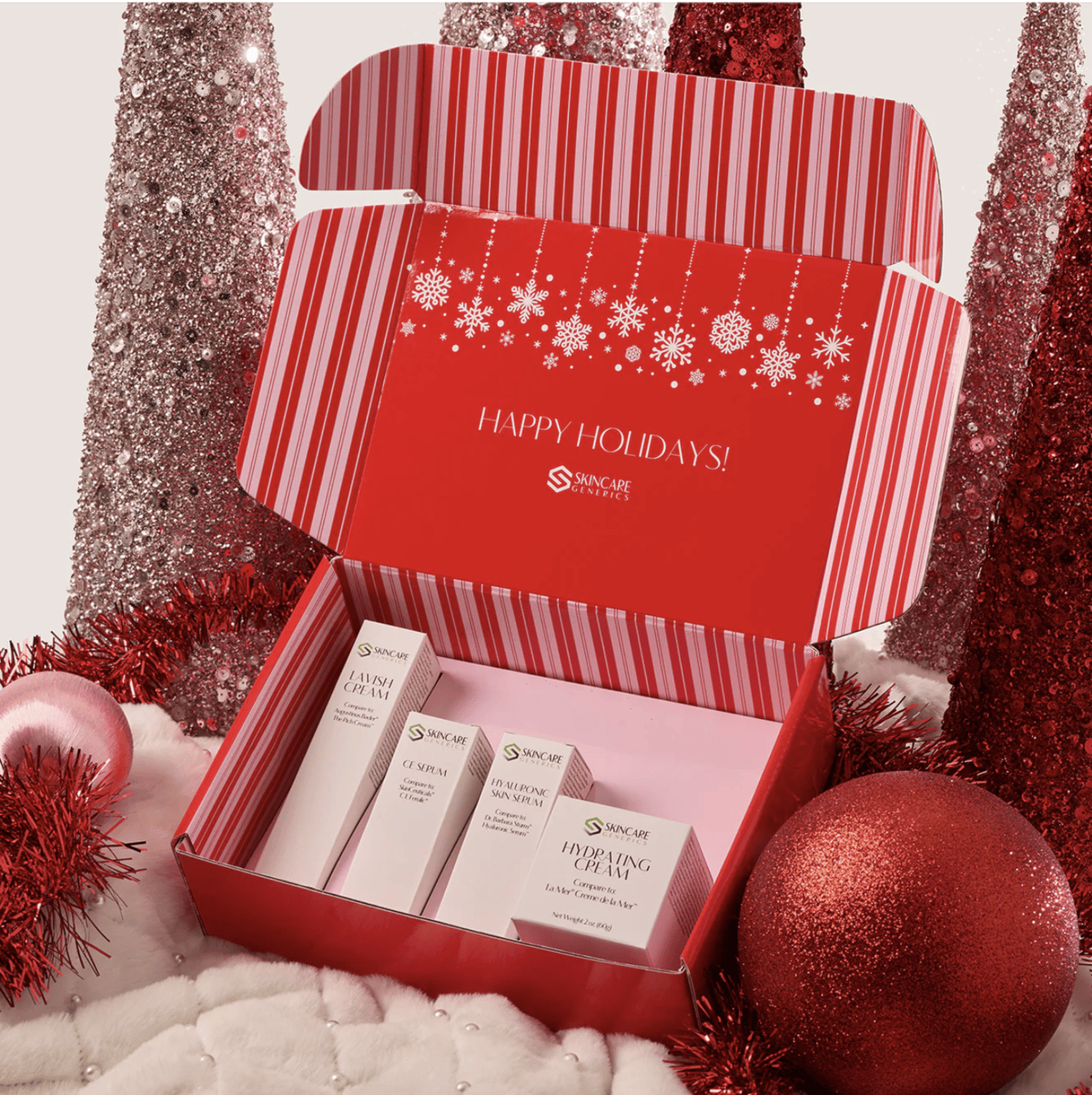
Skincare Generics offered 20% off site-wide between Nov. 18 and Dec. 2, 30% off gift bundles and free shipping for orders over $50. Launched in 2024, the brand is in growth mode as demand for dupes remains high. Black Friday sales were up 200% through Nov. 30, with AOV up 21% from last year and about 43% of orders originating from returning customers. Its $159 holiday gift box bundle, containing the brand’s full product lineup, resonated the most with customers over the period.
“Shoppers are definitely trading down in price but not in performance,” says Henderson. “Consumers are shifting from prestige to drugstore brands or dupes, but they still expect real results. Beauty is one of the few categories where people won’t stop buying. They’ll simply choose smarter, higher-value options.”
Professional skincare brands extended holiday savings from online to in-person clinics. Launched by Ildi Pekar, the namesake skincare brand I Pekar offered customers a 20% discount on all products both online and in the celebrity aesthetician’s New York studio. Customers can get an additional 10% on services throughout the month of December. The brand’s Black Friday sales gained 35% this year, with AOV and units sold increasing.
The Stem Company registered a 30% increase in holiday sales after offering a buy two, get one free promotion across its website and at its Beverly Hills clinic from Nov. 20 to Dec. 2. The brand’s hero product, the $150 Stem Regenerative Serum, was its top-selling product during the buying period. Units sold and AOV were up year-over-year.
Nathan Newman, dermatologist and founder of The Stem Company, believes skin minimalism and a growing attraction to scientific-backed formulas influenced how skincare shoppers purchased products this year. He says, “Instead of emotional or impulse-driven purchases, consumers now prioritize products that represent a smart, evidence-based investment.”
SHOPPER BEHAVIOR
Beauty shoppers are prioritizing practicality, results and products they’ve purchased before and loved. “Items that combine emotional impact with real function are standing out,” says Oh. “That insight helped shape our offers and the way we communicated about our products throughout the season.”
Ildi Pekar is seeing clients flock to quality over quantity and shy away from fast-moving micro-trends and impulse buying. She says, “Value matters: long-lasting formulas, multifunctional products and treatments with proven results are where they’re putting their money.”
Karpuzoglu agrees, saying, “Spending per person did not feel careless, yet there was a clear willingness to invest in fewer, higher value items that deliver multiple benefits. A number of customers chose a hero cream plus device combination instead of many smaller products. That pattern tells me that people may be spending slightly less in total across categories but are concentrating their budget on products and tools that feel science-backed, multifunctional and grounded in real expertise rather than trends.”
The players
5 mentionedToo Faced

AS Beauty
Better Being
iS Clinical
Augustinus Bader