Breaking Down Fair Packaging And Labeling Act Basics So Brands Don't Run Afoul Of The FDA
While beauty brands are largely left to self-regulate–outside of color additives, the law doesn’t require cosmetic products and ingredients to secure approval from the United States Food and Drug Administration, the agency that oversees cosmetics, prior to sale–there are laws that govern the ways in which cosmetics companies operate.
The two most important are the Federal Food, Drug, and Cosmetic Act (FD&C Act) and the Fair Packaging and Labeling Act (FPLA). All cosmetics and personal care items sold in the U.S., including those imported from abroad, must comply with these laws. Passed in 1938, the FD&C Act established governmental enforcement powers over cosmetics and medical devices. It prohibits the marketing of adulterated or misbranded cosmetics, and allows the removal of cosmetics from the market that are mislabeled or contain unsafe ingredients.
Established in 1967, FPLA directs the FDA and the Federal Trade Commission to issue regulations regarding consumer commodities. The regulations can encompass the disclosure of the contents of those commodities, their identities (for e.g., sponges or soaps), and the names and places of business of the packers, manufacturers and distributors. The FPLA is intended to prevent consumer deception involving ingredients and labeling.
The FPLA requires brands to be truthful so consumers can make informed purchasing decisions by accurately comparing products. However, packed with specific details, it’s not the easiest thing to understand. “As a founder, I always found FDA labeling guidelines really tedious,” says Megan Cox, president at beauty lab Genie Supply. “I spent a lot of time deciphering the FDA’s language, checking and cross-checking.”
Inspired by Cox’s challenges deciphering regulatory gobbledygook, Genie Supply created an interactive labeling page to make understanding FDA labeling guidelines simple for its clients. The National Institute of Standards and Technology, an agency under the Department of Commerce, also outlines the FPLA and answers basic questions about it.
Different countries have different definitions of cosmetics, but, in the U.S., they’re considered any item applied on the human body for cleansing, beautifying, promoting attractiveness or altering appearance without affecting the functions or structure of the body. Cosmetics subject to the FPLA include skin creams, skin washes, lotions, perfumes, nail polishes, lipsticks, eye products, shampoos, hair colors, toothpastes, deodorants and soaps. The act describes labeling as the written, printed or graphic matter that accompanies a product.
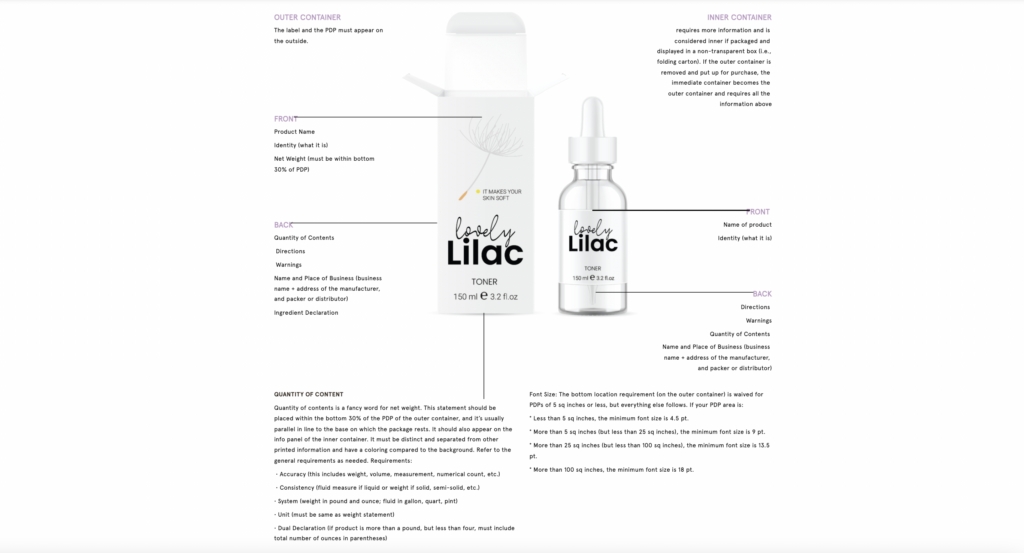
FPLA requires that packaging spells out the product name, what the product does and net weight on the bottom 30% of the product label area on the front of the packaging. The back of the packaging must have directions, warnings and ingredients—an INCI list format is preferred—in descending order of weight up to 1%. After 1%, the ingredients can be listed in an order desired by the brand.
FDA-recognized colorants are separated in a “May Contain” section in any order, and the manufacturer name and address have to be included as well. The label that the consumer sees must state the name of the product, an illustrated or name description of contents, and accurate net quantity of contents by weight, volume, measure or numeric count.
It’s crucial that brands follow the FPLA to ensure its labeling isn’t false or misleading to customers. Selecting a reputable manufacturer that will be truthful, transparent and knowledgeable about what should go on the label is of the utmost importance since failure to comply could result in FDA regulatory action.
Cox says, “Any brand that develops a product or private labels with us will be given all necessary information upfront, and you can actually find all of it on each product page within our online catalog, so that if you white label with us, you can just copy and paste the information over to your own designs and remain compliant.”
Rachel Roberts Mattox, founder of Oyl + Water, says most of her beauty brand development and marketing consultancy’s clients work directly with their labs to finalize INCI lists, but when it comes to the rest of their packaging, they lean on her team to guide them through the rules and requirements. “Historically, areas of confusion are around minimum font size requirements, required information for primary or secondary packaging and, of course, claims,” says Roberts Mattox.
Brands that want to sell internationally have to get up to speed on a completely separate set of regulations in the markets they wish to enter. Roberts Mattox recommends they get in touch with Jene Roestorf, founder of strategic business advisory Activist Beauty and skincare brand Luxe Botanics. “She’s brilliant at helping guide indie brands through global regulatory compliance,” says Roberts Mattox.
In listing the name and place of the manufacturer, the address should be included on the label with the correct street address, city, zip code and country of origin if imported. If the distributor isn’t the manufacturer or packer, that wording should also be listed as “Manufactured for” or “Distributed by” as a means to give credit to the manufacturer.
The label must be placed at the bottom 30% portion of the container, parallel to the base of the product with the type size equivalent to the size of the container as prescribed by regulation. If the net quantity of contents is more than a pound, it must be expressed in ounces followed by parentheses by a declaration of the largest whole units (for example, pounds and ounces or quarts and pints). These must be on the inside and outside of the container or wrapper.
The names of the listed beauty ingredients should adhere to names in the Cosmetic Ingredient Dictionary, a comprehensive accounting of beauty ingredients authored by the trade association Personal Care Products Council. As indicated previously, the ingredients must be listed in descending order of predominance, meaning the highest percentage is listed first, the next highest percentage second, etc. All ingredients, including color additives, less than 1% can be listed in any order following the ingredients with more than 1%. Blended ingredients can’t be listed as one ingredient. They must be shown individually in an order that accords with their percentages.
With the exception of products distributed solely in a U.S territory with a primary language that’s English (e.g., Puerto Rico) all labeling should be in English. Some states have additional regulations governing cosmetics. A notable example is California’s Prop 65 that requires businesses to include a clear and reasonable warning on labels that have chemicals known to cause cancer, birth defects and other reproductive harm.
For liquid oral hygiene products (think mouthwash, fresheners and tongue spray) and cosmetic vaginal products, products must be placed in tamper-resistant packages when sold at retail. When a customer sees a sealed carton, tape seal or tube that has been tampered or altered, it suggests to them the product has been damaged. The packaging seal must be distinctive and obvious to the consumer, alerting them that it shouldn’t be tampered with and to not use the product if it is.
There are additional labeling requirements for two big categories: professional products and alpha hydroxy acids.
Cosmetics and haircare products that aren’t distributed for retail and only used by professionals on their customers at their establishments for skin cleaning are exempt from requirements.
There are many skincare products formulated with alpha hydroxy acids (AHAs). Common types of AHAs are glycolic acid, lactic acid and citric acid. Because the FDA classifies AHAs as ingredients than can cause skin sensitivity when worn on skin exposed to the sun and potentially produce a sunburn, products that contain AHAs must be marked with this statement:
“This product contains an alpha hydroxy acid (AHA) that may increase your skin’s sensitivity to the sun and particularly the possibility of sunburn. Use sunscreen, wear protective clothing, and limit sun exposure while using this product and for a week afterwards.”
Similar warnings must be listed on cosmetic aerosols, feminine deodorant sprays, foaming detergent bath products and sun tanning products.
The players
5 mentionedAS Beauty

Commodity
Formulate
Under Your Skin
Addition