10 Big Trends At Adit Live New York 2023
But as human existence gets phygital, in-person connections are being informed by online experiences. TikTok is changing the ways consumers are showing up to purchase and practice beauty. Kline states, “The virality on TikTok has played a critical role in the resurgence of makeup, creating frenzied demand and capturing new audiences without incurring significant acquisition costs.”
At Adit Live, the impact of TikTok was clear in trends involving body mists, dupes and rosemary hair products. We dive into those trends and seven more shifting shopping behavior and retail merchandise mixes.
A spritz (or more) a day keeps the doldrums away, at least that’s what beauty brands selling body mists are discovering. Increasingly, they’re seeing gen Z consumers gravitate to body mists for instant mood boosts. The hashtag #bodymist has over 885 million views on TikTok, and Circana estimates prestige body spray sales volume has tripled in the last year. To be more precise, the market research firm pegs prestige body spray sales at $119 million from April 2022 to April 2023.
Introduced in 2021, French fragrance brand Solinotes’ line of body mists has become a favorite of its young customers in the United States. Drilling down on the line, vanilla, a gen Z scent hit, is a brisk body mist seller. Other coveted scents from Solinotes are tonka, almond, rose, cherry blossom and white tea. The brand will be growing its body line next year. It’s available stateside at CVS, J.C. Penney and C.O. Bigelow.
Deciphering the body mist boom, Fanny Foucaut, an export coordinator for Solinotes, says, “American customers like to refresh themselves during the day after a training session. It is also the first step for teenagers to use for the very first time as a fragrance.”
During Beauty Independent’s Dealmaker Summit held last month in New York City, Larissa Jensen, VP and beauty industry advisor at Circana, shared that she’s witnessed her gen Z children spray fragrance into the air and walk into it. “I thought it was just them and that they’re weird, but apparently not,” she joked.
Foucault reasons that younger consumers are drawn to body mists because they’re lighter, don’t have alcohol and tend to be affordable. Circana seconds Foucault’s theory on affordability. The firm divulges, “The average price of scented body sprays, $21, are a fraction of the price of a traditional fragrance product, making these particularly appealing among gen Z consumers who are more influenced by price.”
Squeezing in a shower can be difficult for consumers dealing with the daily grind of professional and personal responsibilities. Dry shampoo has been a go-to remedy, but it has downsides. It’s not great for every hair color, can be drying and deposits unwanted remnants. Thankfully, brands are dreaming up plenty of hair product possibilities to fulfill the purpose of dry shampoo—and amplify it.
In July, Dip, a premium eco-conscious haircare brand known for shampoo and conditioner bars, is launching Secret Sauce Enzyme Spray. Priced at $12 for a 4-oz. purse-friendly size or $22 for a 10-oz. size, Dip founder Kate Assaraf devised the spray to be helpful for people with locs, weaves, braids and extensions.
“It’s a funny little SKU because it solves a problem people don’t realize they have yet. I have had several customers with locs or extensions or box braids say that they love our bars, but only shower once a week or every two weeks,” she says. “This is a product that allows them to clean their hair and scalp without a full shower.”
Assaraf mentions Secret Sauce Enzyme Spray has a multiplicity of applications for consumers without locs, weaves, braids and extensions as well. “The secondary use is for those many instances where people are in an environment where they cannot shower—festivals, camping trips or after an injury that leaves you immobile,” she says. “In these environments, the Enzyme Spray is your best friend because it takes away buildup so effortlessly.”
That’s not all. Assaraf expounds, “A tertiary use is for the elderly who are unable to shower often or are in a nursing home or hospital bed and still want to feel human. I know this isn’t a sexy beauty topic, but if you have ever had a relative or loved one in the hospital for a long time, they deserve the dignity of having clean hair.”
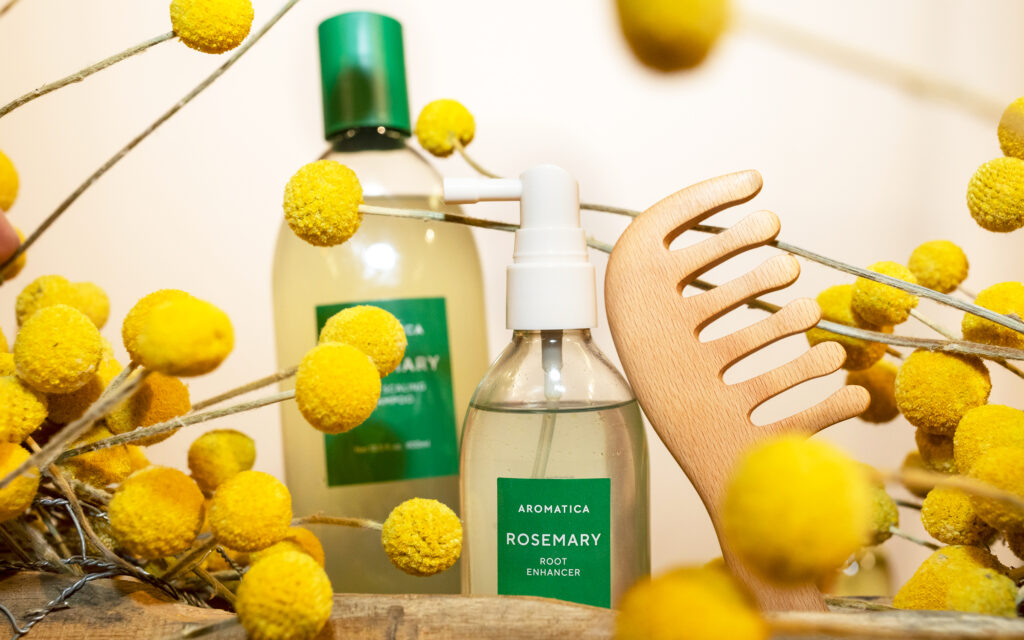
South Korean aromatherapy-centered brand Aromatica is riding the social media-fueled rosemary wave in haircare with its bestselling Rosemary Root Enhancer. Pairing rosemary with ingredients such as panthenol, biotin, riboflavin, ascorbic acid and mulberry fruit, the scalp spray isn’t as heavy as rosemary hair oil, making it a good fit for consumers with fine hair and oily scalps. Priced at $16 for a 3.3-oz. bottle, it sits in Aromatica’s collection of rosemary products with Rosemary Scalp Scaling Shampoo, Rosemary Hair Thickening Conditioner and Rosemary Scalp Scrub.
“Rosemary Root Enhancer packs a punch in one small product,” says Juri Jung, senior manager at Aromatica. “It relieves heat and scalp irritation, and the relief can instantly be felt upon application. With rosemary as a main ingredient, it also helps promote blood circulation on the scalp, encouraging hair growth. It’s lightweight application also meant that it can be used repeatedly throughout the day without weighing down hair or making it look greasy.”
Going forward, Jung hints Aromatica is “exploring the development of a sister product specifically tailored to meet the needs of individuals with dry or low porosity hair. Our aim is to provide a comprehensive range of products that cater to a diverse range of hair types, ensuring that everyone can experience the benefits of our brand.”
The market research firm Euromonitor’s data finds inflation is forcing beauty consumers worldwide to trade down. As they flock to affordable products, dupes have reemerged as a dominant sales driver (on TikTok, the hashtags #beautydupes and #dupes have 63.8 million and 4.3 billion views, respectively)—and beauty brands are responding explicitly to demand for them.
At Adit Live, two brands doing the dupe thing stood out: M2U NYC and Clover by Clove + Hallow. Amy Chou Granger, who launched M2U NYC in 2020, says, “From the beginning, customers started comparing our products to premium brands.” She points out M2U NYC’s $6 Eye Crayon has been likened to Glossier’s $18 Skywash; its $10 Everyday Volumizing + Lengthening Mascara has been likened to Thrive Causemetics’ $25 Liquid Lash Extensions Mascara; and its $8 Eye Primer has been likened to Urban Decay’s $28 Eyeshadow Primer Potion.
Referring to Eye Primer, Chou Granger says, “We did not intentionally set out to copy other luxury brands, but developed our own formula to create a high-quality primer.” She elaborates, “Many customers switched to our dupe products once they discovered the more affordable alternative to their cult-favorite brands. This indicates that customers prioritize the performance of a product over the brand name. They are willing to explore and switch to more affordable options that deliver comparable results.”
Clover by Clove + Hallow is focused on clean and sustainable beauty product dupes. The 2-year-old company launched with 50 SKUs and generated a six-figure sales total in its first year on the market, according to founder and CEO Sarah Biggers-Stewart. Dupes of products from brands such as Rare Beauty, Fenty Beauty and IT Cosmetics, its most popular items are $22 Skin Is In Serum Foundation, $16 Glow Stick Illuminator, $18 Pressed Silk Blushing Balm and $14 Super Slick Lip Jelly. Biggers-Stewart says, “People are still very skin-focused and that’s why our complexion products do so well.”
Based on what brands were displaying at Adit Live, showerers can revel in innovative and luxurious formulas to enliven their cleansing experiences. Brands are bringing joy to the daily bathroom chore and integrating scents to spark aromatherapy moments.
Voesh New York, a skincare brand that’s broadened its assortment in foot care, hand care and body care, has introduced the $53 Shower & Empower Duo with Sugar + Scrub Bubble Wash and Vitamin C Shower Filter. Launched in 2021, Vitamin C Shower Filter is its hero product. It’s designed to imbue showers with mesmerizing smells as it removes chlorine and other icky substances from hard water to protect hair and skin. Vitamin C Shower Filter comes in five scents: clean ocean, lavender land, citrus crush, blossom bliss and rainforest mist.
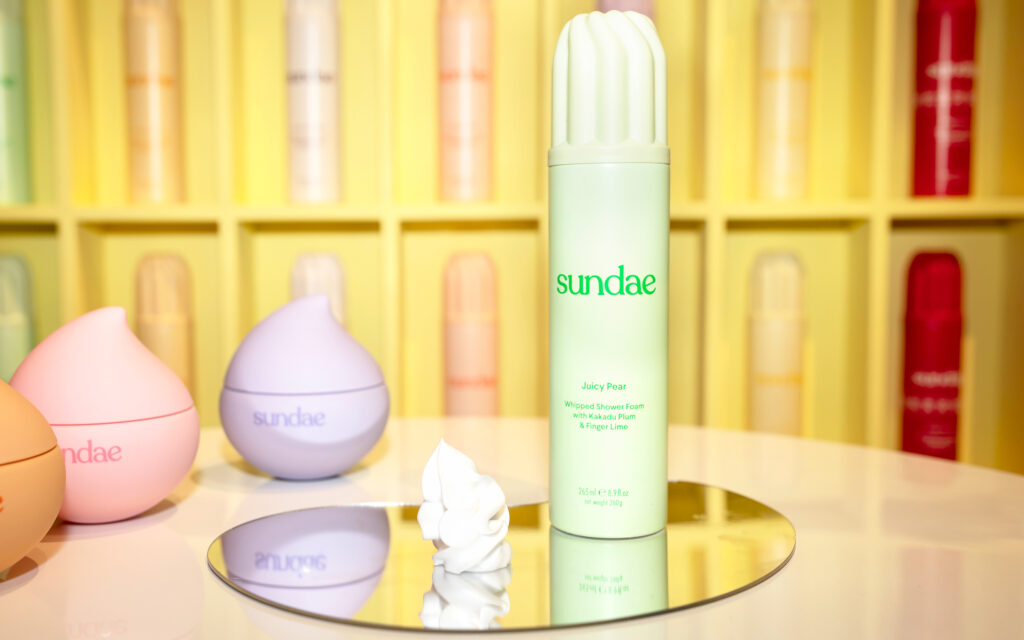
Priced at $20, Sundae Body’s Whipped Shower Foam is an affordable body wash with fruit-forward scents like orange crush, juicy pear and pomegranate fizz. The brand has also put out four playful “flavors” of the product—strawberries & cream, raspberry sorbet, lemon meringue pie and lamington—in partnership with dessert dynamo Messina Gelato. A collaboration bundle retails for $68. Whipped Shower Foam lasts about four weeks or 60 washes. Co-founder Lizzie Waley says Sundae Body’s projected sales for this year are in the high seven figures.
Exfoliation products are the norm for body care, but Sun Coast has a twist on them. Its exfoliators, notably the daily exfoliator Salt Scrub, can be employed to prep for self-tanner. The brand uses a fine powder in its scrub that doesn’t cause residue to linger behind. Founder Hollie Palmer sources essential oils from around the globe to ensure Sun Coast’s products have high-quality ingredients. Its prices run from $28 to $48.
Complexion products are usually the subject of conversations about makeup inclusivity, but brands are realizing the importance of inclusivity in other product categories.
Mora Cosmetics, for instance, launched two glitter products this year, the highlighters Rio and Pink Sands, for all skin tones. “With Rio, if you are lighter skin tones, you can create a beautiful beachy bronzed effect. If you are darker, it’s perfect to create that natural glow from within,” says founder and CEO Minara El-Rahman. “With Pink Sands, lighter toned customers have the perfect glow and darker toned customers really get that pop of shimmer to accentuate their beauty.”
Ember Wellness is another brand striving to be inclusive on the glitter front. It launched the Sculpt + Glow Bar in rose quartz to much success last year, but founder Amanda Schuler received feedback from customers with darker skin tones that the original bar didn’t work as an all-over moisturizer for them. As a result, Ember Wellness is launching two bronze and golden versions this year to accommodate them.
“The bars can be layered together to create different effects,” says Schuler. “For example, the new bronze shade can act as an all-over moisturizer for darker skin tones and a pop of color for lighter ones. The golden colored bar, which we call Sunstone, has more of a golden/translucent effect across all skin tones.”
Mineral sunscreen brand CoTZ released Flawless Complexion Richly Tinted SPF 50 in February to complement its top-selling Lightly Tinted version. It’s formulated for consumers with medium to dark skin tones. “Our goal was a no-compromise option,” says Kathleen Dwyer, VP of marketing and sales. “The safety and gentleness of a mineral sunscreen without sacrificing aesthetics.”
The response has been upbeat. Cosmetic chemist Esther Olu posted an Instagram video showing her rubbing in the product. She was wary of its rich consistency at first—she’s been let down by mineral sunscreens before—but her wariness diminished after she rubbed it in. “This actually doesn’t look horrible,” she mused.
Speaking of the importance of inclusive products, Dwyer says, “Whether we differ in our skin tone, size, gender, style, age or any other parameter, we all want to feel heard and responded to. As a brand, we can’t meet everyone’s specific needs, but we like to be as inclusive as we can.”
Whatever name it’s given, anti-aging skincare has been a staple of the beauty scene. Although consumers in their 20s and 30s can absolutely slather it on, it’s directed at older consumers trying to fight off wrinkles, dark spots and other stubborn signs of getting older. Now, in tandem with candid discussions about menopause, product choices for women of a certain age are certainly exploding, not just in skincare, but in haircare, body care and color cosmetics.
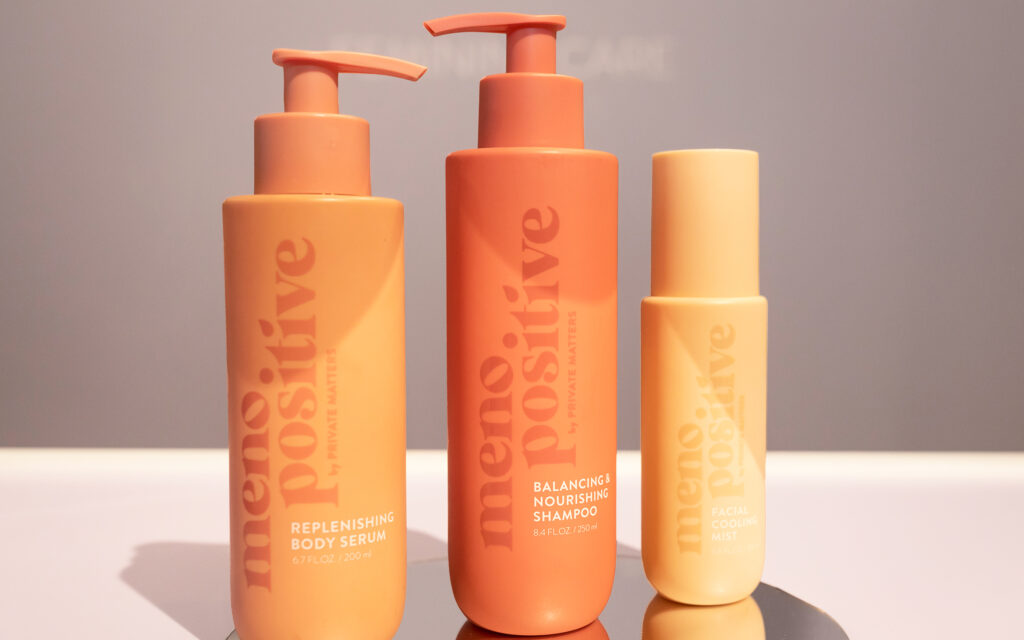
With a wide array of intimate care, sexual wellness, body care and haircare products, the brand Private Matters is proliferating menopause-related products. In an aging haircare segment that’s gained notice from Credo and Ulta Beauty, it participates with a Meno-Positive line featuring Balancing & Nourishing Shampoo and Balancing & Nourishing Conditioner. In body care, products in a Body Love line are Soothing Leg Cream, Vulva & Bum Cooling Spray and Hydrating Hips, Belly & Bum Balm.
Louisa Booth, founder and CEO of sleep mask sensation Popmask, has popped into the menopause picture with new brand Blushing LA. Priced from $5.99 to $18.99, its products are face wash Bring On The Balance, cooling spray Flash Me, intimate wipes Fresh As A Daisy, face mask Glow Get Her and bath soak Soak It Up. Booth discloses the brand will landing at Superdrug and Sephora in the United Kingdom. In the U.S., she envisions it spanning the retail gamut from Walgreens to Bloomingdale’s.
Booth spotlights accessible prices, lively packaging and the demographic target as big reasons for retail interest in Blushing LA. She says the brand is “a reflection of women in their 40s and 50s. They are at the beginning of something, not at the end.”
Early to address consumers 50 years old and above, Boom! By Cindy Joseph is extending its product lineup. It’s adding a shade to its $28 signature lipstick and blush combo Boomstick and releasing a brow pencil intended to aid with the appearance of fuller brow hair for people whose brow hair is sparse.
At cosmetics brand Flyte.70, co-founders Elena Frankel and Carolyn Barber, who were born in 1970, are developing makeup that pushes the boundaries of what older consumers are conventionally expected to wear. Frankel says, “When it comes to makeup and color, formulas and textures that works for mature skin tends to also work beautifully on younger skin, but the reverse is often untrue. It’s key to get those right, and then the sky is the limit when it comes to shades and even finish. Just because you’re getting older doesn’t mean you have to compromise freedom of expression and always stick with neutrals.”
Delving into specific Flyte.70 products, Frankel highlights the $36 highlighter GlowBack.Lucent Light and $28 mascara The Fundamental. She says the highlighter “uses micronized diamond powder which refracts and reflects light away from texture and doesn’t exaggerate it. This is one reason why we call it the ‘grownup highlighter.’ You still get beautiful luminosity and radiance, so those results aren’t compromised.”
Frankel calls Flyte.70’s mascara “true lash care in a tube.” She explains, “We understand that with age, hair starts to thin and becomes more rigid and sparse. We use ingredients that help strengthen, nourish, and help promote growth, but stay realistic with our customers. It comes in an indigo-infused black which helps brighten the appearance of eyes as black often feels stark with age because our complexions lose pigment cells. It’s important to work with what you have and not resort to gigantic caterpillar brush heads with thick textures.”
In the spa channel, the product selection for beauty services has long been restricted mostly to legacy spa and professional brands. Emerging indie brands, however, have been steadily infiltrating the “backbar,” the spa industry term for products typically packaged in large sizes that aestheticians rely on for services. Whish Beauty is no stranger to the spa circuit, but founder Aimee Werner is doubling down on her commitment to service providers with the launch of a range strictly for professionals.
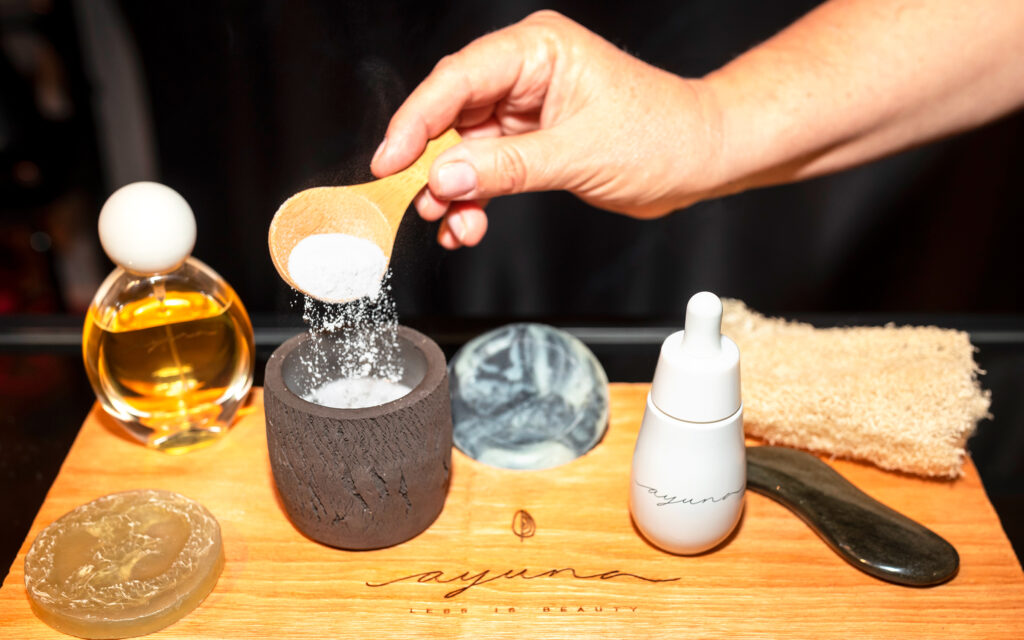
Luxury beauty brand Ayuna fashions what it calls “ceremonies” for the backbar that go beyond cleansing, toning and treating the face. Co-founder Begoña Sanjuan says the ceremonies create “a way to truly tap into and experience the brain-skin connection that is at the root of the concept of Ayuna.” For instance, she details that the Mirror Meditation ceremony features “a steam ritual wherein we pour our effervescent Aromatic Powder into hot water and allow the client to wholly reflect through the senses. This, combined with our textures and aromatherapy, stimulates the senses throughout the entire experience.”
Ayuna’s products are at upscale spas at premium hospitality properties across the globe, including St. Regis Punta Mita in Mexico, Ibiza Gran Hotel in Spain, Ritz Carlton in Naples and Cayo Levantado, a private island resort in the Dominican Republic.
Brands have been embracing IRL advertising and marketing efforts in recent years as digital advertising costs have risen and the world has opened up post-pandemic lockdowns. They’re especially looking to pop-ups and out-of-house or OOH ads to raise awareness offscreen. But somewhere between impermanent stores and wheat-paste posters, there are advertising vehicles once considered outré that are being reassessed.
Case in point: Upcycled skincare specialist AllWell Beauty will unveil a direct-response cable television ad campaign on June 26. The campaign will start with a long-form 28-minute commercial and move to testing shorter spots in the near future. AllWell also plans to ponder bringing the campaign to streaming services.
“Direct-response television commercials help educate the consumer on a deeper level, which allows us to better share our unique technology story and the clinical results of our line, and that’s something that really excites us,” says Lindsey Zinno, VP of marketing and e-commerce at AllWell. “Clearer expectations and better understanding of what the products will do and how to use them will lead to even better customer satisfaction and loyalty.”
Founders are passionately incorporating mental health support into their brands’ value propositions, including with affirmations and meditations that bolster brain function and self-confidence. Ieró Beauty has crafted recommended rituals in the form of beautifully illustrated guided meditation videos to pair with product application.
Product formulator and makeup artist Nick Gavrelis, who spent nearly two decades at MAC creating iconic color products, recently launched the “high vibrational” beauty and lifestyle brand with four crystal-infused products priced from $32 to $72: Moonkissed Luminous PH Lip Comforter, Moonkissed Radiant Skin Restorative Serum-Oil, Moonkissed Radiant Moisture Restorative Emulsion and Moonkissed Serene Essence Replenishing Mist.
Reshona Jessamy started working on her skincare brand, Novara, which premieres later this month, following a suicide attempt in 2015. She says, “By going back to an old hobby of mine—formulating—and with the help of therapy, I was able to get myself out of that dark place.”
After getting out of that dark place, Jessamy was compelled to assist others’ mental health. She developed a thousand different affirmations that are inserted into her brand’s product boxes. There’s a 99.5% chance that a customer will never receive the same message twice. Novara’s debut product collection has six products priced from $75 to $150: Purifying Cleanser, Revitalizing Essence, Illuminating Serum, Nighttime Resurfacing Serum, Ultra Hydrating Cream and Oil-Free Hydrating Cream. Twenty percent of the profits from product sales will be dedicated to the organization American Foundation for Suicide Prevention.
“My inspiration for creating these messages stems from my own struggle to find positive affirmations, upliftment and reasons to keep going during my battle with depression to no avail,” says Jessamy. “I created these messages to remind women that they are loved, adored and that they matter.”
With the American economy sidestepping a recession so far this year, brands hailing from South Korea to Australia are putting down roots in the United States. The aforementioned brand Aromatica is traveling to the U.S. after nearly 20 years of being sold in Asia. It’s at Olive Young in South Korea, Qoo10 in Japan, and Sephora in Singapore and Malaysia.
Jung says, “The U.S. market is renowned for its robust consumer spending power and a cultural emphasis on health, wellness and sustainable living, all of which align closely with the core values of the brand.”
Aromatica’s journey to the U.S. is motivated by early indicators of resonance. Jung remarks sales of the brand’s products, notably Rosemary Root Enhancer, have been surging on Amazon in the country. She says the sales increase demonstrates “that the market is highly receptive to our brand and offerings,” which encompass skincare, body care and haircare. She identifies Ulta as an ideal retail partner for Aromatica in the U.S.
German brand Geske is hoping to make headway in the U.S., too. Its beauty devices focus on anti-aging, firming and cleansing, and are a fraction of the price of most beauty devices on the market. Geske is zeroing in on the U.S. due to the nation’s influence and innovation. Stephanie Trachtenberg, director of PR and marketing at the brand, says, “With Geske as an engine of innovation, we need to be locked in to the U.S. market to usher in a new age of beauty. “
At Australian brand Sundae, Waley senses a gap in the American market for the brand’s unique body care. She says, “American consumers are known for embracing new ideas and are often early adopters of emerging trends, so we feel we’re a perfect match.”
Waley spent the past two years boosting Sundae’s business in Australia, New Zealand and United Kingdom. The brand is in 2,000 doors. “We have the learnings, experience and proven success to now confidently take on the U.S. market,” says Waley. “Our long-term goal is to expand our footprint globally so that everyone, everywhere can make every day a Sundae.”
The players
5 mentionedEssence

Bubble
Ritual
Urban Decay
Deeper